"Last Chance to Get Rich?" ... The Temptation of '590,000-Won Samsung and 4 Million-Won Hynix' [Salaryman’s Joys and Sorrows]
- Input
- 2026-05-24 16:25:10
- Updated
- 2026-05-24 16:25:10
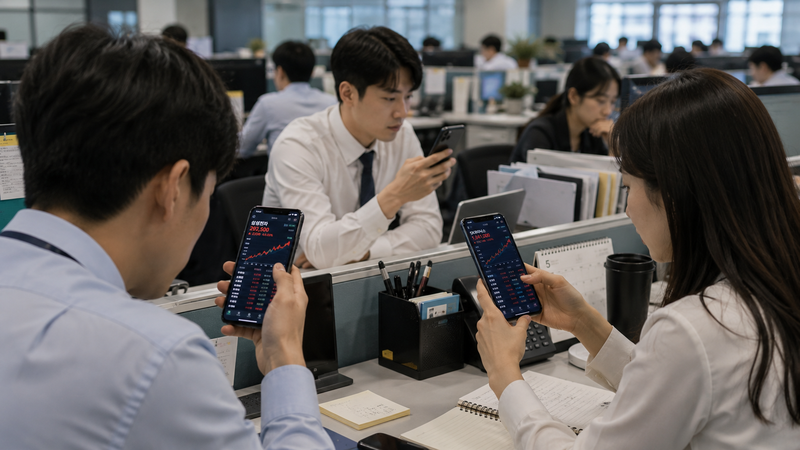
[Financial News] "Samsung Electronics' target price is said to be 590,000 won. Is it still okay to buy now?" "People are even talking about 4 million won for SK Hynix. Hasn't it already risen too much?"
Recently, conversations about Samsung Electronics and SK hynix have become hard to avoid among office workers. That is because Nomura Securities in Japan sharply raised its target prices for the two companies. Expectations are growing that demand for artificial intelligence memory has entered a long-term growth phase, but investors are also increasingly wondering whether it is still safe to buy after the recent surge.
Target prices raised sharply on AI memory hopes
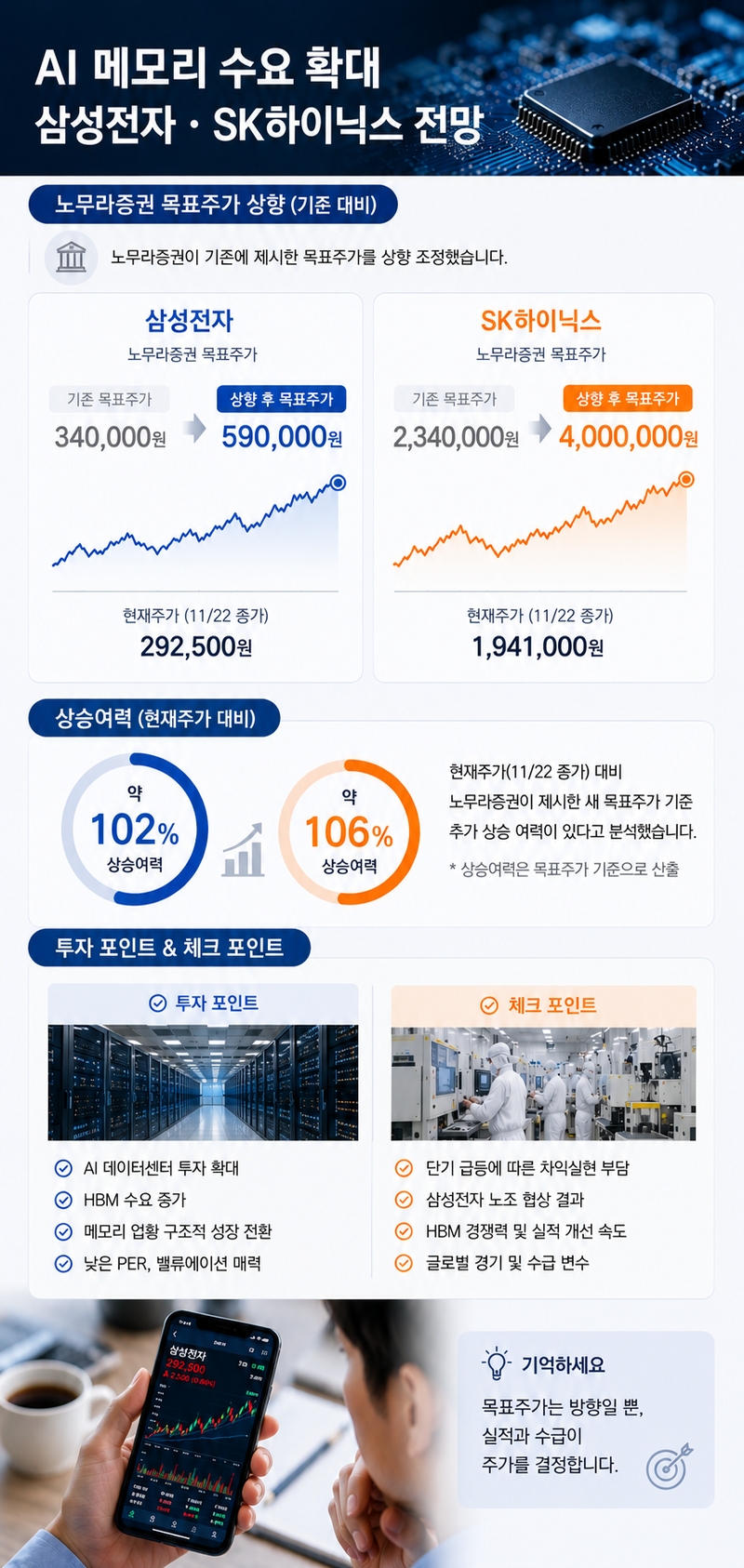
According to the financial investment industry on the 24th, Nomura Securities raised its target price for Samsung Electronics from 340,000 won to 590,000 won in a report released on the 15th. It also lifted its target for SK hynix from 2.34 million won to 4 million won.
What Nomura focused on was the changing nature of memory semiconductors. In the past, memory chips were seen as a cyclical sector whose performance swung sharply with demand for PCs and smartphones. But with rising investment in AI data centers and growing demand for high bandwidth memory (HBM), Nomura believes Samsung Electronics and SK hynix should now be viewed again as structural growth stocks.
Nomura said the 12-month forward price-to-earnings ratio of Samsung Electronics and SK hynix remains at around 6 times, adding that they could be valued at around 20 times, similar to Taiwan Semiconductor Manufacturing Company Limited (TSMC).
About twice the current share price
On target prices alone, the upside looks large. As of the market close on the 22nd, Samsung Electronics finished at 292,500 won, while SK hynix closed at 1.941 million won. Compared with Nomura's targets, that implies additional upside of about 102% for Samsung Electronics and about 106% for SK hynix.
However, a target price is only an estimate that reflects earnings forecasts and valuation at a specific point in time. It does not mean the stock will actually rise to that level. Both stocks have already moved sharply. Samsung Electronics closed at 299,500 won on the 21st, up 8.51% from the previous session, while SK hynix also jumped 11.17% that day to 1.94 million won.
A man in his 30s, identified as A, said, "If you look only at the target price, it feels like a loss not to buy, but once I try to get in, I get scared it may already be the peak." He added, "My salary stays the same, but stocks move by hundreds of thousands of won in a single day, so I keep checking them even while working."
Samsung Electronics also faces a union vote as a variable
Samsung Electronics is facing not only expectations of a stock re-rating, but also internal uncertainties. After talk of a possible general strike, management and the Samsung Electronics labor union drew up a tentative agreement on wages and collective bargaining, and a vote by union members is now under way.
According to the industry on the 24th, the turnout for the vote on the tentative agreement had reportedly exceeded 80% as of that morning. Voting runs through the 27th. The agreement is said to include the creation of a special management performance bonus for the semiconductor division.
If the agreement passes, strike risks could ease. If it fails, labor-management conflict could return to the spotlight. Separate from Nomura's long-term growth thesis, these internal issues could also affect the stock in the short term.
The target price points the way, but the stock price must be confirmed first
SK hynix is widely seen as having the lead in the HBM market. For Samsung Electronics, the key issues are restoring HBM competitiveness and improving its foundry business. Both companies are grouped together as beneficiaries of AI memory demand, but the challenges the market sees for each are different.
A man in his 40s, identified as B, said, "SK hynix looked too expensive, so I didn't buy it, and I'm still debating Samsung Electronics because it seems like it has more room to run." He added, "Everyone around me keeps talking about semiconductors, so if I don't own them, I feel like I'm falling behind."
Nomura's outlook for "590,000-won Samsung and 4 million-won Hynix" reflects the view that the semiconductor industry has moved beyond a simple cyclical upswing and entered a structural growth phase. But what investors need to verify is not the target price itself, but the earnings and supply-demand conditions that support that outlook.
As of the 22nd, the two stocks were still trading at about half of Nomura's target prices. The bold forecast from the brokerage community has clearly boosted expectations, but after a sharp short-term rally, even small variables could cause large swings in share prices. For Samsung Electronics and SK hynix to move toward those targets, investors will need to see not only stronger AI memory demand, but also faster earnings improvement and the resolution of internal issues.
[email protected] Han Seung-gon Reporter