"I’m So Jealous I Could Burst"... Workers Buzz Over Samsung Electronics and SK hynix’s Billion-Won Bonuses [The Joys and Sorrows of Salary Workers]
- Input
- 2026-05-24 06:00:00
- Updated
- 2026-05-24 06:00:00

[Financial News] "Didn’t SK hynix say its bonus was as much as a yearly salary?"
In recent group chats among office workers, semiconductor bonuses have become a frequent topic. On one side, people talk about billion-won payouts. On the other, some say they were disappointed by the results of salary negotiations. Even among salaried workers, compensation gaps are widening sharply depending on the company and industry, turning bonuses into a number that inspires both envy and a sense of deprivation.
The semiconductor boom is spilling over into comparisons of employee bonuses. SK hynix has paid out its largest-ever bonus, and Samsung Electronics has also prepared a tentative agreement that includes a special bonus for its semiconductor division. As compensation differences grow depending on the company and business unit, bonuses have become more than just an internal reward. They are now a benchmark for comparison among workers.
"It’s as much as a yearly salary"... SK hynix’s expected bonus stirs envy
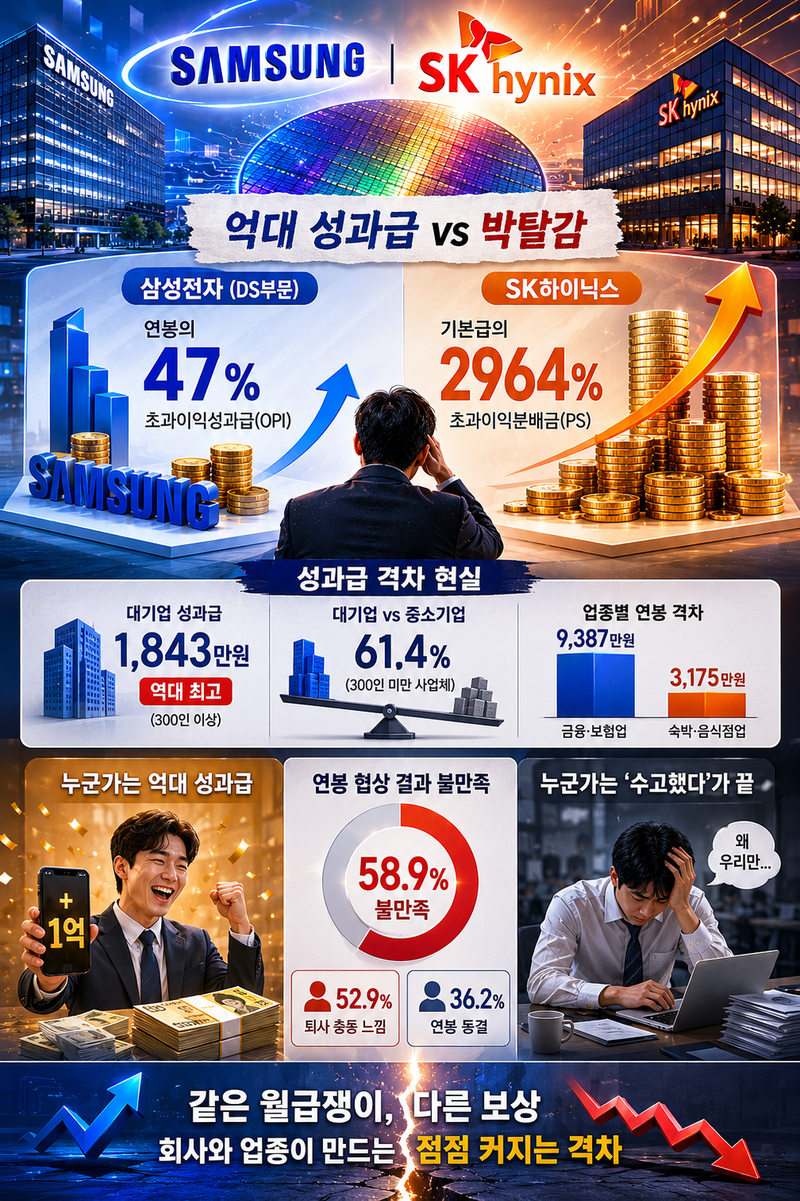
SK hynix was the company that ignited this year’s bonus debate. Based on its record results in 2025, SK hynix finalized this year’s profit-sharing payment rate at 2,964% of base pay. For an employee earning 100 million won a year, that would amount to roughly 148.2 million won in bonuses alone.
The profit-sharing system pays out 10% of operating profit as a pool, based on annual performance. In 2025, SK hynix posted sales of 97.1467 trillion won and operating profit of 47.2063 trillion won. As the semiconductor market improved, led by high-bandwidth memory (HBM), employee compensation also rose sharply.
Workers compare those figures with their own pay slips. One office worker in his 30s said, "When I read bonus articles, the company name starts to feel like a benefit in itself," adding, "I’m calculating how much my salary went up in percentage terms, but then I hear that people at other companies are getting billion-won bonuses in one shot, and it feels deflating."
Another worker said, "It’s not that the companies paying bonuses are doing anything wrong, but it makes the phrase ‘we’re all salaried workers’ feel meaningless," adding, "These days, choosing the right company seems to create a bigger gap than salary itself."
Workers are also paying close attention to Samsung Electronics’ bonus package
Samsung Electronics is also at the center of the bonus issue. The company’s Device Solutions Division has finalized a 2025 overperformance incentive (OPI) rate of 47% of annual salary. OPI is a bonus paid when a business unit exceeds its target performance, with a maximum payout of 50% of an employee’s annual salary.
Recently, a tentative labor-management agreement was also reached that includes a special management performance bonus for the DS Division. The proposal reportedly creates a new special bonus funded by 10.5% of the division’s business performance, with no cap on payouts.
Reactions within Samsung Electronics are mixed, however. That is because the gap in bonuses could widen between the Memory Business, non-memory operations, and the DX Division. Some employees in the DX Division are moving to oppose the tentative agreement. In other words, bonus comparisons are no longer limited to companies outside the firm; they are spreading within the same company as well.
The Samsung Electronics labor union has postponed the general strike it had announced from the 21st to the 7th of next month, and is holding a vote on the tentative agreement from 2 p.m. on the 22nd to 10 a.m. on the 27th.
"How much is our bonus this year?"
The reason bonus comparisons are becoming more intense is that variable pay stands out more than base salary. Monthly wages rise only gradually, but bonuses are disclosed as large lump-sum payments. They are rewards for strong company performance, yet outside the company they are reduced to a simple number: how much one firm paid compared with another.
Special pay is also having a growing impact on wage statistics. According to a report titled "Analysis of Wage Increase Trends at Businesses in 2025," released by the Korea Enterprises Federation (KEF) in March 2026, the average annual wage of regular employees in 2025 reached 50.61 million won, surpassing 50 million won for the first time. Annual wage totals include base pay, allowances, and special pay such as bonuses and incentives.
In particular, bonuses at large companies with 300 or more employees hit a record 18.43 million won last year. By contrast, wage levels at businesses with fewer than 300 employees were only 61.4% of those at larger firms. The gap by industry was also wide. Annual wages in finance and insurance reached 93.87 million won, while the figure for lodging and food service businesses was just 31.75 million won.
Companies where bonuses have risen are pulling further ahead, while those that have not are left with a growing sense of relative deprivation. Even when people casually ask in the office, "How much is your bonus this year?" the question can end up highlighting the differences between companies and industries.
Workers’ frustration over compensation is not limited to bonuses. With inflation, loan interest rates, and living costs all rising, bonus news sounds even louder when salary increases fall short of expectations.
According to Incruit’s survey of 1,305 workers on the results of 2026 salary negotiations, 58.9% said they were not satisfied with this year’s outcome. While 61.4% said their salary had increased, that figure was down 5.3 percentage points from the same survey a year earlier. Another 36.2% said their pay had been frozen. Meanwhile, 52.9% said they felt like quitting after salary negotiations.
A worker in his 40s said, "At work, they say performance is difficult, but the news keeps talking about bonuses at other companies," adding, "People who can switch jobs will move, but most of us just end up comparing ourselves and moving on." He added, "What’s more frustrating than not getting a bonus is not being told why we didn’t get one."
[email protected] Han Seung-gon Reporter