"Now We Know Why We Crave Meat More Than Rice" ... Korean Researchers Uncover How the Gut Controls the Brain
- Input
- 2026-05-25 06:00:00
- Updated
- 2026-05-25 06:00:00

[Financial News] Korean researchers have, for the first time, identified the detailed mechanism by which the gut regulates brain neurons to prompt the body to prioritize essential amino acids, such as those found in meat, when protein levels are low. The findings are expected to open a new path for treating obesity as well as eating disorders such as binge eating and anorexia.
According to the Ministry of Science and ICT on the 23rd, a team led by Greg Seong-Bae Suh, head of the Center for Microbiome-Body-Brain Physiology Studies at the Institute for Basic Science (IBS), uncovered the neural and hormonal regulatory mechanism of the gut–brain axis in joint research with Seoul National University (SNU) and Ewha Womans University.
Through animal experiments on fruit flies and mice, the researchers confirmed that the gut–brain axis responds to nutritional deficiency not through a single pathway, but through a precise control system that activates both a "fast neural network" and a "slow hormone" response at the same time.
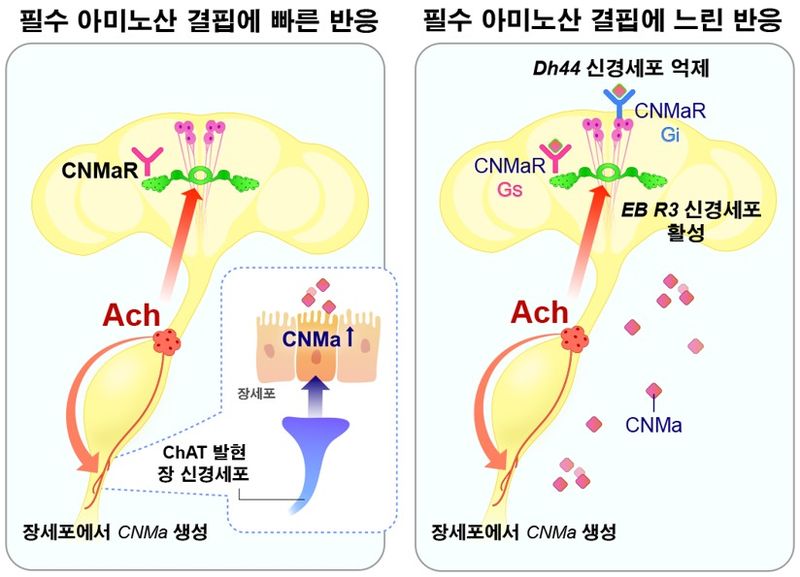
First, when intestinal epithelial cells detect a shortage of essential amino acids, or protein, in food, they immediately send a rapid signal to the brain through the gut–brain neural pathway, encouraging the intake of essential amino acids.
Next, the peptide hormone CNMamide, secreted from the gut, travels slowly through the circulatory system to the brain and helps sustain protein-seeking behavior over the long term.
In particular, the researchers newly found that gut-derived CNMamide signals not only promote the intake of essential amino acids in the brain, but also suppress the activity of a specific neuron, DH44 neurons, that drives carbohydrate, or glucose, intake.
This means that, to make up for missing nutrients, animals do not simply increase their overall food intake. Instead, the gut and brain jointly reprogram selective feeding behavior by choosing the nutrients they need while excluding others.
The mechanism identified in this study was also shown to work even in the absence of FGF21, a liver-derived hormone previously known as a key hormone in the response to protein deficiency. This proves that the gut–brain axis functions as a powerful alternative feeding-control system that operates independently of the existing pathway.
Suh said, "Most current drugs for obesity and appetite control use gut hormone signals, but until now, the effects of naturally secreted gut hormones on the brain and behavior, as well as their specific pathways, have not been sufficiently studied." He added, "This study, which reveals the principle behind how the gut and brain select nutrients, will serve as an important foundation for future research into treatments for metabolic diseases and eating disorders."
The findings were published in Science, one of the world's most prestigious international journals.
[email protected] Sung Min-seo Reporter