"Porsche Was Lined Up" Mr. Kim, Who Sold NVIDIA and Returned to Samsung Electronics, vs. "A Peak Signal" Mr. Lee, Who Is Exiting [Mr. Kim vs. Mr. Lee]
- Input
- 2026-05-23 09:30:00
- Updated
- 2026-05-23 09:30:00
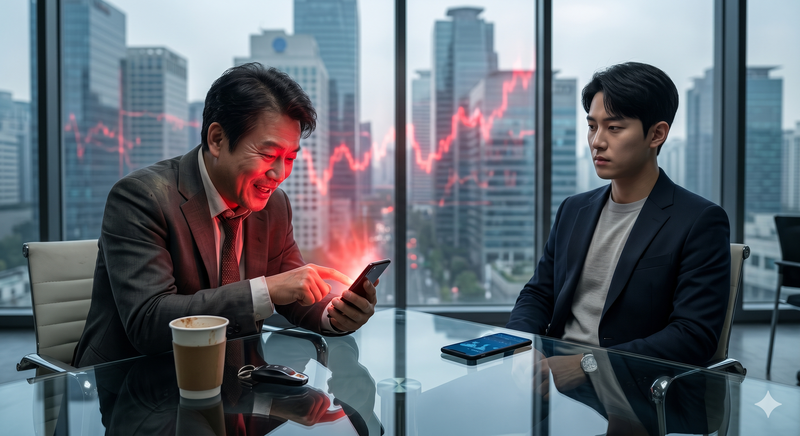
"Mr. Kim, did you see the article about Samsung Electronics' 600 million won bonus? Porsche and Lamborghini were lined up in front of the Seocho headquarters. Selling NVIDIA for a profit the other day and loading up Samsung Electronics at 290,000 won through a 'domestic market return account (RIA)' was a stroke of genius. Nomura says the KOSPI will hit 10,000. As always, Samsung Electronics is the best stock for our kids' accounts."
"Boss, did you see the market this morning? After jumping 8% yesterday, foreign investors are dumping 1.2 trillion won worth of shares in the early session today. Individual investors are absorbing more than 1 trillion won of it. Historically, whenever headlines about bonus parties dominate the news, that has marked the exact top of the semiconductor cycle. I'll keep exiting into the U.S. market when the stock bounces."
At a franchise cafe in Yeouido, the smartphone screens of two office workers who had just finished lunch were both glowing red, but their views of the market could not have been more different.
This is the era of the 'Korean stock market.' Amid a stream of bullish news about the AI semiconductor supercycle, South Korea's capital market is boiling like a furnace.
Yet in the middle of this massive whirlpool of money, Mr. Kim in his 50s and Mr. Lee in his 30s are shaking their heads at each other, saying the other side does not understand reality.
So whose intelligence is higher?
"The flow of money has turned toward the Korean market" ... returning overseas investors
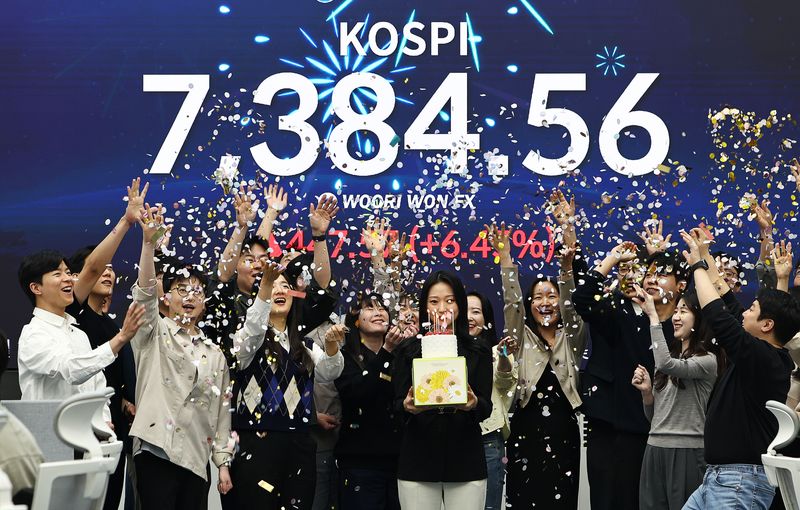
Mr. Kim's confidence is not based on empty patriotism or blind national pride. It rests entirely on market flows and data from global investment banks.
A recent report from Nomura Securities sent Yeouido into a frenzy. It sharply raised this year's KOSPI target to 10,000 to 11,000 points and set target prices for Samsung Electronics and SK hynix at 590,000 won and 4 million won, respectively. The logic is that, given the premium TSMC commands at a 20-times P/E ratio, South Korea's two semiconductor giants, now trading at around 6 times earnings, are absurdly cheap.
The money is already moving. The 'domestic market return account (RIA),' introduced by the government as a measure against a weak won, has attracted nearly 2 trillion won in just over two months. More than half of the subscribers, 57%, are in their 40s and 50s, like Mr. Kim. They have no hesitation in selling NVIDIA and Tesla after locking in gains, then using that money to buy Samsung Electronics and SK hynix.
Fueling the fire was the so-called '600 million won bonus' controversy. News that employees in Samsung Electronics' Device Solutions Division had received bonuses of up to 600 million won crushed the motivation of workers nationwide, while also becoming the most explosive signal yet that the semiconductor supercycle is real. Mr. Kim's belief that "the only real cash cow is South Korea's semiconductor industry" is increasingly looking like the correct answer as the order book keeps hitting record highs.
"Sell into euphoria, the foreign exit" ... the MZ generation's cold gaze
But the younger generation, represented by Mr. Lee, sees things in a far colder light. They interpret the current frenzy as a "blow-off top," the final burst of irrational exuberance.
What Mr. Lee focuses on is not flashy target prices, but the facts, especially who is driving the flows. Yesterday, on a wave of bullish news including hopes that the war in Iran would end, Samsung Electronics and SK hynix surged 8.5% and 11.1%, respectively. But in the early session on the 22nd, foreign investors dumped 1.2 trillion won worth of KOSPI shares into the market. Individual investors, meanwhile, are piling in with more than 1 trillion won in margin debt, absorbing the entire amount.
To Mr. Lee, this mirror-image flow of money is a familiar omen of a tragedy that has repeated many times before. At the top of every past semiconductor cycle, the finale was always marked by headlines about record bonuses, rosy reports from global investment banks, and retail investors borrowing heavily to buy in.
He firmly believes that the essence of the Korea discount has not been resolved. With the tilted playing field still intact, including spin-offs designed for controlling shareholders and token shareholder-return policies, he is skeptical that the current rally, driven by a short-term HBM theme, will ultimately become nothing more than a profit-taking window for foreign investors. His conviction that "if I'm going to take sleeping pills and hold for 10 years, Nasdaq is the place, not the volatile Korean market" remains unshaken.
A clash of expectations in front of a 1.93 million won order book
There is no single correct answer in the debate between Mr. Kim and Mr. Lee. Faced with the enormous wave of the AI revolution, the overwhelming cash-generating power of South Korea's semiconductor infrastructure is undeniably attractive. At the same time, however, the ruthless trading pattern of foreign investors, who unload shares when the good news is at its peak and quietly exit, is also an undeniable reality of the capital market.
Even today, with Samsung Electronics trading at 290,000 won and SK hynix breaking through 1.93 million won, some are hitting the buy button and shouting that this is the dawn of a new era, while others are hitting sell and calling it the last chance to escape.
Ordinary office workers, grimacing at the article about 600 million won bonuses, stare at their HTS screens. One year from now, who will be smiling at that cafe: Mr. Kim, who called for a return to the Korean market, or Mr. Lee, who insisted on escaping it? As always, the capital market will prove the answer with the numbers in each account, without pity or mercy.
[email protected] Jeon Sang-il Reporter