Government to Supply 90,000 Purchase-Rental Homes in the Seoul Metropolitan Area... "Will Strictly Crack Down on Pumping Up Home Prices and Tax Evasion"
- Input
- 2026-05-22 08:58:55
- Updated
- 2026-05-22 08:58:55
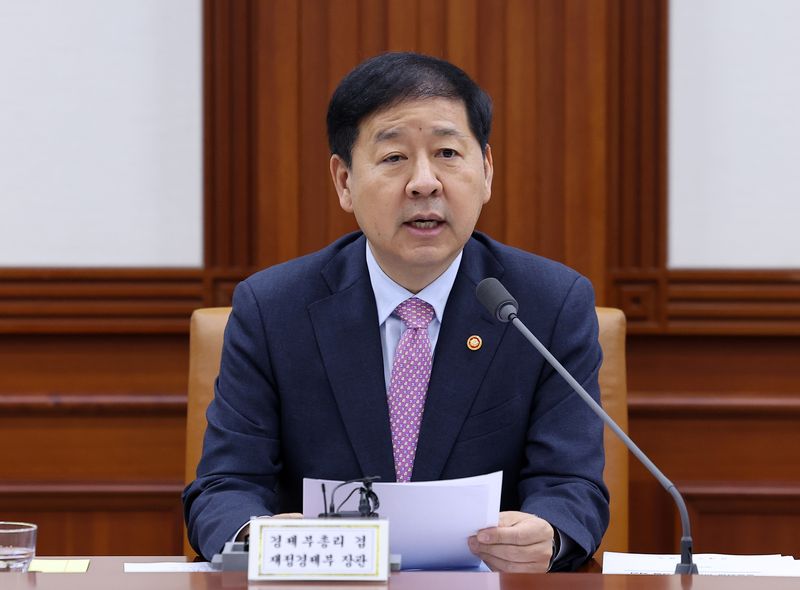
According to the government, Koo Yun-cheol, Deputy Prime Minister for Economic Affairs and Minister of Economy and Finance, chaired the Ministerial Meeting on Real Estate at Government Complex Seoul and discussed housing market trends and response measures, the current status of intensive crackdowns on illegal real estate activity, and future plans. The meeting was attended by the chairperson of the Financial Services Commission, the first vice minister of Land, Infrastructure and Transport, the second vice minister of the Office for Government Policy Coordination, the commissioner of the National Tax Service, and the commissioner of the Korean National Police Agency.
The government will first push ahead with measures to expand the supply of non-apartment housing. It believes that non-apartment units such as officetels can be supplied relatively quickly and could produce visible results within one to two years.
Accordingly, the government has decided to supply 90,000 purchase-rental homes in the Seoul metropolitan area over the two years from 2026 to 2027 so that the public can lead efforts to boost non-apartment housing supply. Of those, 66,000 homes will be concentrated in regulated areas such as Seoul.
It will shorten construction periods by applying modular construction methods and reduce cost burdens for builders to encourage early groundbreaking. Projects that have already received permits but have not yet broken ground will be closely managed on a site-by-site basis, while projects with strong business viability will receive support to prevent financing difficulties.
In his opening remarks, Koo said, "The pace of increase in Seoul apartment sale prices has widened for two consecutive weeks," adding, "We will closely monitor price movements and listing trends and respond actively to stabilize the market." He also emphasized, "Non-apartment housing is an important part of the housing ladder," and "We are reviewing various measures to expand supply in order to ease housing difficulties for young people."
The government is also stepping up crackdowns on market-distorting behavior. The National Tax Service has launched tax audits on 127 people suspected of real estate tax evasion. It is also checking whether 2,630 high-priced homes worth more than 900 million won each and owned by corporations are being used for private purposes.
The Korean National Police Agency is also carrying out a special crackdown on real estate crimes, including pumping up home prices and redevelopment corruption. As of the 19th, it had investigated more than 2,200 people and sent 861 of them to prosecutors.
Koo said, "We will not overlook a single act that disrupts market order," and added, "We will do everything we can to ensure that the measures being pursued with the stability of the public's housing as our top priority lead quickly and decisively to results."
[email protected] Jang In-seo Reporter