"Going to Work Feels Terrifying"... Starbucks Frontline Staff Unfairly Turned Into the Scapegoat
- Input
- 2026-05-22 05:30:06
- Updated
- 2026-05-22 05:30:06
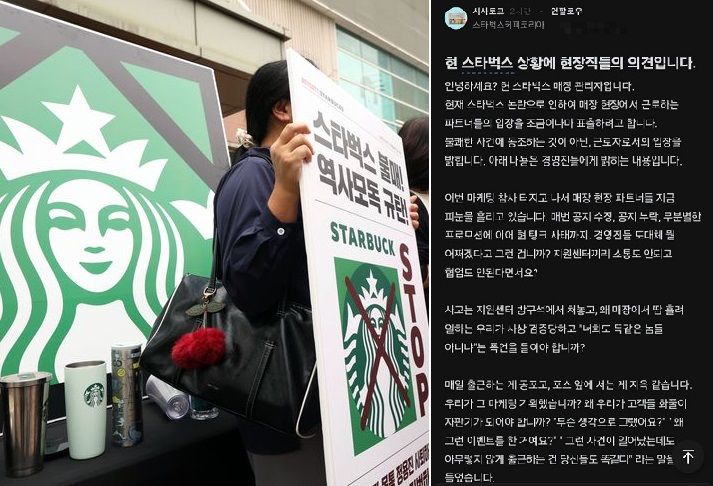
[The Financial News] As the backlash continues over Starbucks Korea's so-called "Tank Day" marketing campaign, which sparked controversy for allegedly disparaging the May 18 Democratic Uprising, customer anger is increasingly being directed at frontline store employees. Unrelated workers at stores are now complaining of severe emotional labor and distress.
On the 21st, a post from a person identified as A, who said they were a Starbucks store manager, spread across Blind and other online communities. A said the post was not meant to support the offensive incident, but was written as a worker trying to alert management to the serious situation at the stores.
A said, "Since this marketing disaster, store partners on the front lines have been crying tears of blood." A added, "The mistake was made at headquarters, so why should employees who sweat it out in stores have to face ideological tests and verbal abuse from customers?"
A continued, "Going to work every day feels terrifying, and standing at the register feels like hell." A said frontline employees had become the target of customers' anger.
In fact, employees were reportedly taking the full force of sharp criticism from some customers who visited stores, including remarks such as, "What were you thinking when you ran that marketing campaign?" and "If you can still go to work as if nothing happened after such an incident, you're just the same." In effect, they are being forced to bear the stigma of working for a company accused of belittling the May 18 Democratic Uprising, while absorbing the backlash with no protection.
"Posting an apology at the store is just putting up a target board... Headquarters should handle this directly."
Criticism also mounted over headquarters' complacent response and follow-up measures. A strongly criticized the company's instruction to print out an apology and post it in stores. A said, "The moment we put up an apology, store employees just become a target board telling customers, 'Come here and curse at me.'" A added, "Headquarters must step forward and serve as a shield for store partners."
A also urged the company not to dump customer complaints and refund demands onto stores. Instead of pushing angry customers who want refunds for Starbucks Cards or tumblers into stores, A called for headquarters to set up a dedicated refund channel and separate the issue from frontline staff.
A also exposed what they described as unfair work instructions that emerged during the effort to contain the crisis. A said it made no sense to talk about self-reflection while first cutting frontline staff, reducing overtime, or claiming that employees would be retrained properly. A insisted that stores should never be pressured over falling sales caused by the scandal, and that any so-called "apology promotion" must be strictly banned. There is no reason for stores to clean up a mess made by headquarters, A said.
"The Fallout of 'Leaving Starbucks' That Has Not Subsided Even After the Dismissal and Apology"
The controversy was triggered by a tumbler marketing campaign that Starbucks Korea launched one day before the anniversary of the May 18 Democratic Uprising. The problem began with the use of the phrase "Tank Day" and the promotional slogan "Bang on the desk!" on the event page. The campaign drew fierce criticism for evoking the military's violent crackdown during the 1980 May 18 Democratic Uprising and the police cover-up remarks made in connection with the 1987 death by torture of martyr Park Jong-chul.
As the controversy spread out of control, Starbucks immediately suspended the event, issued an apology, and took strong action by dismissing its chief executive. However, consumer anger has not subsided easily. Online, posts certifying that people will stop using Starbucks, so-called "leaving Starbucks" pledges, are spreading like a trend. The fallout is also expanding into boycott lists shared against Shinsegae affiliates, widening the impact across the group.
[email protected] Moon Young-jin Reporter