Designing combat solutions with AI... The era of simultaneously controlling unmanned vehicles and robots
- Input
- 2026-05-21 18:28:42
- Updated
- 2026-05-21 18:28:42
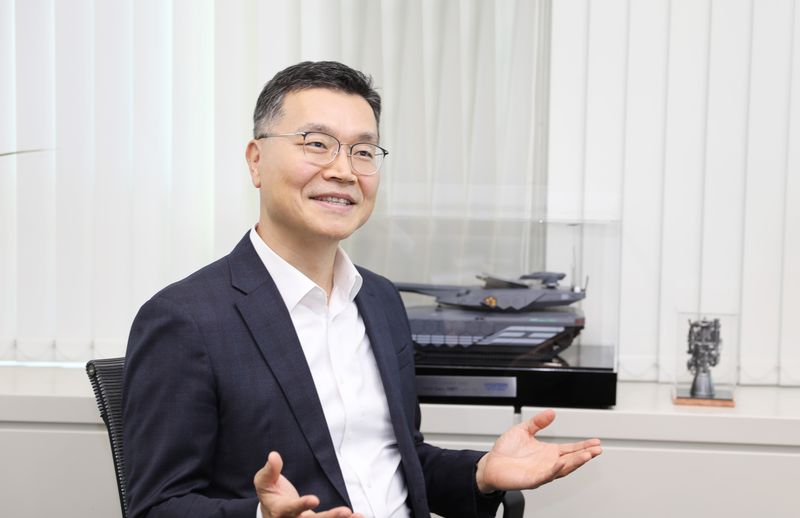
S. defense technology company Anduril for the joint development of an AI-based Manned/Unmanned Combined (MUM-T) command and control system. ■ Hyundai Rotem Shifts Paradigm from Single Vehicle Control to Cluster Control Cho Hyung-joon, Executive Vice President and Head of Hyundai Rotem’s Defense Solution (DS) Division, opened the discussion with the Financial News on the 21st by stating, "We will incorporate AI to the fullest extent and release it as soon as possible. " Having assumed the position of Head of the DS Business Division (concurrently serving as CTO/Chief Technology Officer) last January, he has been spearheading the "six core technologies," including autonomous driving, MUM-T, and AI, since his time as Head of the Defense Solution Research Institute.
This is the first comprehensive roadmap unveiled since his promotion. The core of this roadmap is the transition from "one person, one vehicle control" to "N-to-M integrated control. " Executive Director Cho emphasized, "In a situation where the population is declining and troop numbers are shrinking, having a single person operate a single robot does not meet the military's needs," adding, "A hybrid manned-unmanned system where one person controls multiple unmanned systems is what the military desires. " It is a structure where multiple tank crew members simultaneously command homogeneous and heterogeneous unmanned vehicles and multi-legged robots.
To this end, cooperation with Anduril was decided. The primary goal is to integrate and control unmanned vehicles and multi-legged robots by linking them with Anduril's Lattice OS. The starting point for the AI application envisioned by Hyundai Rotem is mobile weapon systems. He summarized this as "running, shooting, and blocking," stating, "The beginning is intelligent mobility.
" He further suggested, "We must implement waypoint-based autonomous driving, and further achieve complete autonomous driving in complex terrain environments such as urban areas, off-road, and rough terrain, and ultimately, even achieve platooning. " The core of 'intelligent mobility' is the vehicle's perception of its surrounding environment. He stated, "Humans know because they have learned, but for vehicles, situational awareness utilizing AI is essential," adding that "the autonomous driving of multi-purpose unmanned vehicles is the result of approximately three years of effort. " Hyundai Rotem plans to significantly increase its investment in AI-related R&D over the next five years.
Eleven R&D projects—including the advancement of AI-based environmental perception technology, the development of core intelligent battlefield situational awareness technologies, and the development of robustness technology for multi-legged walking robots—will be carried out in parallel with the establishment of AI learning infrastructure for autonomous driving technology development. The company will simultaneously pursue the hiring of additional AI development personnel, the expansion of internal training programs, the strengthening of industry-academia collaboration, and cooperation with AI technology companies. ■ Walking Robots to be Deployed Next Year. "From Reconnaissance to Engagement on a Single Platform" The field where results are becoming visible most rapidly in the unmanned systems strategy is multi-legged walking robots.
Delivered to the military last January through the Rapid Research and Development Project, this robot was recognized for its usability during pilot operations, leading to the selection of an urgent procurement project. Operational deployment is scheduled to begin in 2027. A government-led procurement project is currently underway for the multi-purpose unmanned vehicle, the 'HR-Sherpa'.
The 4th-generation HR-Sherpa, featuring a six-wheel electric drive system, travels at a maximum speed of 60 km/h and is capable of autonomous driving and remote-controlled weapon operation. Securing interoperability between platforms is also a key task. He stated, "We equip robots with flashbangs, tear gas, pistols, cameras, and radar, but if the communication protocols between the devices and the platform do not match, we have to modify them individually.
" He added, "It is like saying a mechanical platform is measured in millimeters while screws are measured in inches; they won't fit. The government is developing K-MOSA (Modular Open System Architecture) for a common interface. " K-MOSA is an open design standard that reinterprets the U.
S. Department of Defense's MOSA to suit the Korean defense environment, and it is expected to enable interoperability between weapon systems and rapid technology updates. Executive Director Cho stated, "It handles everything from reconnaissance and CBRN mission execution to material transport and rifle-level engagement on a single platform," adding, "We will expand defense technology into the civilian sector.
"
[email protected] Ganggugwi Reporter