[Editorial] Samsung Electronics bonus settlement is welcome, but undermining compensation principles is a problem
- Input
- 2026-05-21 18:24:23
- Updated
- 2026-05-21 18:24:23
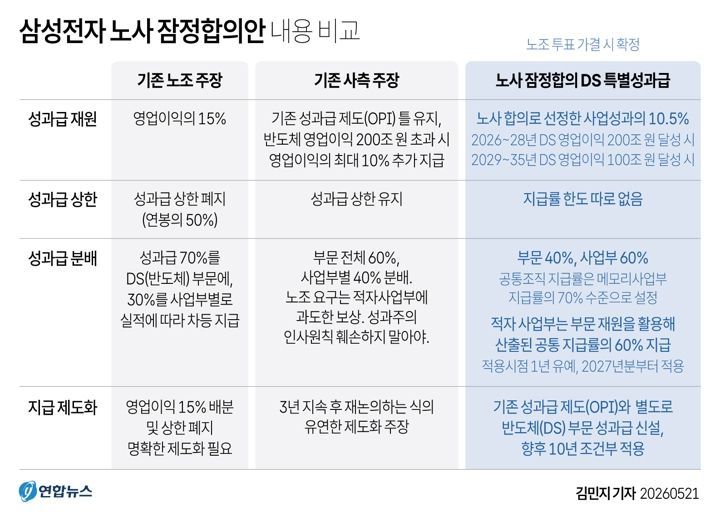
First, the agreement includes a plan to pay at least 160 million won in bonuses even to the Samsung Foundry Division, which is likely to post a loss this year. Of course, some conditions were attached. Since the plan redistributes profits generated across the company to loss-making divisions, it is not necessarily a major issue. It is also understandable that management wanted to prevent key talent from leaving for overseas rivals if no bonus were paid at all. But if compensation for loss-making divisions becomes a routine practice, it will undermine the principle that rewards should follow performance.
Another major concern is that while employees in the Device Solutions division memory business can receive up to 600 million won, the DX (Device eXperience) Division, which handles smartphones and home appliances, will feel even more neglected. The principle that performance should be rewarded must, of course, be applied consistently. But a widening gap in compensation between the Device Solutions division and the DX Division at such a sharp level would be highly damaging to corporate culture.
It is possible to differentiate compensation between individuals. The problem is that the louder the labor union's voice becomes, the more it can extract in rewards, causing personal compensation gaps to widen dramatically. If the union's bargaining power becomes the decisive factor in determining the size of bonuses, it will only encourage greater militancy.
Even more troubling is the possibility that the Samsung Electronics agreement could ripple across industry like dominoes. When company performance improves, it is certainly possible to offer exceptional rewards to employees who have worked hard. To win the global talent war, companies must provide sufficient compensation to their people.
However, this latest deal could become a precedent and serve as a bargaining benchmark for labor unions at other major companies. Across industry, demands for performance-based bonuses could surge dramatically from now on. That would be a serious concern for businesses.
Subcontractors and partner companies that work hard for a prime contractor such as Samsung Electronics are also likely to feel a strong sense of relative deprivation. In reality, compensation for the efforts of workers at small and medium-sized companies is far lower than at large corporations. Differences in job roles can be reflected in pay, but if the gap becomes excessively wide, it can distort the labor market and deepen its dual structure.
Political circles also bear a heavy responsibility for allowing these structural problems to grow. For decades, measures to strengthen labor flexibility, such as easing dismissal requirements, shifting to job-based pay, and improving rules on dispatch and fixed-term work, have been recurring policy agenda items. Successive governments have tried labor reforms that included greater flexibility, but they have repeatedly failed. Negotiations were often overturned by strike threats, or reforms were abandoned ahead of elections out of concern for voter sentiment. Once again, the company appeared to be dragged around by a labor union that used the threat of a strike as leverage.
The result of leaving labor reform unattended, without pushing it forward decisively, is the structural dysfunction now seen in the labor market. If the Samsung Electronics case is taken seriously, the current government should actively prepare measures that can strengthen not only labor rights but also corporate management rights. The top policy priority should be labor reform centered on rational employment flexibility.