[Editorial] Opening Large Discount Stores on Weekends Had No Impact on Traditional Markets
- Input
- 2026-05-21 18:24:02
- Updated
- 2026-05-21 18:24:02
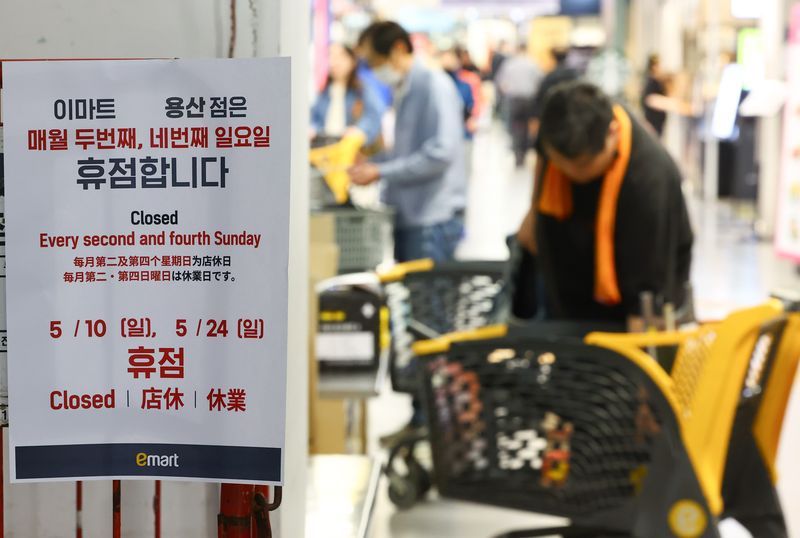
The twice-monthly mandatory closing rule for large discount stores was introduced in 2012, and 14 years have already passed. It was justified as a way to protect traditional markets, but there has been no evidence that those markets were significantly revitalized. Instead, sales at large discount stores fell sharply. Even so, the government has kept the regulation in place without easing operating restrictions.
Instead, local governments effectively loosened the rule by moving closing days from weekends to weekdays. The number of local governments that made the change rose to 30, while the number of large discount stores reached 67 and the number of corporate supermarkets (SSMs) climbed to 245. KDI analyzed that as a result, store sales increased, but traditional market sales did not fall, and in some areas they even rose.
KDI said traditional markets and large discount stores do not compete for the same consumers in the same way. Instead, consumer purposes, product categories, and shopping methods have become more differentiated. In other words, the real competitor to large discount stores is not traditional markets but online shopping. That means the policy goal behind regulating large discount stores was set incorrectly and failed to achieve its purpose. The mandatory closing rule did not help revive traditional markets, and consumers simply shifted to online retailers.
In fact, over the past decade, sales at large discount stores have fallen sharply, while online retailers have seen strong growth. Traditional markets have shown little change. Consumers did not turn to traditional markets on weekends when large discount stores were closed; they moved online instead. As a result, only consumers' freedom to choose where to shop in person was restricted.
It is therefore appropriate to lift the mandatory closing rule for large discount stores now. If the rule cannot be abolished, the government or local governments should change the system so that closing days fall on weekdays rather than weekends. Consumers will buy what they need anyway, whether in offline stores or online. In other words, the overall size of the domestic market remains almost the same. An attempt to save traditional markets ended up benefiting online retailers.
There has also been analysis showing that traditional markets near large discount stores see higher sales when the stores are open on weekends. That means shoppers who go to the stores often stop by nearby traditional markets and buy items while they are out. Large discount stores and traditional markets are not simply rivals selling the same goods; they have strong potential to complement each other and coexist.
Successive administrations have known that the regulation on large discount stores has effectively failed, yet they have kept it in place until now. The government has learned for itself that rules are easy to create but difficult to remove. Now that empirical research has produced clear results, it should consider scrapping the policy. That is all the more necessary if consumer choice is taken seriously. If consumers come back out, it will help revitalize the market and boost spending.