What if a Village Had Its Own Solar Power Plant? How Feasible Is a 'Sunlight Income Village'? [Eco & Energy by Lee You-beom]
- Input
- 2026-05-23 06:00:00
- Updated
- 2026-05-23 06:00:00
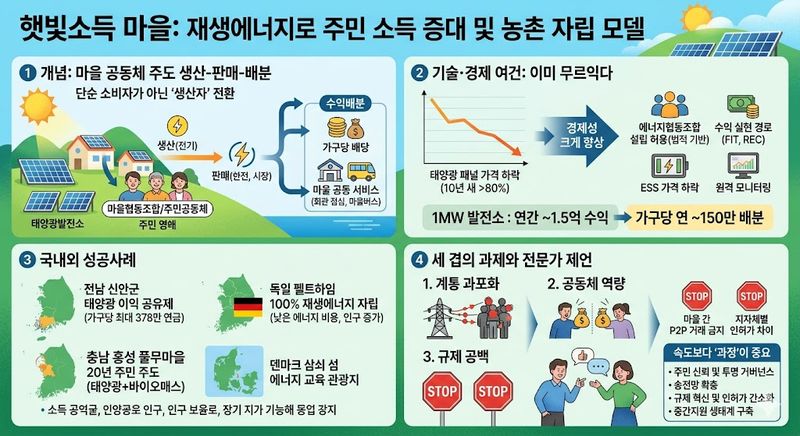
[Financial News] Discussions are heating up over the idea of a 'Sunlight Income Village,' where residents share income from electricity generated and sold through renewable energy. The technological and economic conditions are already in place. Solar panel prices have fallen by more than 80% over the past decade, and the legal foundation for establishing Energy Cooperatives has been set, improving profitability. The government has also announced a large-scale expansion plan, saying it will create 2,500 Sunlight Income Villages nationwide by 2030 with 550 billion won in state funding. But experts say process must come before speed. Unless trust among residents, transparent governance and grid congestion are addressed, solar panels could become a source of conflict rather than opportunity.
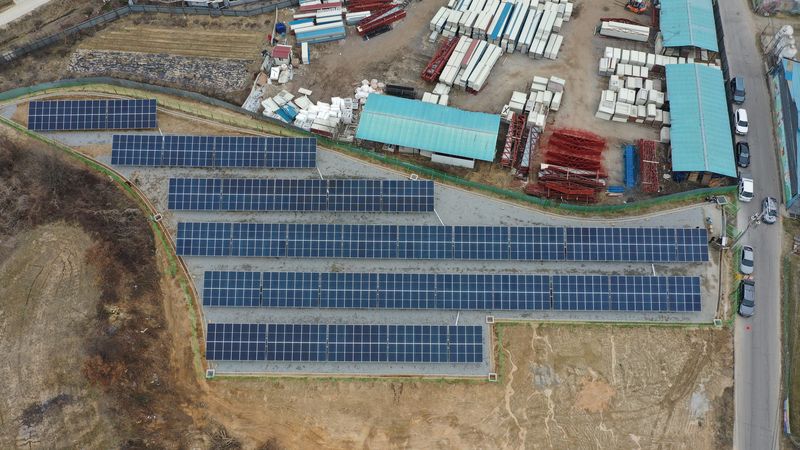
A village community earns income from solar power
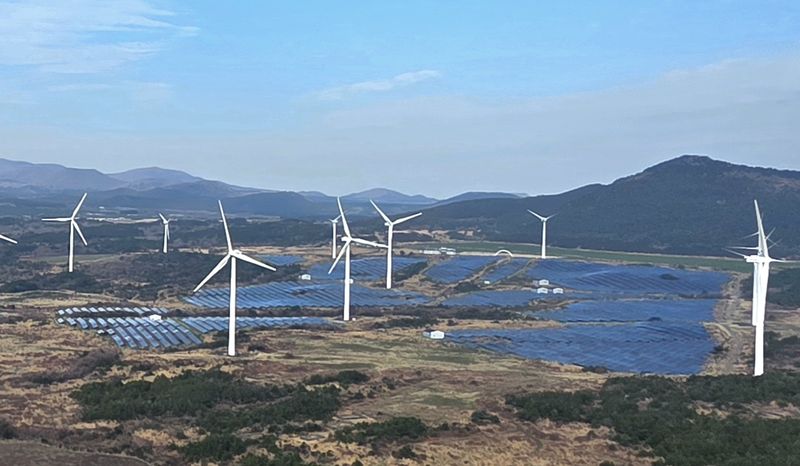
According to government ministries on the 23rd, a Sunlight Income Village is an energy self-sufficient village model in which a village community takes the lead in installing and operating solar power plants on idle land, farmland and reservoirs within the village, then shares the proceeds from electricity sales among residents. The key point is that the village is transformed from a mere consumer of electricity into a producer, and that the income generated from that production goes not to outside companies or investors, but to the resident community. Because the power plant is owned and operated by a village cooperative or resident organization, it is distinct from simple rooftop solar projects or large-company-led power generation businesses.
There are two main ways to sell the electricity. One is to sell the power to KEPCO through the Feed-in Tariff (FIT) scheme. The other is to receive Renewable Energy Certificates (REC) and trade them in the energy market. The village uses the electricity it generates for itself, sells the surplus, and then uses the revenue for cooperative dividends or village services. In other words, it creates both a cost-cutting effect through lower electricity bills and a revenue-generating effect through power sales.
The idea is spreading quickly against the backdrop of the rural extinction crisis. In farming and fishing communities where aging populations and outmigration have eroded income bases, solar panels that generate power as long as the weather is clear are attractive because they provide income without labor. Residents of Guyang-ri, Yeoju-si, formed the Sunlight Dure Energy Cooperative, installing solar power facilities on village warehouses and parking lots and using the sales revenue to run free lunches at the village hall and a village bus. The government has held up this case as a benchmark for nationwide expansion.
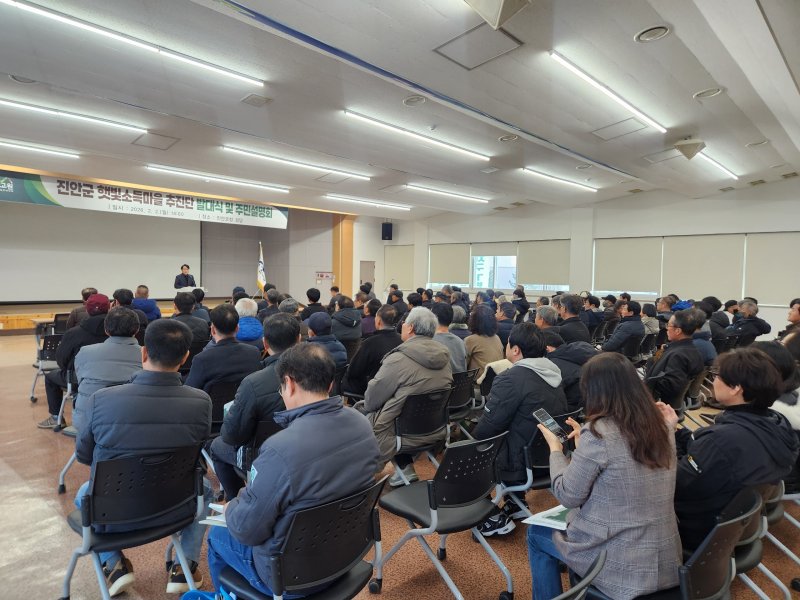
Technological and economic conditions are sufficient
On the question of whether Sunlight Income Villages are feasible, experts are generally positive from a technological and economic standpoint. The most decisive change has been the plunge in solar panel prices. Ten years ago, installing a 1-kilowatt system cost several million won, but now the price has fallen to less than one-fifth of that. Costs can be reduced further through joint purchasing and cooperative models. Prices for Energy Storage Systems (ESS) are also declining, and internet-based remote monitoring technology now makes it possible to manage power plants without specialized staff.
Profitability has also improved markedly. The 'dual effect' of cutting electricity bills through self-consumption while earning cash from surplus power sales has become a reality. In rural areas in the south, where sunlight is abundant, annual power generation can be predicted with relative accuracy, making it a stable source of income. Based on the national average hours of sunlight, the industry estimates that a 1-megawatt (MW) solar plant can generate about 100 million to 150 million won a year. For a village of 100 households, that would mean distributing about 1 million to 1.5 million won per household annually.
The institutional foundation is also in place. Amendments to the Framework Act on Cooperatives and the Electric Utility Act have legally allowed the establishment of village-level Energy Cooperatives. Revenue channels through the FIT and REC markets are open as well. With the government also offering long-term low-interest loans covering up to 85% of solar installation costs and injecting 550 billion won in state funds, the biggest barrier — raising initial capital — has been lowered.
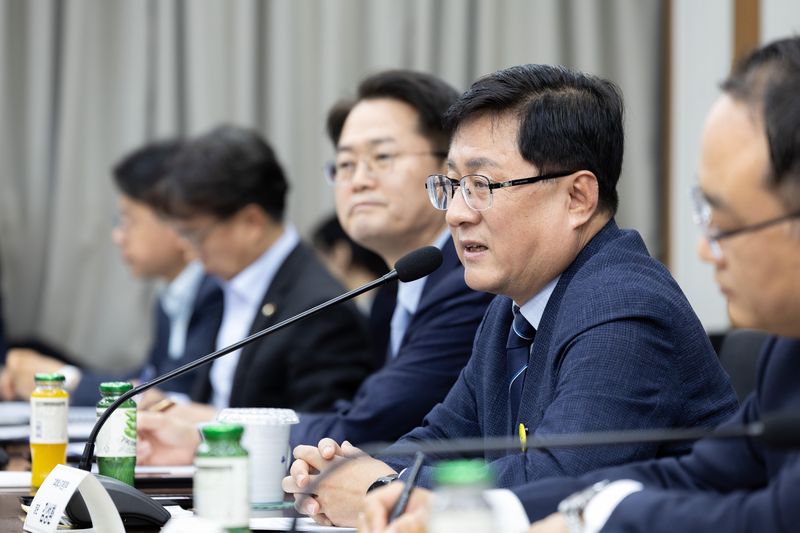
There are also plenty of successful cases at home and abroad
There are already many domestic and overseas examples that support the feasibility of this model. Sinan County, South Jeolla Province, is regarded as the most advanced domestic case. Since 2019, it has operated a Solar profit-sharing system, paying residents part of the power-generation revenue in the form of land lease fees and dividends. At present, 49% of county residents are receiving pensions of up to 3.78 million won per household, and some analysts say this income is helping boost the local population. The sight of elderly residents smiling and saying, 'I get a paycheck at this age,' shows that the energy transition in rural areas is more than just a policy slogan.
Pulmu Energy Self-Sufficient Village in Hongseong, South Chungcheong Province, stands out as a model of durability. For more than 20 years, residents have led the way in producing and managing energy by combining solar power and biomass. Its significance lies in the fact that it is not a short-lived success, but an experiment in self-sufficiency that has continued across two generations. Machim Village in Pocheon, Gyeonggi Province, is also often cited as a case that has generated solar revenue since 2015.
Among overseas examples, the small town of Feldheim in Brandenburg is widely regarded as a global model. With a population of just 145, the village combined solar and wind power to achieve full self-sufficiency in electricity and heating from renewable energy in 2010. As a result, energy costs fell 30% to 40% below those of nearby cities, and the population, once at risk of disappearing, actually grew. Samsø Island in Denmark is another success story, having become a world-famous destination for energy education and tourism by powering the entire island with wind and solar energy.
Grid, community and regulation: three layers of challenges
Even if the technology and economics are in place, the project will not necessarily run smoothly. There are three major challenges on the ground. First is grid congestion. Rural transmission networks lack the capacity to absorb large-scale renewable energy, and there are many cases in which applicants wait years after filing for grid connection. The government has promised priority connections, but in already saturated areas, output restrictions are unavoidable. Critics say it is like 'building a highway but leaving the tollgate jammed so no one can enter.' Community capacity is also crucial. Installing panels is a job for technicians, but operating a cooperative for more than 20 years and distributing profits transparently is a human task. Many projects have collapsed because of profit disputes, land ownership conflicts and complaints about landscape damage. Successful villages in Germany and Denmark all went through two to three years of resident organizing before breaking ground. Ultimately, experts say transparent information sharing, inter-municipal experience sharing and mandatory reinvestment of profits are needed. Regulatory gaps must also be addressed. Under the current Electric Utility Act, peer-to-peer electricity trading between villages is effectively banned, so unless that rule is eased, revenue structures will remain limited. There are also concerns that permitting procedures differ from one local government to another, reducing predictability for projects.
An industry official said, "To raise the chances of success, we need to build a dense ecosystem that supports residents' voluntary organizing capacity, trust at the village level and intermediary support systems." The official added, "If the 2,500-site target by 2030 is pushed forward as a numbers-driven race for speed, many 'flash-in-the-pan villages' could emerge — places that install equipment but fail to build operating capacity and then fall apart over early profit disputes."
"Climate, environment and energy are like two sides of the same coin. Depending on how energy is produced, it can accelerate global warming. Conversely, changes in climate and the environment affect energy demand and supply."[Eco & Energy by Lee You-beom]It visits readers every Saturday with issues in climate, environment and energy, which are inseparable from one another. If you subscribe to the reporter page, you can receive it more conveniently. Due to reporting schedules, we will take a one-week break and return on the June 6 edition.
[email protected] Lee You-beom Reporter