Supreme Court: No Duty to Bargain with HHI Subcontractor Union Without Contract Under Former Union Law
- Input
- 2026-05-21 15:13:56
- Updated
- 2026-05-21 15:13:56
[The Financial News] The Supreme Court of Korea ruled in favor of the parent company in a collective bargaining lawsuit filed by HHI subcontractor union members against the parent company. Although the recently enacted Yellow Envelope Act expanded the scope of employers, the court said that in this case, which is governed by the former law, a labor contract relationship is required for a duty to bargain collectively.
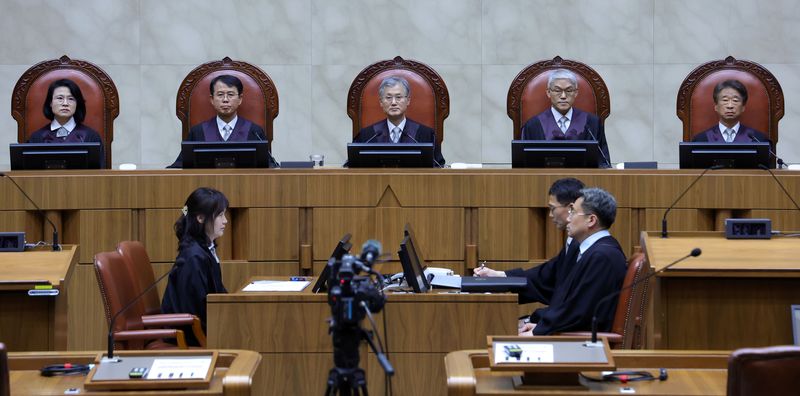
The Supreme Court Grand Bench, presided over by Justice Oh Kyung-mi, made the ruling on the 21st in the final appeal hearing of a collective bargaining suit filed by the Hyundai Heavy Industries Subcontractors Branch of the KMWU against HHI.
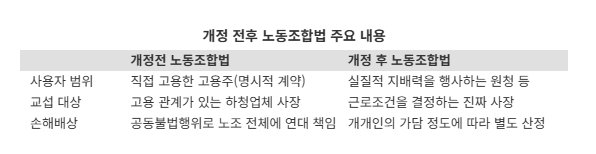
The Supreme Court said that under the revised Trade Union and Labor Relations Adjustment Act, the definition of an employer with a duty to bargain can be expanded to include a parent company that affects the working conditions of subcontracted workers. But under the former law, it held, a parent company has no duty to bargain with subcontracted workers.
The court stated, "The revised Trade Union and Labor Relations Adjustment Act, amended in September 2025, adds a provision that even a person who is not a party to a labor contract may be deemed an employer if they can make substantial and specific control decisions. However, because no transitional provision was established for the new clause, the former Trade Union and Labor Relations Adjustment Act applies to this case."
The lawsuit was filed in 2017 and has dragged on for nearly eight years. The court said that under the former union law framework, an explicit or implied labor contract relationship was essential to recognize employer status. It also said the revised law does not provide for retroactive application to past cases, so the lower court was correct to apply the former law in this case.
By a majority opinion of eight justices, the court established the legal principle that only a parent company with an explicit or implied labor contract relationship has a duty to bargain collectively with a subcontractor union. Four justices — Lee Heung-koo, Oh Kyung-mi, Shin Sook-hee and Ma Yong-ju — dissented.
They argued that even without a labor contract, a company can still be considered an employer if it is in a position to substantially control and determine working conditions, and therefore can be subject to a duty to bargain collectively.
Justice Oh said, "Among the three labor rights guaranteed by the Constitution of the Democratic People's Republic of Korea, the right to collective bargaining is a core right, and the definition of an employer under the former Trade Union and Labor Relations Adjustment Act must be applied consistently." She added, "The Supreme Court has issued rulings that protect workers and their three labor rights in line with changes in the labor environment, and the precedent that a contract is required for an employer to engage in collective bargaining should be changed."
In fact, in March 2010, the Supreme Court had already ruled that a parent company could qualify as an "employer" as the subject of an unfair labor practice. At the time, the court said that a person who is in a position to substantially and specifically control and decide basic working conditions, to the extent that they can be seen as sharing part of the authority and responsibility of the employer that hired the worker, falls under the definition of an employer subject to a remedy order for unfair labor practices if they engage in union control or interference.
In other words, the Supreme Court has now held that while a parent company may be treated as an employer in cases involving unfair labor practices, it cannot be considered an employer with a duty to bargain unless there is an explicit or implied contract. The lower court in this case also found, based on earlier precedents, that the employer as the subject of an unfair labor practice is different from the employer as a party to collective bargaining.
Attorney Park Sang-heum of Woori Deul Law Firm said, "The application of the law has temporal limits, so it is not appropriate to apply the revised Yellow Envelope Act retroactively."
[email protected] Lee Hwan-ju Reporter