Xi Jinping and Putin Meet Right After Trump Departs, Issue Anti-U.S. Joint Statement Saying "Attack on Iran Is Illegal"
- Input
- 2026-05-21 13:33:06
- Updated
- 2026-05-21 13:33:06
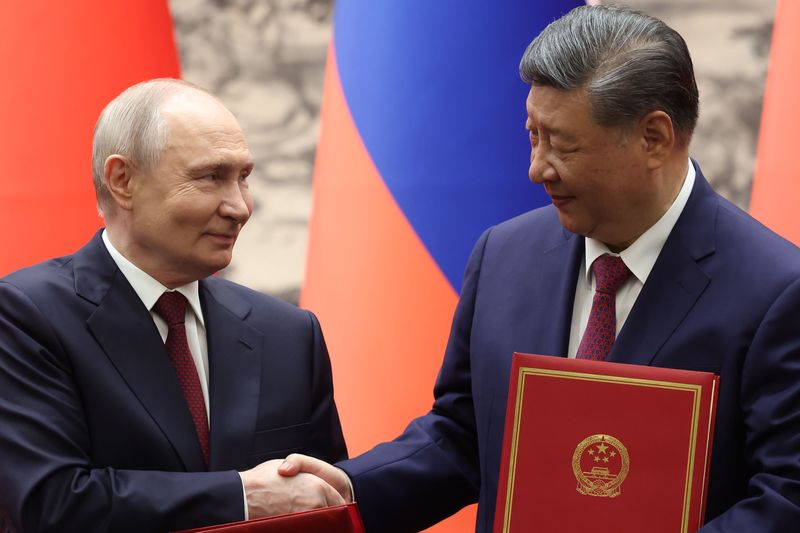
[Financial News] China and Russia jointly condemned the United States' attacks on Iran as a violation of international law. They also reaffirmed their willingness to respond together to issues tied to their strategic interests, including the Russo-Ukrainian war and Japan's rearmament. Just after the U.S.-China summit appeared to find common ground on the Iran nuclear issue and reopening the Strait of Hormuz, China-Russia once again showcased anti-U.S. coordination through a separate joint statement.
In the "China-Russia Joint Statement on Further Strengthening Comprehensive Strategic Coordination and Deepening Good-Neighborly Friendship and Cooperation," signed on the 20th, local time, Xi Jinping and Vladimir Putin said the U.S. and Israeli military strikes on Iran violated international law and the basic principles of international relations.
The joint statement said, "The two countries share the view that the U.S. and Israeli military strikes on Iran violated international law and the basic norms of international relations, and seriously undermined stability in the Middle East."
It added, "The parties to the conflict should return to dialogue and negotiation as soon as possible and prevent the war from expanding further," and urged them to "maintain an objective and fair stance and work to ease tensions."
The joint statement is seen as having a subtle but clear contrast with the recent U.S.-China summit. Earlier, the White House said that U.S. President Donald Trump and Xi agreed during their summit that "Iran must not have nuclear weapons" and also shared the view that the Strait of Hormuz should remain open.
However, the China-Russia Joint Statement issued that day made no direct mention of Iran's nuclear weapons program or the blockade of the Strait of Hormuz. Instead, it contained a series of criticism aimed at the United States.
The two leaders devoted much of the statement to criticizing the U.S.-led security order. It said, "Certain countries are clinging to hegemonism and neo-colonial thinking, further intensifying international competition," and added that "these countries are violating the sovereignty of other states, suppressing economic and scientific and technological development, and placing obstacles in the way of building a multipolar world."
They also indirectly targeted the United States on nuclear issues. The statement claimed that "some nuclear-armed states are seeking absolute security superiority, deploying strategic offensive and defensive weapons around other nuclear-armed states, and recklessly expanding military alliances."
The two countries also strongly criticized moves by the United States and Japan to deploy missiles targeting China. The statement said they would jointly respond to situations in which some nuclear-armed states and their allies deploy medium- and short-range missiles aimed at other nuclear-armed states. It also denounced the U.S. missile defense system, the "Golden Dome," saying it "undermines strategic stability."
The language on Japan was equally sharp. The two leaders said Japan is "accelerating remilitarization and seriously threatening peace and stability in the region." They expressed concern that Japan is stockpiling large amounts of sensitive nuclear material with no civilian use, and noted that right-wing forces in Japan are pushing to revise the country's three non-nuclear principles.
The statement said it opposes "nuclear sharing with allies, the joint implementation of extended deterrence, and attempts to acquire nuclear weapons independently," and added that the Japanese government should faithfully fulfill its obligations under the Treaty on the Non-Proliferation of Nuclear Weapons (NPT).
On the Russo-Ukrainian war, it said the root causes of the Ukraine crisis must be removed and a system of common security and lasting peace must be built. Putin has argued that Ukraine's push to join the North Atlantic Treaty Organization (NATO) and NATO's eastward expansion are the fundamental causes of the war. China has also maintained that NATO expansion has heightened Russia's security concerns.
The statement also said that "individual countries and their allies are undermining the existing security architecture through confrontational policies and rhetoric," adding that "China also takes note of Russia's concerns over the strengthening of the European Union's defense capabilities."
[email protected] Kim Kyung-min Reporter