"Should We Sign Now or Wait?" European Companies Face an Energy Dilemma
- Input
- 2026-05-21 10:53:58
- Updated
- 2026-05-21 10:53:58
Forty-one European green and energy companies backed by the European Union (EU) visited South Korea. At the EU Business Hub - ENVEX 2026, held from the 20th to the 22nd at COEX Convention & Exhibition Center in Seoul, European companies with technologies in energy transition, batteries, waste treatment and carbon reduction sought opportunities to enter the Korean market and expand business cooperation. On the 20th, this paper met with representatives from four of them — AI energy solutions company Companion Energy, sodium battery technology company Broadbit Batteries, biomass solutions company Haffner Energy and medical waste treatment technology company EcoSteril — to hear their views on changes in the global energy and environmental markets.
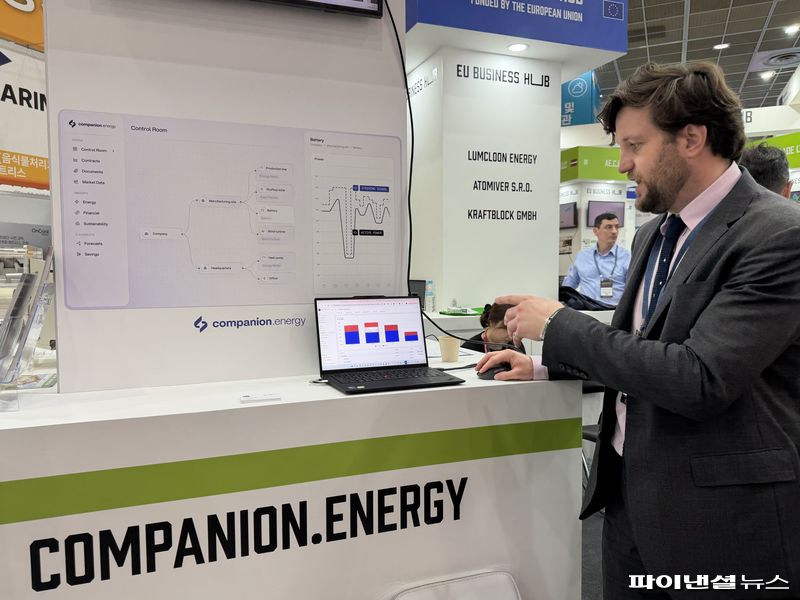
In an interview with this paper on the 20th, Jack Eastwood, business director at Companion Energy, said that "European manufacturers now bear the risk of energy price volatility directly, unlike in the past." He added that the ability to optimize when electricity is used is now directly tied to manufacturing competitiveness. The following is the interview.
"Adjusting even the timing of electricity use" ... Cutting energy costs with AI
―What is your core business?▲Companion Energy is an AI-based energy cost optimization software company. It integrates and analyzes energy consumption data, market prices and contract data to help companies use electricity at the most efficient times.
For example, when solar power generation is high during the day, companies can charge batteries and concentrate production activities. Conversely, when electricity prices spike, they can reduce consumption. Refrigeration and air-conditioning systems can also be run in advance when power is cheaper, then scaled back during peak hours.
―How much cost reduction can actually be expected?
▲In general, we expect energy cost savings of around 5% to 20%. We aim for returns worth five to 10 times the license fee paid by customers.
"European manufacturers now bear energy volatility directly"
―What has changed the most in the European energy market since the war in Ukraine?▲There have been two major changes. The first is the expansion of renewable energy. As solar and wind power generation has increased, output volatility has grown, while electrification has also pushed up electricity demand. However, Europe’s power grid is quite outdated, making price swings and bottlenecks more severe.
The second is a change in contract structures. During the 2022-2023 energy crisis, many suppliers suffered losses or went bankrupt. Since then, suppliers have expanded variable-price contracts instead of fixed-price ones as before. In the end, price volatility has shifted to manufacturers and consumers.
―What impact are the recent war in the Middle East and the Strait of Hormuz risks having?
▲The war in Ukraine was a long-term, sustained crisis. After the initial shock, the market was able to price it in to some extent.
By contrast, the current Middle East risks come with a much higher level of uncertainty. Statements by President of the United States Donald Trump keep changing, and the market finds it difficult to judge which remarks reflect the actual situation. In the end, that uncertainty increases price volatility even further.
In particular, companies are struggling to decide whether they should sign contracts now to hedge against future price swings or wait for prices to fall later.
―If the Middle East crisis drags on, could the market eventually adapt?
▲The key is the "uncertainty premium." At present, it is difficult to predict future prices, so a high premium is added on top of energy prices. On the other hand, if the market becomes certain that the war will last for three years, the uncertainty premium will shrink even if prices themselves remain high. That is because companies will be able to forecast future costs and build response strategies.
AI is both an energy hog and a solution ... the green transition is essential
―With power demand surging due to the expansion of AI data centers, do you still think a green transition is possible?▲The energy transition is still absolutely necessary. People often see it only as a cost, but it is also a new investment opportunity and an industrial opportunity.
Of course, AI and data centers consume enormous amounts of electricity. But AI can also become a tool for improving grid efficiency. For example, AI analysis can be used to reduce the operation of refrigeration and air-conditioning systems during periods of heavy demand, while concentrating battery charging or production activities during times of high solar output. It is also possible to build data centers in regions with abundant solar and wind resources or high cooling efficiency.
―Some argue that the green transition could increase the burden on low-income households.
▲That is why a "Just Transition" is important. Climate action is necessary, but low-income households and energy-poor groups should not bear the entire burden. The government and society must create support structures. What matters is that the energy transition and social protection must happen at the same time.
―Why is the energy transition necessary in the long run?
▲Because the cost of doing nothing is likely to be much greater. Wildfires, extreme weather, reconstruction costs and climate migration will continue to grow. It may look like a cost now, but 20 years from now, the price of failing to act today could come back far more heavily.
[email protected] Hong Chaewan Reporter