"Before Taxes Are Even Taken Out, the Union Wants Its Share?" Samsung Electronics Opens a Pandora's Box with 'N% Performance Pay'
- Input
- 2026-05-21 08:18:34
- Updated
- 2026-05-21 08:18:34
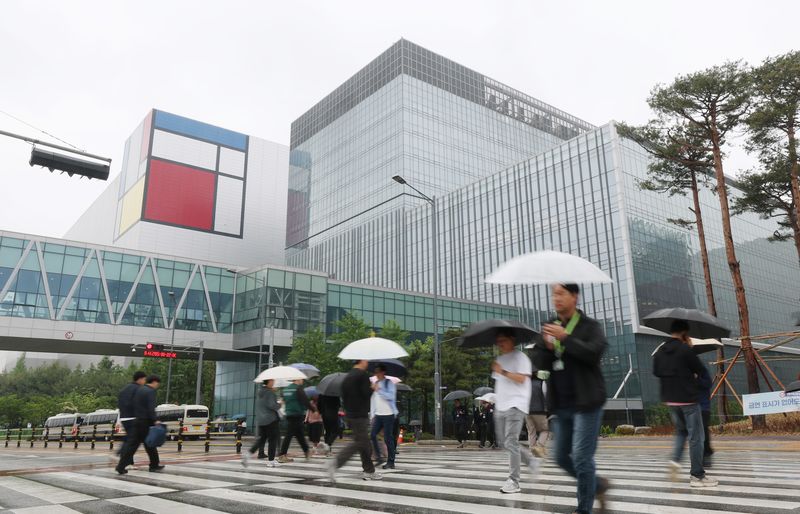
[Financial News] Samsung Electronics and its labor union narrowly avoided a major crisis after reaching a dramatic tentative agreement on the performance pay formula just about an hour before a general strike was set to begin. However, the union has set a precedent by using the threat of a strike to codify a performance bonus equal to a fixed percentage of business results, raising concerns that this summer's wage and collective bargaining battles could spread like wildfire across the industrial sector.
According to the Ministry of Employment and Labor (MOEL) on the 21st, Samsung Electronics and its union reached the tentative agreement through voluntary negotiations held the previous evening at the Gyeonggi Regional Employment and Labor Office, arranged by MOEL Minister Kim Young-hoon. The union decided to suspend the general strike scheduled for that day and hold a vote among members from the 22nd to the 27th.
The key issue, the performance pay structure, was settled as conditional stock compensation that largely reflected the union's demands. Under the agreement, the two sides codified the special management performance bonus pool at 10.5% of business results. However, the payout is not automatic. It will be granted only if the Device Solutions division posts operating profit of 20 trillion won from 2026 to 2028, and 10 trillion won from 2029 to 2035.
The payment will be made entirely in company stock after taxes, with restrictions on selling it immediately, after one year, and after two years. The performance pay applies only to the Device Solutions division, while the DX (Device eXperience) Division and the CSS Business Team will receive company stock worth 6 million won separately.
"Critics say the agreement undermines the basic principles of capitalism and market economics"
Although the labor dispute has been settled for now, markets and academia are voicing strong criticism that the agreement undermines the basic principles of capitalism and market economics. They argue that it makes no sense for workers, through the institutionalization of performance pay, to take what should be the 'residual claim' belonging to shareholders who bear the risk.
President Lee Jae Myung also unusually weighed in with criticism. He said, "The essence is that investors who bear the risks and losses naturally have the right to share in the profits," adding, "The government also contributes to companies through tax breaks and infrastructure support, but it is something even investors cannot do for a union to take a fixed share of operating profit before taxes are even deducted."
Legal and academic experts also expressed serious concern, saying that if management judgment by the board is distorted through coercion, directors could face liability for breach of trust. Some Samsung Electronics shareholders have already warned of a lawsuit, claiming the agreement violates the principle of capital maintenance.
A catalyst for labor disputes at other major companies in the industrial sector... fears of a domino effect
The biggest concern in business circles is that Samsung Electronics' agreement could serve as a justification for labor disputes at other major companies, triggering a domino effect. Across the industrial sector, demands for profit sharing at unprecedented levels are already pouring in.
Hyundai Motor Company's union has already included a demand for a performance bonus equal to 30% of last year's net profit in this year's wage and collective bargaining proposal. The total amount would exceed 3 trillion won, a massive sum. After hearing of Samsung Electronics' dramatic settlement, the Hyundai union is likely to take an even harder line in future pressure on management.
The shipbuilding industry, which has broken out of a long slump and is now seeing a turnaround in earnings, is no exception. Unions at HD Hyundai Heavy Industries and HD Hyundai Samho Co., Ltd. have demanded performance sharing equivalent to 30% of operating profit, while the union at Hanwha Ocean is also strongly pushing for a complete overhaul of performance bonus standards and escalating the dispute.
Adding to the tension are protests from subcontractor and affiliate unions, pushing the sense of crisis in the industrial sector to its peak. With the recent implementation of the Yellow Envelope Act broadly recognizing the responsibility of parent companies as employers, subcontractor unions at companies such as HD Hyundai Heavy Industries and Hanwha Ocean are preparing labor disputes while demanding performance bonuses on the same level as the parent companies, raising fears that the situation could spiral out of control.
In response, the Korea Enterprises Federation (KEF) said, "This agreement reflects Samsung Electronics' unique circumstances, so it should not be generalized across the industry."
Experts say the outdated practice of reaching agreements only at the last minute before a strike must be fundamentally reformed. They are also calling for the introduction of an external mediation body that can help resolve conflicts in advance.
[email protected] Moon Young-jin Reporter