"Reward Where There Is Performance"... Samsung Chooses Its 70-Year Management Principle [Final Round of Samsung Electronics Labor-Management Talks]
- Input
- 2026-05-20 18:22:13
- Updated
- 2026-05-20 18:22:13

"The principle that there must be reward where there is performance must be applied thoroughly. Those who do well should be given wings, while those who fall behind should be kept on edge so that the organization can stay alive and move." (Remarks by the late Samsung Chairman Lee Kun-hee during the 1993 Frankfurt Declaration)
Samsung Electronics said on the morning of the 20th that, during the second post-mediation meeting of the National Labor Relations Commission, which lasted three days, it had reached substantial agreement with the union on the size and institutionalization of performance bonuses. However, it said there was "one issue on which compromise was impossible." That issue was whether it was appropriate to pay employees in the loss-making System LSI and Foundry divisions performance bonuses estimated at 300 million won to 400 million won per person over three to five years simply because they belong to the semiconductor division, known as the Device Solutions Division (DS Division). Samsung also cited the fact that the Mobile Division under the Device eXperience Division (DX Division), the other half of the company, had remained profitable but was still completely excluded from the discussion of this special bonus worth hundreds of millions of won.
■ "If the principle is abandoned, it could affect other companies"
Samsung Electronics revived on the day the 70-year management principle inherited from founder Lee Byung-chul and the late Chairman Lee Kun-hee: "There is reward where there is performance." In a statement, the company made clear that accepting the union's proposal and the National Labor Relations Commission's mediation plan would "directly violate the management principle of performance-linked compensation." It also stressed that it had concluded that "abandoning this principle could have a negative impact not only on Samsung Electronics, but also on other companies and industries."
Samsung Electronics was not simply clinging to principle in this negotiation. To prevent a strike by the semiconductor union, which could cause damages of up to 100 trillion won, the company proposed paying substantial performance bonuses even to the loss-making System LSI and Foundry divisions. However, the gap with the union's demands and the mediation plan was reportedly wide.
A Samsung Electronics official said, "Despite concerns that it would go against the management principle passed down from our predecessors, we already proposed performance bonuses even for the loss-making System LSI and Foundry divisions. In particular, for the Memory Business, we said we would pay more than SK hynix if it ranked first, but the level of demand for the loss-making divisions itself was extremely excessive."
■ "You sell phones, but only semiconductors get allocated?"
The union demanded that the performance bonus pool be split between a common payout for all semiconductor divisions and differentiated payouts by business unit, with 70% for the entire semiconductor division and 30% for each business unit. In response, management proposed 40% for the semiconductor division and 60% for business units, seeking to increase the share going to the Memory Business, which has driven the earnings boom.
Inside Samsung, there was reportedly deep concern over whether to uphold the performance-based principle under pressure from a general strike. Another variable was labor conflict between the DX Division and the DS Division, the company's two main pillars. In particular, tensions are intensifying between employees in the Memory Business, employees in the loss-making System LSI and Foundry divisions, and employees in the DX Division, who were completely excluded from the bonus negotiations. Resistance is spreading across the company, with some asking, "Why should the money earned by the Memory Business be shared with loss-making divisions?" and others saying, "We used to sell smartphones to help grow semiconductors, but now they want to distribute memory profits to loss-making divisions."
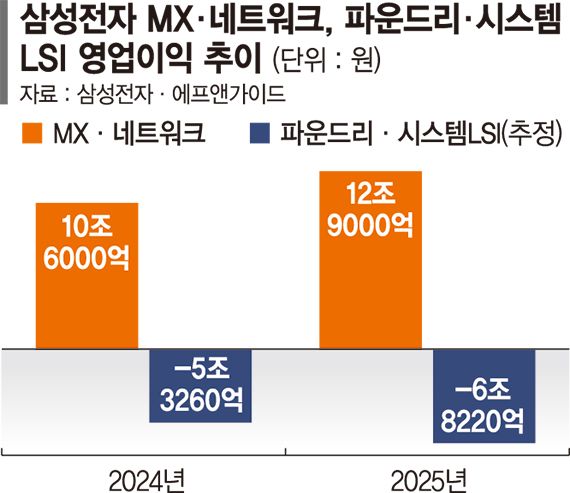
The MX and Network divisions posted an operating profit of 12.9 trillion won last year, improving profitability by about 2.3 trillion won from 10.6 trillion won the previous year.
By contrast, the Foundry and System LSI divisions did not disclose their results, but they are estimated to have posted an operating loss of 6.822 trillion won over the same period. That is 1.496 trillion won worse than the estimated operating loss of 5.326 trillion won in 2024. The gap in profit and loss between the non-memory division and the MX and Network divisions widened from 15.926 trillion won in 2024 to 19.722 trillion won in 2025. While the MX Division, led by Samsung Galaxy smartphones, generated profits in the trillions of won, Foundry and System LSI, burdened by advanced-process investment and customer acquisition costs, remained stuck in the red.
ehcho@fnnews.com Jo Eun-hyo, Im Su-bin, Jeong Won-il Reporter