"Emergency arbitration is the last resort": Government steps in until the final moment [Samsung Electronics labor-management final showdown]
- Input
- 2026-05-20 18:20:44
- Updated
- 2026-05-20 18:20:44
■ Government reviews its de facto final option
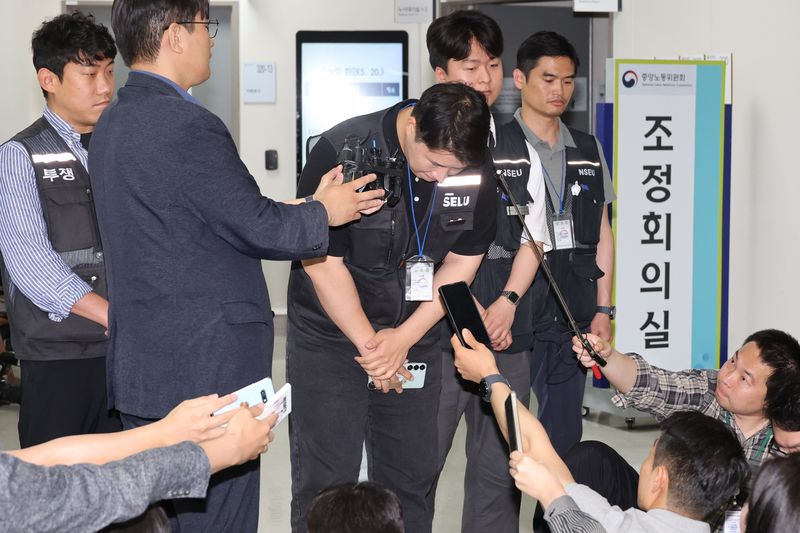
After the second round of post-dispute mediation collapsed earlier in the day, Samsung Electronics and the union resumed voluntary talks at 4 p.m. at the Gyeonggi District Employment and Labor Office.
Kim Young-hoon, the labor minister, took part in the negotiations directly. With just one day left before the planned general strike, this was effectively the final showdown. Since the government has mobilized all possible mediation measures, including post-dispute mediation and support for voluntary talks, the likelihood of emergency arbitration will rise sharply if this round also ends in failure.
Kim, who holds the authority to invoke emergency arbitration, is still maintaining a cautious stance. After the second post-dispute mediation collapsed, MOEL said, "There is still time for dialogue," and added, "It is too early to mention emergency arbitration."
Still, observers say that if the general strike becomes a reality, the government will have few practical options left beyond emergency arbitration. At a Cabinet meeting that day, President Lee Jae Myung said, "Ultimately, the responsibility for all this mediation lies with the government," and added, "When the situation crosses the line, the government must fulfill its given responsibility for the sake of the entire social community." Labor circles and others are interpreting this as a message that the government could intervene more forcefully if the union pushes ahead with a general strike alongside excessive demands.
Emergency arbitration is a system under which the government intervenes to halt a strike and refer the dispute to compulsory arbitration when voluntary labor-management negotiations break down and the strike is likely to have a serious impact on the national economy. The last actual invocation was after the Korean Air (KAL) pilots' union strike in 2005. If it is invoked this time, it would be the first such case in 21 years and the fifth in history.
■ Bonus dispute remains the stumbling block
Whether the negotiations will be settled remains uncertain. The labor-management dispute over bonuses has been the key issue that has defied a solution throughout the six-month bargaining process since last December.
The union has demanded the abolition of the bonus cap and asked that a fixed percentage of operating profit be used as the bonus pool. The company, meanwhile, is leaving open the possibility of additional compensation for the memory division, but it is holding firm on keeping the existing bonus system, which it says can be operated flexibly in line with changes in business conditions and the broader management environment.
After their first meeting in December last year, the two sides entered the process of securing the right to strike in February, about two months later, when the union declared the talks deadlocked and filed for mediation with the National Labor Relations Commission. As strike pressure intensified, the bargaining table was set again that same month, but talks were suspended once more after the two sides failed to find common ground on revising the bonus system.
In particular, as union membership surged, especially in the Samsung Electronics Device Solutions Division, which handles the semiconductor business, the enterprise-level union declared in April that it had launched the company's first official majority union. Since then, from the announcement of a general strike to the first and second rounds of post-dispute mediation and the voluntary talks held that day, the bonus issue has remained the main obstacle at every stage of negotiations.
jhyuk@fnnews.com Kim Jun-hyeok, Jeong Won-il Reporter