Is the New York Stock Exchange's Party Coming to an End? Wall Street Floods the Market with Downside Warnings
- Input
- 2026-05-20 18:14:55
- Updated
- 2026-05-20 18:14:55
Vincent Mortier, chief investment officer at Amundi, told the Financial Times (FT), "We will see a correction," adding, "The question is not whether it will happen, but when." He warned that "within six weeks, the narrative, outlook and investment behavior in the stock market will change completely." Mortier said bond investors are already worried that a closure of the Strait of Hormuz could send prices soaring across the board, from diesel to gasoline and jet fuel, while the stock market has yet to fully recognize that risk.
Raphael Touin of Tikehau Capital also said that a stock market that keeps setting all-time highs cannot coexist with a tight credit market, high interest rates and the economic shock from higher oil prices. Touin said, "It is time for the market rally to hit its limit and pause for a while." BofA said on the same day that profit-taking could emerge in early June, adding that the scale of stock selling would depend on the selling pressure in the bond market. The bank said this based on an analysis of portfolio allocations in its survey.
Mandy Zhu of the Chicago Board Options Exchange (Cboe) said trading in single-stock options is reminiscent of the meme-stock bubble in 2021. Zhu also expressed concern that the sharp rise in government bond yields has not yet curbed extreme bullish positioning in equities.
U.S. 10-year Treasury yield at 5%, oil at $115 seen as tipping point
Analysts say the tipping point that could bring the NYSE bull market to an end would be a 5% yield on the U.S. 10-year Treasury note, the benchmark for market interest rates, and international oil prices at $115 per barrel. 22V Research, known for its technical analysis, warned on the 19th local time that this threshold is not far away and that investors should proceed with caution.
According to CNBC, Denis Duboucher, chief market strategist at 22V Research, said in a research note that the conclusion came from a survey of investors. Investors said that crossing this threshold would trigger "demand destruction" and bring the NYSE bull market to an end. They also said that if U.S. Gross Domestic Product (GDP) growth stays below 1% for several quarters, that would also be considered a tipping point for the end of the bull market.
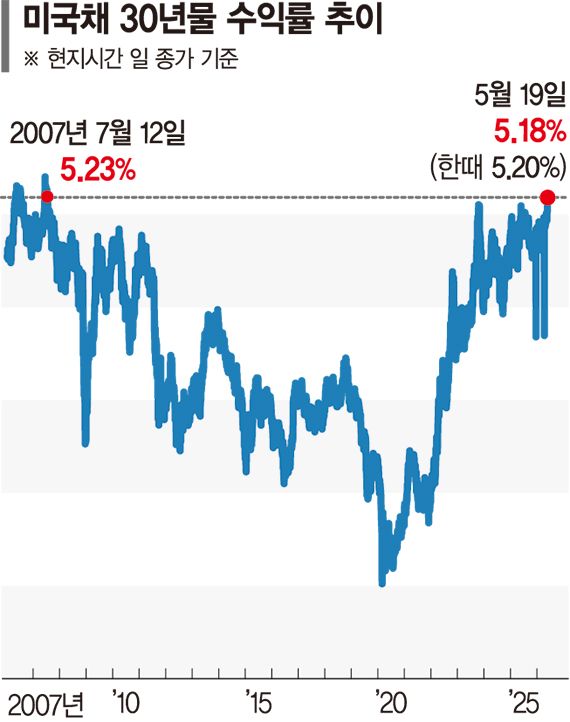
The yield on the U.S. 30-year Treasury bond at one point jumped 7 basis points, or 0.07 percentage point, to 5.20% on the day. That was the highest level in 19 years, since July 2007, just before the Global Financial Crisis (GFC). The benchmark 10-year U.S. Treasury note also rose as much as 10 basis points to 4.69%, its highest level since January 2025. The 10-year yield has kept rising after breaking through the 4.5% level on the 15th, a line widely seen as a strong psychological resistance point.
Long-term Japanese government bond and UK government bond (gilt) yields are also moving higher. On the 18th, the 10-year Japanese government bond yield rose to 2.8%, reaching its highest level in about 30 years. On the same day, the 10-year UK government bond (gilt) yield climbed to 5.18%, marking its highest level in decades.
Inflation is the key variable for the stock market
Will McGuff, chief investment officer at Prime Capital, said, "The Bond Vigilantes are moving." The term refers to investors who sell government bonds in protest against fiscal or monetary policies that could fuel inflation.
Peter Oppenheimer, Goldman Sachs' head of global equity strategy, said inflation is the key variable for the stock market going forward. If inflation overheats, equities could quickly turn into a sharp selloff. He warned that the surge in government bond yields, driven by inflation concerns, is a "meaningful risk" for stocks. He said the market is currently being supported by strong earnings, but if growth and inflation are hit, the trend could reverse almost instantly.
He added that the telecommunications, media and technology sectors account for 85% of the S&P 500 Index's gains this year, and said inflation that hurts the outlook for those sectors will be a key factor shaping the market ahead.
[email protected] Song Kyung-jae Reporter