"Union-Linked Performance Pay Based on Operating Profit Is an Illegal Dividend": Samsung Electronics Shareholder Group Pushes Back
- Input
- 2026-05-20 17:20:33
- Updated
- 2026-05-20 17:20:33
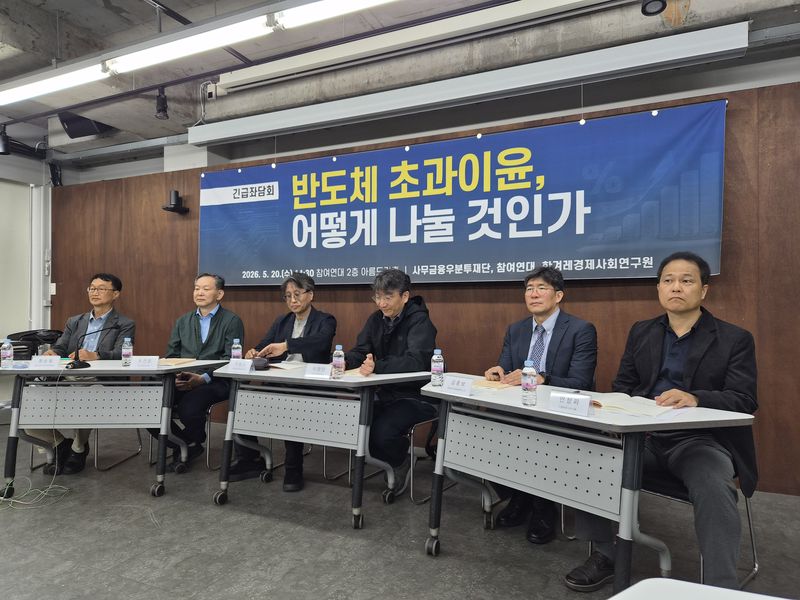
At a roundtable held on the 20th at Neutinamu Hall in People's Solidarity for Participatory Democracy in Jongno District, Seoul, Lee Chang-gon, chairman of the Sahoeum Finance Ubuntu Foundation, said, "Performance pay linked to operating profit margins is intuitive, but in capital-intensive industries it has a limitation because it does not reflect the cost of capital." He added, "If operating profit rises as a result of building facilities with tens of trillions of won in capital investment, it is difficult to view that solely as an achievement from workers' efforts."
Concerns were also raised about a structure in which performance pay is directly tied to external variables such as expanded AI investment. He pointed out, "Changes in the external environment, such as NVIDIA's increased AI investment, affect operating profit growth, which means compensation is being linked to variables employees cannot control."
Industry officials said the core of the dispute lies in the structure itself, in which excess profits generated by the AI semiconductor boom are concentrated among specific stakeholders. They argued that, since the semiconductor industry has grown on the basis of state fiscal support and tax incentives, there is a need to discuss social distribution of those excess gains.
In response, civil society proposed returning part of semiconductor windfall profits to the national economy by raising the effective corporate tax rate, among other measures. Kim Jong-bo, head of the Economic and Financial Center at People's Solidarity for Participatory Democracy, said, "Since public finances are directly invested in the semiconductor industry and various tax benefits are provided, strengthening taxation on excess profits is something that can be discussed sufficiently." He added, "Legal grounds must be established in line with the principle of no taxation without law."
There were also calls to view the distribution of excess profits as an issue that extends beyond the semiconductor industry to the broader industrial ecosystem. Ahn Jeong-hwa, head of Labor Forum Namu, said, "This issue became a social topic precisely because it is not just a matter between labor and management in the semiconductor sector." She added, "Any alternative also needs to be prepared at the level of the entire industry."
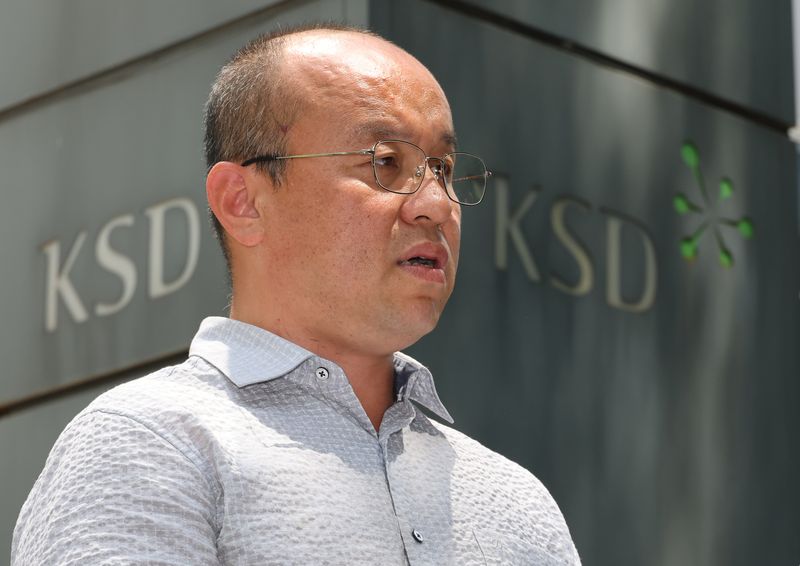
In a statement released that day, the Shareholder Movement Headquarters of the Republic of Korea argued, "A method that uniformly distributes a fixed percentage of operating profit at the pre-tax profit stage bypasses the dividend-available profit calculation structure and shareholder meeting procedures set out in Article 462 of the Commercial Act." It added, "This could amount to a disguised illegal dividend that infringes on shareholders' interests."
The group explained that Samsung Electronics' existing Economic Value Added (EVA) system is based on "residual excess profit" calculated by subtracting the cost of capital from after-tax profit, and therefore does not conflict with the Commercial Act's principle of capital maintenance. It also stressed that a uniform distribution based on operating profit is legally different from the existing EVA system because it would send out profits before interest expenses, corporate tax, and statutory reserves are reflected.
The Shareholder Movement Headquarters also said it plans to hold a rally on the 21st in the Yongsan District area of Seoul to protest what it described as violations of Samsung Electronics shareholders' rights and to respond to the illegal union strike.
Meanwhile, the second post-facto mediation session between Samsung Electronics and labor on the morning of the same day ended without a conclusion, but negotiations are scheduled to resume at 4 p.m. under the chairmanship of Kim Young-hoon, Minister of Employment and Labor.
[email protected] Lee Dong-hyeok Reporter