Producer prices post the sharpest jump in 28 years on Middle East shock... What about May?
- Input
- 2026-05-21 06:00:00
- Updated
- 2026-05-21 06:00:00

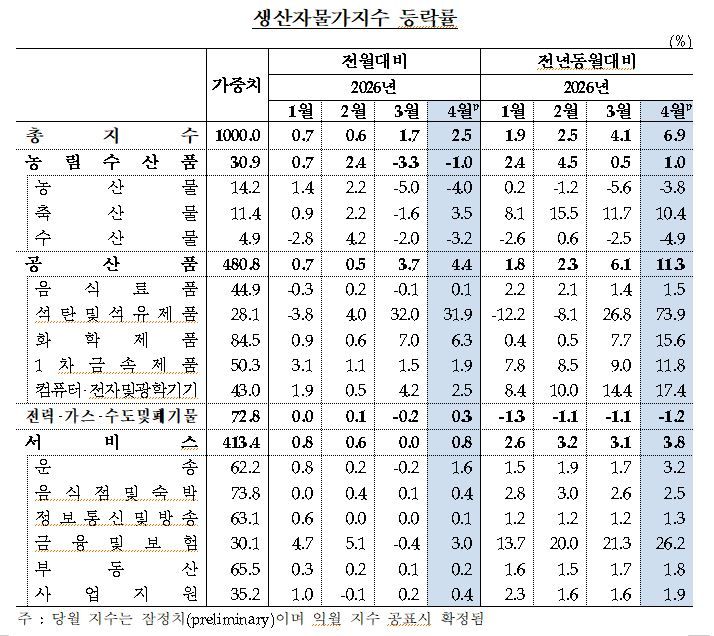
According to the Bank of Korea (BOK) on the 21st, the Producer Price Index rose 2.5% in April from the previous month. That was 0.8 percentage points higher than March's gain of 1.7%, marking eight consecutive months of increases since September last year, when it rose 0.4%. It was the highest level since February 1998, when it also rose 2.5%, and the biggest increase in 28 years and two months.
Compared with the same month a year earlier, it rose 6.9%, the highest since October 2022, when it climbed 7.3%, and the strongest in three years and six months.
Agricultural, forestry and fishery products fell 1.0% over the period, as gains in livestock products (3.5%) were offset by declines in farm products (-4.0%) and fishery products (-3.2%). The drop was smaller than in the previous month, when it fell 3.3%. Industrial products rose 4.4% from a month earlier, driven by coal and petroleum products (31.9%), chemical products (6.3%), and computers, electronic and optical equipment (2.5%). That was 0.7 percentage points higher than the previous month's increase of 3.7%.
In particular, the increase in coal and petroleum products was similar to the previous month, when it reached 32.0%, the highest level in 28 years and three months since December 1997, when it surged 57.7%.
Electricity, gas, water and waste rose 0.3% on the back of industrial city gas, which increased 3.9%. Services climbed 0.8% from the previous month, led by transportation services (1.6%) and financial and insurance services (3.0%).
Moon-hee Lee, head of the Price Statistics Team at the BOK's Economic Statistics Department 1, explained, "The rise in Naphtha prices, which had surged sharply in March, slowed in April, but the upward trend in gasoline and Diesel continued, and jet fuel jumped significantly, so the overall rate of increase was similar."
Lee added, "For May, international oil prices and the won–dollar exchange rate fell somewhat on average, but supply disruptions in raw materials are expected to feed through to various sectors with a time lag, creating upward pressure. At this point, it is difficult to predict the direction of fluctuations."
The Producer Price Index is a statistic that shows changes in the prices of goods and services supplied by domestic producers to the local market. It is used as an indicator of economic trends and as a GDP deflator, among other measures. However, because it measures price changes, it does not show absolute levels.
Looking at special classifications beyond the five main categories, food prices fell 0.4% from the previous month and fresh food prices dropped 5.7%. Energy rose 7.9%, while information technology increased 1.2%. Excluding food and energy, prices climbed 2.2%.
On the impact on consumer prices, Lee said, "It will act as an upward factor, but the extent and timing of the ripple effects from changes in raw material and intermediate goods prices are also influenced by market demand and government policy, so uncertainty remains high."
The Domestic Supply Price Index is calculated to more comprehensively track price changes in goods and services supplied domestically by combining items produced and shipped within the country with goods and services produced overseas and imported into the country.
The Gross Output Price Index rose 3.9% from the previous month, driven by industrial products, which jumped 5.8% as exports (7.9%) and domestic shipments (4.4%) both increased, even though agricultural, forestry and fishery products fell 0.8%. It has been rising for 10 straight months since July last year, when it increased 0.5%. Compared with the same month a year earlier, it was up 13.8%.
The Gross Output Price Index is calculated by combining the Producer Price Index and the export price index to gauge overall price changes in domestically produced goods, including those exported overseas.
[email protected] Kim Tae-il Reporter