Foreign Investors Haven't Left the Korean Stock Market, Betting on a Korea Re-Rating
- Input
- 2026-05-21 06:00:00
- Updated
- 2026-05-21 06:00:00
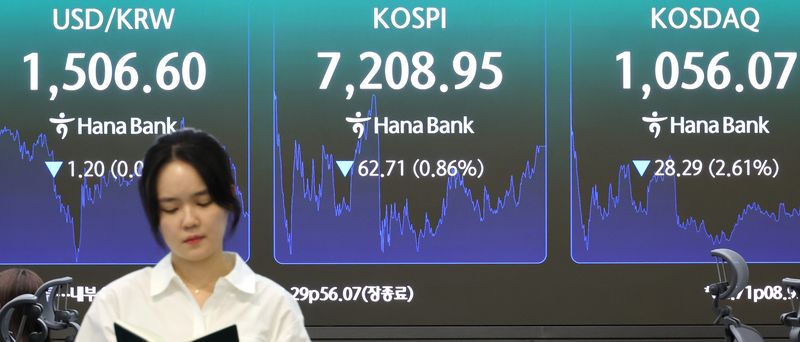
[Financial News] Foreign investors have net sold about 94.0772 trillion won worth of domestic stocks so far this year, based on the closing price on the 20th. Even so, foreign ownership in the Korean stock market has surged to an all-time high. Analysts say this suggests global funds are not simply taking profits, but are slowing their selling as they expand their exposure to Korea.
According to the financial investment industry on the 21st, foreign ownership in the KOSPI stood at 38.5% as of the previous day, the highest level on record. The market value of foreign holdings reached 2,224 trillion won, exceeding 38% of the KOSPI's total market capitalization of 5,777 trillion won.
Lee Kyung-soo, a researcher at Hana Securities, said, "Foreign investors have net sold more than 90 trillion won this year, but their ownership ratio continues to rise," adding, "This should be interpreted as a trend that allows for a larger weighting in Korean stocks."
Analysts estimate that if foreign investors had tried to maintain only their early-year ownership level of 36%, their net selling this year would have had to reach around 230 trillion won. Since the actual amount is far below that level, it is difficult to view the move as a simple exit from the Korean market.
This is different from the pattern seen during the COVID-19 pandemic. Since March 2020, foreign investors net sold 44 trillion won, and their ownership ratio fell from 37.7% to 31.4%. This time, however, the ownership ratio is rising despite the net selling.
The securities industry sees the Morgan Stanley Capital International (MSCI) event as the biggest variable for foreign fund flows. In its May review, MSCI sharply raised Korea's weighting in the MSCI Emerging Markets Index from 15.4% to 21.7%, narrowing the gap with China, which stands at 22.0%. As a result, passive funds worth about 140 billion won are expected to flow in based on the closing price on the 29th.
Market expectations are also rising ahead of the MSCI World Index Watchlist announcement scheduled for June. Hana Securities projected that Korea's chances of being added to the Watchlist are above 60%.
Lee said, "MSCI's decisions place more weight on investor surveys and assessments of reform commitment than on quantitative criteria," adding, "There have been cases where a specific and irreversible timetable alone was enough for Watchlist inclusion, even without full implementation."
Other positive factors include the government's push to liberalize the Forex market, launch a 24-hour Forex market, normalize short selling, and expand English disclosure. In particular, short selling was one of MSCI's key negative assessments last year, but this year it has been viewed as an issue that has effectively been resolved.
An industry source said, "The market is paying attention to the possibility that expectations for MSCI World Index inclusion could go beyond a simple improvement in supply and demand and lead to a narrowing of the Korea Discount and a re-rating of the stock market," adding, "The fact that foreign ownership is rising despite net selling shows that the trend of global funds increasing their exposure to Korea is continuing."
[email protected] Choi Du-seon Reporter