"Are Those Flies Dancing in Front of Your Eyes a Warning Sign of Blindness?" One Week After Discovery Is the Golden Time [What Disease Is This?]
- Input
- 2026-05-20 19:00:00
- Updated
- 2026-05-20 19:00:00

[Financial News]"At first, I thought the dust-like specks floating in front of my eyes were just something that comes with age. But at some point, one eye started to look dark, as if a shadow had fallen over it."Lee, 63, a homemaker, had been bothered for months by black specks drifting in front of her eyes. She dismissed them as worsening presbyopia or simple fatigue. But her symptoms gradually worsened, with flashes of light in a dark room and a black curtain-like shadow covering the outer field of vision in one eye.
When the black spots blocking her vision increased to the point that she could barely read a newspaper, Lee went to the hospital and was diagnosed with retinal detachment. By then, she had already missed the early treatment window, and a large portion of the retina had separated.
\r\n
Retinal detachment is an emergency that can cause blindness
\r\n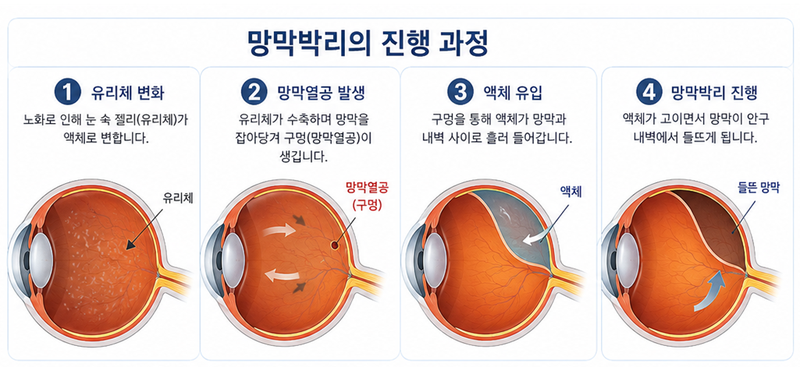
The retina is the nerve tissue attached to the innermost layer of the eye that receives light. It acts like the camera's film.Retinal detachment is the condition in which this tissue lifts away from the inner wall of the eye, much like wallpaper peeling off a wall.Once the retina detaches, the supply of nutrients to the photoreceptor cells is completely cut off. If left untreated, it can eventually lead to blindness.
In most cases, retinal detachment begins with a retinal tear, where a hole forms in the retina. As the jelly-like vitreous humor inside the eye changes into a liquid with age, it pulls on the retina, creates a tear, and fluid then seeps through the opening, causing the retina to lift away.
\r\n
It is not only aging that causes it... Even people in their 20s and 30s with high myopia are at risk
\r\n\r\n

Since aging is the most decisive factor behind changes in the vitreous humor,retinal detachment is classified as a representative degenerative disease.
According to statistics from the Health Insurance Review & Assessment Service (HIRA), about 118,000 patients received treatment for retinal detachment in 2024. People in their 50s accounted for 26,800 cases, or 24.2 percent, ranking first, followed by those in their 60s with 26,500 cases, or 23.9 percent.
One notable point isthat the incidence among people in their 20s is significantly high. Patients in their 20s made up 13.1 percent of the total, surpassing those in their 30s at 10.4 percent and coming close to the share of patients in their 40s, when aging begins to accelerate, at 13.7 percent.
The reason is none other than myopia. The more severe the myopia, the longer the eye becomes from front to back. As a result, the retina lining the inside of the eye is stretched tighter and becomes thinner to its limit. A thinned retina can tear or develop holes easily from even minor impact or changes in the vitreous humor, which can lead to retinal detachment.
Other known risk factors include eye trauma, the habit of rubbing the eyes hard and frequently, and eye surgeries such as LASIK, LASEK, and cataract surgery.
\r\n
Flies, flashes, black curtains... 'You should suspect it if you have these symptoms'
\r\n
Retinal detachment does not strike as if vision suddenly disappears one day. There are three major warning signs.
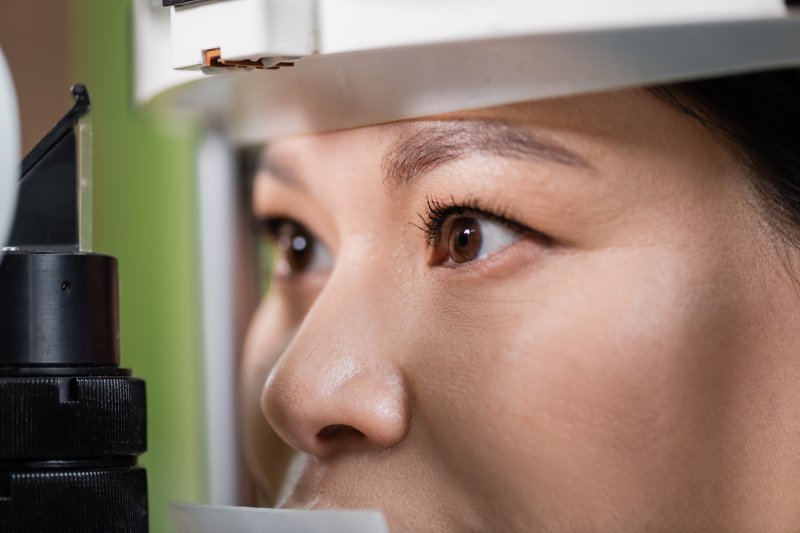
The most common early sign is"floaters,"or specks and gnat-like particles drifting in front of the eyes.These particles tend to follow the direction of your gaze persistently."Photopsia,"
the sensation of flashes of light like lightning or sparks even when the eyes are closed or in a dark place,is also a strong sign that the retina is being irritated.As symptoms worsen, visual field loss occurs. It begins gradually in the peripheral vision,
\r\n
as if a black curtain were being drawn
\r\n\r\n
".
The prognosis is better if treatment begins before the macula, the core of vision, completely separates from the wall of the eye.
If the condition is caught early and the detachment is localized, laser treatment may be enough. But if the macula has already been affected, surgery is required.Surgical options include scleral buckling, in which the eye is tightened from the outside with a silicone band to close the tear, and vitrectomy, in which the vitreous humor is removed and gas is injected to push the retina back into place and reattach it.Even when surgery goes well, however, it is difficult to fully recover the original vision.
\r\n
Because damaged photoreceptor cells do not regenerate, vision loss or distortion may remain as a lasting effect.In the end, the best approach is prevention and early detection. Patients with high myopia should undergo an eye exam once a year even if they are young, and middle-aged and older adults, when aging begins, should also get annual checkups even if they have no special symptoms."If you dismiss it as age or stress, you may miss the disease."
[What Disease Is This?]
This series highlights warning signs and prevention methods for diseases that are easy to overlook in daily life. If you subscribe to the reporter's page, you can conveniently receive useful health information.
\r\nsms@fnnews.com Sung Min-seo Reporter