Japanese Media Say South Korea-Japan Leaders Draw Closer Amid U.S. Focus on the Middle East and Energy Uncertainty
- Input
- 2026-05-20 07:30:16
- Updated
- 2026-05-20 07:30:16
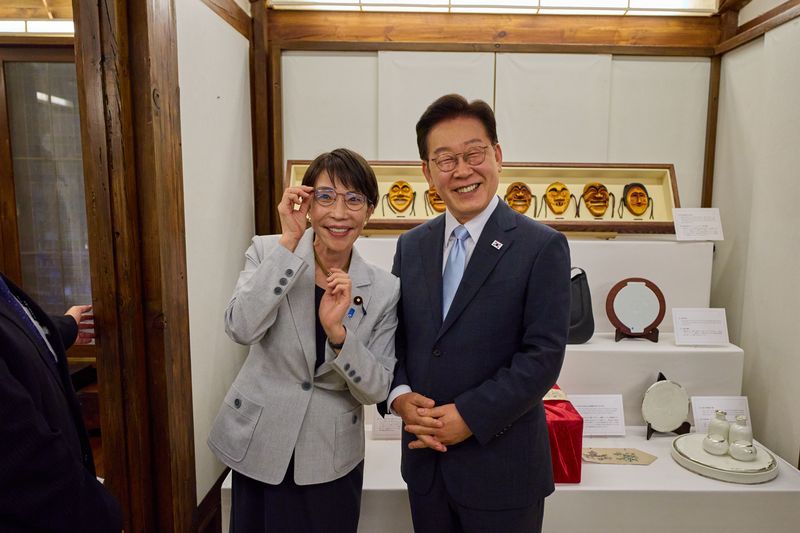
[The Financial News, Tokyo = Seo Hye-jin correspondent] Japanese media analyzed on the 20th that the summit between President Lee Jae-myung and Japanese Prime Minister Sanae Takaichi, held on Nov. 19 in Andong, North Gyeongsang Province, reflects how East Asian security concerns and an energy crisis triggered by the United States' focus on the Middle East are pushing the two countries closer together.
Japanese outlets said the two leaders' agreement to expand mutual supplies of crude oil and petroleum products, along with cooperation on economic security, goes beyond simple economic ties. They described it as a joint response to a shifting international order.
They also said that U.S. President Donald Trump concentrating diplomatic and military resources on the Middle East, along with his recent description of U.S.-China relations as a 'G2,' is heightening a sense of crisis in both South Korea and Japan.
Nihon Keizai Shimbun, or The Nikkei, said, "The U.S. focus on the Middle East has made the possibility of a 'power vacuum' in Asia feel real," adding, "That is bringing South Korea and Japan even closer."
The Nikkei reported that some of the THAAD system deployed with USFK appears to have been moved to the Middle East, while the U.S. amphibious assault ship USS Tripoli from United States Fleet Activities Sasebo has also been sent there. It said this is fueling concerns that deterrence in East Asia could weaken.
The Yomiuri Shimbun also analyzed that "concerns that the United States may reduce its involvement in the Indo-Pacific have become a shared perception in both countries."
Japanese media paid particular attention to the fact that the summit was held immediately after the U.S.-China summit on Nov. 14-15. In Japan, Trump's G2 remark has raised concerns that Washington and Beijing could move toward dividing spheres of influence.
The Asahi Shimbun reported, "Both Japan and South Korea are wary of the possibility that the United States and China could directly bargain to determine the order in East Asia," adding, "There is no choice but to cooperate."
Energy insecurity tied to the situation in the Middle East was also cited as a direct reason for closer cooperation.
With the Strait of Hormuz effectively blocked and both South Korea and Japan heavily dependent on Middle Eastern crude, the two countries have been facing supply-chain concerns. At the summit, they agreed to expand cooperation through mutual supplies of crude oil and petroleum products, as well as the creation of a public-private consultative body.
The Yomiuri Shimbun called it "an example of a win-win relationship in which the two sides help each other in difficult areas." The Asahi Shimbun said it was more meaningful as a sign of willingness to cooperate than as a source of concrete results.
Analysts also said the two leaders' domestic political interests aligned during the summit.
The Mainichi Shimbun said, "The intentions of Prime Minister Takaichi, who seeks regional stability, and President Lee, who wants to highlight diplomatic achievements, were in sync."
The Yomiuri Shimbun especially noted that Lee highlighted cooperation with Japan in Andong, his conservative hometown, ahead of next month's local elections. It said Lee, who had previously taken a hard line toward Japan, has emphasized pragmatic diplomacy since taking office, reflecting an effort to broaden support among moderate and conservative voters.
Still, Japanese media pointed out that there are limits to how quickly security cooperation between the two countries can expand.
South Korea and Japan have begun 2+2 talks at the vice ministerial level for diplomacy and defense, and they are also seeking to resume a joint search and rescue exercise, or SAREX, for the first time in about nine years. However, South Korea is reportedly cautious about signing an Acquisition and Cross-Servicing Agreement, or ACSA, that would allow the two sides to provide each other with supplies and fuel.
The Asahi Shimbun said security cooperation remains "an area that cannot be crossed in one leap" because of lingering caution in South Korea over the history of Japanese colonial rule.
The Nikkei said, "Japan wants to draw South Korea further into a framework to counter China, but South Korea is also considering its relationship with China, its largest trading partner," highlighting the gap in how the two countries view China.
sjmary@fnnews.com Seo Hye-jin Reporter