"We have to recover the losses from Samsung and SK Hynix tonight." Office workers heading to work with bloodshot eyes. "Even Nvidia..." [The Joys and Sorrows of a Salaryman]
- Input
- 2026-05-20 19:00:00
- Updated
- 2026-05-20 19:00:00
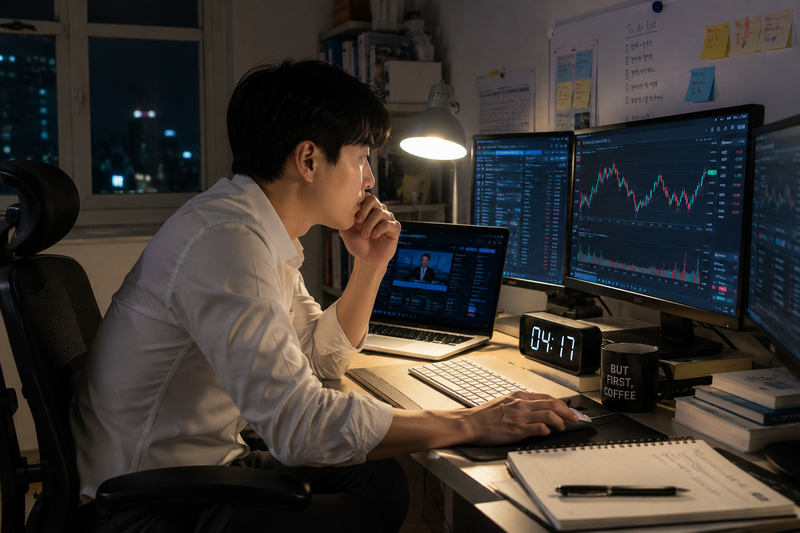
As overseas stock investment has become commonplace, checking accounts after work has solidified into a routine, leading some office workers to complain of sleep deprivation and decreased concentration at work. 10:30 PM, the stock app turns on again A, an office worker in their 30s, turns on the U. S. stock app after eating dinner after work.
S. stock market at night. The U. S. regular trading session opens at 10:30 PM Korean time and closes at 5:00 AM the following day.
They said that while they initially intended to just check the beginning of the session before going to sleep, on days with earnings announcements or sharp fluctuations in stock prices, they end up watching the screen until 1 or 2:00 AM. "It feels like I'm going to work again at night even though my company work is finished," said A. "It is hard to sleep without watching when Nvidia or Tesla are moving. " He lamented, "There are days when I feel spaced out during meetings the next day, but I am more tired on days when I stay up all night watching than on days when I incur losses.
S. stock market at night. The U. S. regular trading session opens at 10:30 PM Korean time and closes at 5:00 AM the following day." U. S. stock market hours are awkward for Korean office workers. Regular trading hours for the NASDAQ and the New York Stock Exchange are from 9:30 a.
m. to 4:00 p. m. Eastern Time.
During periods when U. S. Daylight Saving Time is in effect, trading continues from 10:30 p. m.
to 5:00 a. m. the following day in Korea. Even if one starts with the intention of only watching the beginning of the session, it is difficult to stop easily once fluctuations in major stocks become significant.
S. stock market at night. The U. S. regular trading session opens at 10:30 PM Korean time and closes at 5:00 AM the following day.
Even if one does not watch until the market closes, checking pre-market and after-market quotes, exchange rates, and the impact on the domestic market pushes back sleep time. Managing accounts of "Seohak Ants" (Korean retail investors investing in overseas stocks). Already a part of the daily lives of some office workers Overseas stocks are no longer the domain of only a select few investors. 45 billion.
S. stock market at night. The U. S. regular trading session opens at 10:30 PM Korean time and closes at 5:00 AM the following day.42 billion. The U. S. market, in particular, accounted for a significant portion.
The U. S. 7% of the total foreign securities held. The top foreign stocks in terms of holdings were also all U.
S. stocks, in the order of Tesla, Nvidia, Palantir, Apple, and Microsoft. As holding overseas stocks has become commonplace, the daily rhythms of domestic investors have sometimes begun to align with U. S.
S. stock market at night. The U. S. regular trading session opens at 10:30 PM Korean time and closes at 5:00 AM the following day.
stock market times. Given this situation, office worker Mr. B confessed, "I can't properly watch the domestic market because it is during working hours," adding, "I actually end up watching the U. S.
S. stock market at night. The U. S. regular trading session opens at 10:30 PM Korean time and closes at 5:00 AM the following day.market longer since it is after work. " He remarked, "Sometimes I don't know if stocks are a side job or if I spend more time on it than my side job. " Sleep Drains Before Profits If nighttime investment is prolonged, it also affects work the following day. Mr.
C, an office worker in his 40s, confessed that he drinks several cups of coffee the morning after watching the US market close. He said, "When I make a profit, I feel so good that I can't sleep, and when I suffer a loss, I can't sleep again because I'm thinking about recovering it. " Office worker fatigue is already confirmed by statistics. According to the '2024 Time Use Survey Results' released by Statistics Korea last July, the sleep time of employed individuals decreased from 7 hours and 58 minutes in 2019 to 7 hours and 52 minutes in 2024.
3% of employed individuals answered that they feel tired on a regular basis. Of course, it cannot be concluded that investing in the US market itself is the cause of fatigue. However, if the time that should be spent resting after work is filled again with checking market prices and making trading decisions, the recovery time is reduced. This leads to a situation where one must keep up with news regarding loss recovery, earnings announcements, exchange rates, and interest rates even after work is finished.
S. stock market at night. The U. S. regular trading session opens at 10:30 PM Korean time and closes at 5:00 AM the following day.
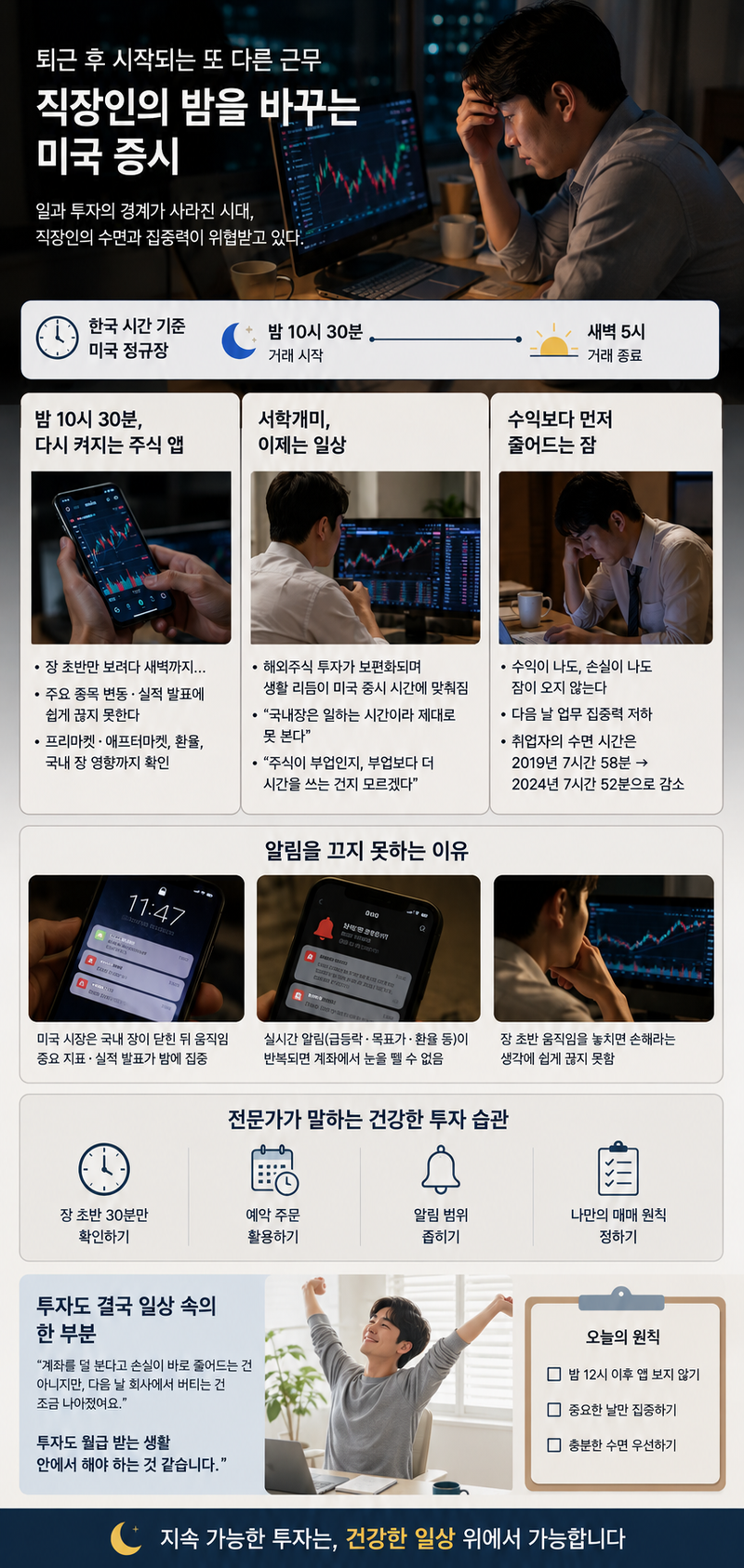
In particular, earnings announcements by major tech companies, U. S. inflation data, and comments from the Federal Reserve often occur late at night or early in the morning Korean time. When stock prices move significantly during these times, it is difficult for investors to turn off notifications.
S. stock market at night. The U. S. regular trading session opens at 10:30 PM Korean time and closes at 5:00 AM the following day.Real-time alerts from brokerage apps also have an impact. When alerts regarding reaching target prices, sharp fluctuations, or exchange rate changes are repeated, investors keep their accounts in their minds even during breaks. Short-term traders are more likely to feel that missing early market movements will result in losses. Experts advise that in overseas stock investing, it is necessary to set specific times in addition to trading criteria.
This could involve checking only the first 30 minutes of trading or narrowing the scope of limit orders and price alerts. Trying to monitor every fluctuation in real-time can lead to fatigue accumulating before investment judgment can be made. Office worker Mr. A recently reduced his U.
S. market alerts. He decided not to check the app after midnight unless it is an earnings release day. He said, "Checking the account less doesn't immediately reduce losses, but it has made it a little easier to get through the next day at work," adding, "It seems that investing, too, ultimately has to be done within the confines of a salary.
"
hsg@fnnews.com Han Seung-gon Reporter