KOSPI Sees 50 Trillion Won a Day, Yet 43% of Stocks Trade Less Than 1 Billion Won
- Input
- 2026-05-19 18:27:07
- Updated
- 2026-05-19 18:27:07
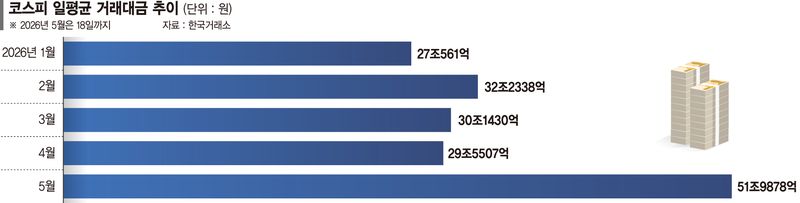
According to the Korea Exchange (KRX) on the 19th, average daily trading value in the Korea Exchange Main Board stood at 51.9878 trillion won from the start of the month through the previous day. That was up about 76% from 29.5507 trillion won in the previous month.
That is the highest monthly figure on record, and it is about 20 trillion won higher than the previous peak of 32.2338 trillion won in February. On the 12th, trading reached 67.1146 trillion won in a single day, setting a new daily record.
Trading value refers to the total amount of buying and selling combined. As it rises, it is generally interpreted as a sign of greater market attention and stronger liquidity.
While money is pouring into the KOSPI, the concentration in a handful of stocks is deepening, leaving more names behind. Of the 948 stocks listed on the KOSPI, 696, or 73.3%, had average daily trading value of less than 10 billion won. Another 410 stocks, or 43.2%, traded less than 1 billion won a day.
Last month, 714 of 949 stocks, or 75.2%, had average daily trading value below 10 billion won, while 443 stocks, or 46.7%, were below 1 billion won. Even though average daily KOSPI trading value differed by more than 20 trillion won, the number of neglected stocks remained at a similar level, suggesting that polarization is intensifying.
The tilt toward Samsung Electronics and SK hynix has become even stronger. This month, the two stocks accounted for 42.4% of total KOSPI trading value, sharply up from 31.8% last month.
Brokerage analysts expect the market’s polarization around semiconductors to deepen further. Maeng Joo-hee, a researcher at Samsung Securities, said, "For now, the supply-demand bias toward large-cap stocks is likely to continue." She added, "Even as foreign investor flows become more volatile, passive funds through Exchange-Traded Fund (ETF) investments and pension accounts are supporting the market floor."
She went on to say, "The two semiconductor leaders are likely to maintain a relatively stable funding base even during periods of heightened volatility." She added, "There is still room for short-term volatility from multiple macro variables, including interest rates, exchange rates, geopolitical risks, and conditions in the U.S. stock market. But changes in fund flows are making the lower end of the index more stable than before."
However, some analysts say excessive concentration in the semiconductor sector could become a burden. Hyun-guk Ahn, a researcher at Hanwha Investment & Securities Co., Ltd., said, "A tilt toward a specific sector or industry raises its correlation with the overall portfolio when volatility increases, undermining diversification and making mechanical rebalancing necessary." He added, "The continued selling of semiconductors by foreign investors and pension funds is not unrelated to this."
On the so-called money move into the stock market, he also predicted that "because deposit rates are gradually rising, fund inflows in the second half of the year will not be as strong as they were in the first half."
[email protected] Seo Min-ji Reporter