Choo: "A 30-Minute Commute Across the Seoul Metropolitan Area" ... Yang: "An Era of 100 Million Won GRDP per Person" [June 3 Local Elections]
- Input
- 2026-05-19 18:27:03
- Updated
- 2026-05-19 18:27:03
The Gyeonggi Province gubernatorial election carries significance far beyond a routine local race. From advanced semiconductor lines in the south to border areas in the north and redevelopment issues in the first-generation new towns, the province concentrates nearly every major social and economic challenge facing South Korea. As the result could reshape the balance of power in national politics, all parties are going all out.
With Choo Mi-ae of the Democratic Party of Korea emphasizing her long political experience and Yang Hyang-ja of the PPP highlighting her expertise, Reform Party candidate Jo Eungcheon and Progressive Party candidate Hong Seong-gyu have joined the contest, setting off a four-way policy battle.
■ Choo Mi-ae: "Balanced development between northern and southern Gyeonggi"
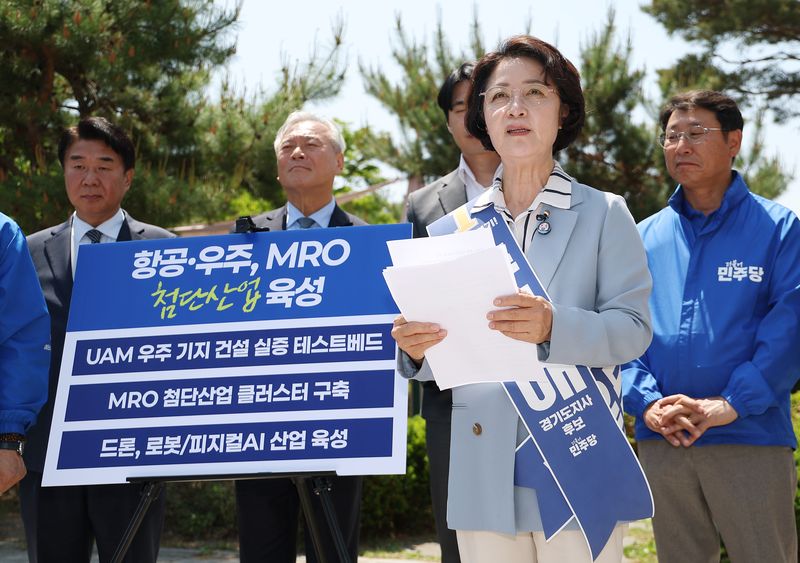
Choo is leaning on her image as a proven leader. To address Gyeonggi Province's chronic problems of regional imbalance and traffic congestion, she has declared she will run a "strong provincial administration that outmatches the central government."
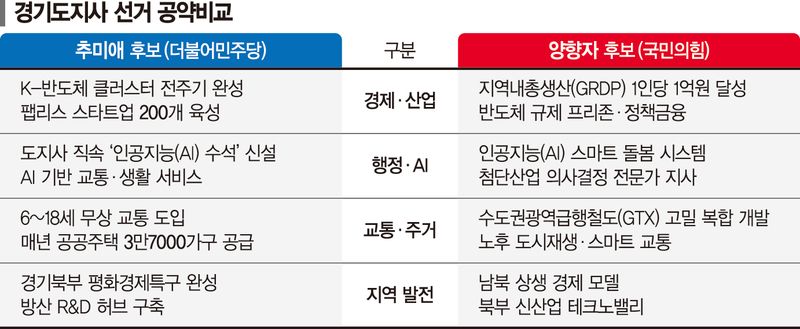
Her top pledge is the "30-minute commute across the Seoul metropolitan area." The plan calls for early completion of GTX-A, GTX-B and GTX-C, along with incorporating GTX-D, GTX-E and GTX-F into the national plan, so that the entire province can function as a single living zone.
She has also made balanced development the core of her campaign strategy by proposing an advanced industrial complex for both military and civilian use in northern Gyeonggi, turning the border region into a new engine of growth. Through her "Gyeonggi Northern Great Transformation" pledge, she said she would complete the northern border area as a "Peace Economic Special Zone."
She plans to establish a "Peace Zone Metropolitan Administrative Council" linking Incheon and Gangwon Province, and to build an R&D hub for future-oriented defense industries such as drones and robots that can serve both military and civilian purposes. She also pledged to create a senior secretary for AI directly under the governor, support AI transformation (AX) for small and medium-sized firms and core manufacturing industries, and introduce an AI-based traffic management system to embed AI across provincial administration.
In the areas of universal mobility and housing, she promised to introduce free transportation for children and teenagers aged 6 to 18, extending the "Free school uniform support policy initiated in Seongnam" into free transit across Gyeonggi Province. On housing, she pledged to supply 37,000 public housing units a year, or 148,000 units in total.
■ Yang Hyang-ja: "Semiconductor renaissance"
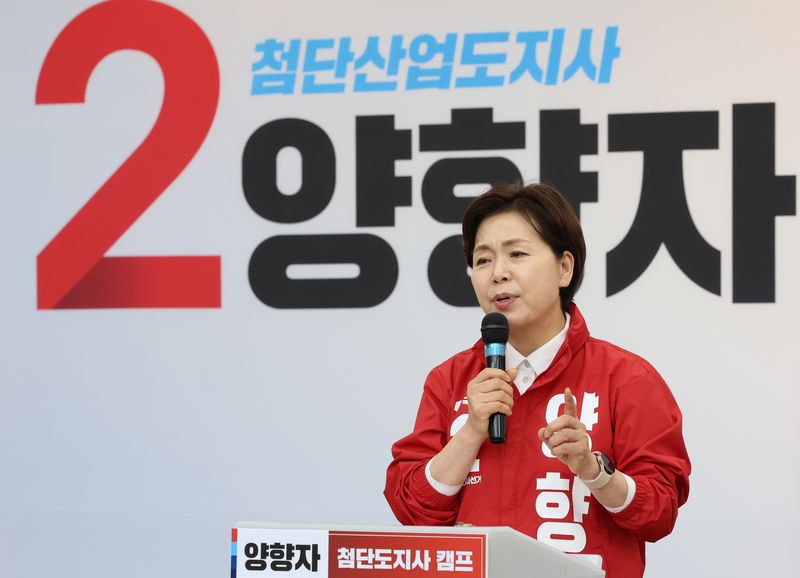
Yang, a former Samsung Electronics executive, has secured the frame of an "economic governor" with her distinctive career background. Emphasizing pragmatism over political conflict and technology over ideology, she is appealing to centrist voters and young office workers.
Yang has promised an era of 100 million won in GRDP per Gyeonggi resident. The centerpiece of her platform is to complete the semiconductor mega cluster linking Yongin, Hwaseong and Pyeongtaek as the world's largest, then reinvest the enormous added value it generates into welfare and education for residents in a virtuous economic cycle. "Gyeonggi's future depends on someone who understands technology taking charge of provincial affairs," Yang said, describing it as her winning strategy.
Her key pledge, the 100 million won GRDP era, aims to transform Gyeonggi into a high-value-added production hub by adopting Taiwan's TSMC-led growth model. At its core is a virtuous economic structure in which semiconductor profits from the south are invested in new industries in the north to close regional gaps.
She also declared that she would "rebirth Giheung as the world's No. 1 semiconductor hub" and promised a Regulation-Free Special Zone along with bold policy financing support.
■ First female metropolitan-level governor in sight
Expectations are also rising that the election could produce the first female metropolitan-level governor in the history of local elections. From the first Nationwide Local Elections in 1995 through the eighth election in 2022, no woman had ever been elected to such a post. In this Gyeonggi Province gubernatorial race, a female winner may emerge for the first time in 31 years.
Political circles believe the race will ultimately be decided by the practical question of "who can change my life more." Choo Mi-ae is countering with a "check on the administration" message, backed by strong opposition consolidation, while Yang Hyang-ja is pushing a "future growth" narrative centered on advanced industrial competitiveness. Jo Eungcheon's rational oversight and Hong Seong-gyu's value-driven policies are broadening voters' choices, and the race is expected to remain uncertain until the final stretch.
A local political source analyzed that because Gyeonggi Province's issues vary sharply by region, the candidate who can prove the most concrete, tailored pledges for each area, such as new town redevelopment and transportation network expansion, will emerge as the final winner.
Meanwhile, candidates from the third bloc and the progressive camp are also moving quickly. Reform Party candidate Jo Eungcheon describes himself as a "practical problem solver for everyday livelihoods." After unveiling his "Gyeonggi Jeonse Safety" pledge, he has made prevention of jeonse fraud and relief for victims his top provincial priority, seeking to win support from moderate voters by focusing on issues that directly affect residents' lives between the two major parties.
Progressive Party candidate Hong Seong-gyu has put forward a "people-centered provincial administration based on values." He has proposed establishing a "Gyeonggi Provincial Public Bank" to strengthen the public role of finance and expanding public care systems for workers and marginalized groups as core pledges. He is also working to rally progressive voters with clear policy proposals, including a Circular Economy model to respond to the climate crisis.
[email protected] Reporter