Soybean Prices Rise on China’s Reopening, Threatening Food Inflation in South Korea
- Input
- 2026-05-19 18:25:12
- Updated
- 2026-05-19 18:25:12
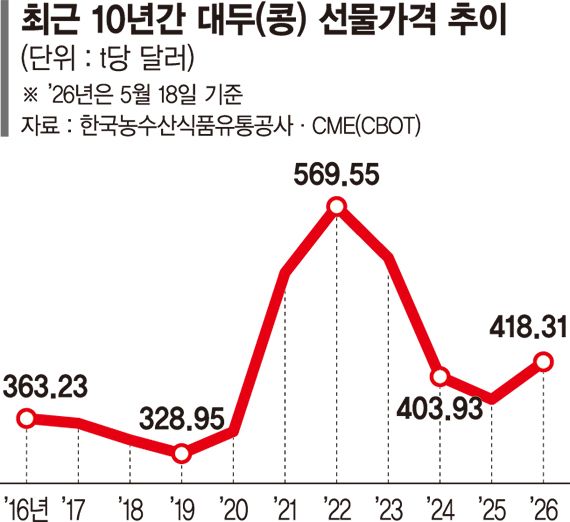
According to Korea Agro-Fisheries & Food Trade Corporation (aT) on the 19th, soybean futures on the Chicago Board of Trade (CBOT) closed at $445.7 per ton on the 18th, up 3.06% from the previous day and 4.05% from a month earlier. That is 12.32% higher than the average price of $369.8 over the past year since May last year, and 17.82% above the level at the start of this year. International futures prices are a key indicator in determining manufacturing costs for South Korea’s food industry. When futures rise, import costs increase, and the impact reaches domestic prices with a lag of three to six months, depending on shipping schedules and other factors.
U.S. President Donald Trump said in a Fox News interview on the 15th, shortly after the U.S.-China summit, that "China is going to buy soybeans in large quantities and purchase a lot of our farm products." According to the White House, China has agreed to buy at least $17 billion worth of U.S. agricultural products each year from this year through 2028. That is separate from the agreement reached at the U.S.-China summit held on the occasion of APEC South Korea 2025 in Gyeongju last October, under which China agreed to buy at least 25 million tons of U.S. soybeans annually for three years.
Experts expect soybean futures to rise further. That is because prices surged when China suspended imports of U.S. soybeans in 2018 in retaliation for tariffs imposed by the Trump administration, then resumed purchases in 2020. According to aT, soybean futures over the past 10 years hit a low of $328.95 per ton in 2019, rebounded in 2020, and reached a peak of $569.55 in 2022. After falling for three consecutive years through last year, they have turned upward again this year, with the average price through May reaching $418.31.
Haksoo Kim, head of the South Korea office of the U.S. Grains Council, said that "U.S. soybeans account for about 30% of the global market" and added that "prices for soybeans and soybean oil are likely to keep rising as demand for biodiesel feedstock increases amid higher international oil prices." He also noted that "April and May are the planting season for U.S. soybeans, so weather conditions over the summer could also affect futures prices." Jung Dae-hee, associate research fellow at Korea Rural Economic Institute (KREI), said that "the blockade of the Strait of Hormuz has also caused fertilizer supply problems" and analyzed that "if global supply falls because of climate and fertilizer issues, stronger price pressure will continue next year."
[email protected] Choi Yong-jun Reporter