Union Running Counter to Corporate Performance... Long-Simmering Conflict Between Business Units Erupts [Samsung Electronics Labor-Management Final Showdown]
- Input
- 2026-05-19 18:19:24
- Updated
- 2026-05-19 18:19:24
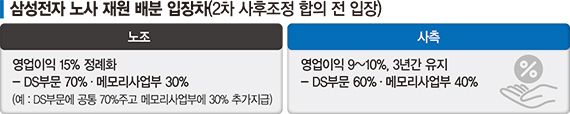
" As earnings become concentrated in the memory business unit due to the AI memory supercycle, the gap in perceived profits and compensation is rapidly widening, affecting not only the Digital Transformation (DX) division but also the memory and non-memory business units within the Semiconductor (DS) division. Consequently, internal backlash against the union leadership is intensifying day by day. Analysts from within and outside the industry suggest that "the clash between performance-based management and organizational integration has finally erupted. " ■ Compensation for 'Loss-making Business Units' is a Stumbling Block According to industry sources on the 19th, Samsung Electronics' labor and management failed to narrow their differences regarding the method of distributing performance bonus funds during the current wage negotiations.
One of the key issues is how to divide 'N% of operating profit' into 'common division funds' and 'business unit funds' if it is to be used as a source for performance bonuses. The leadership of the supra-enterprise union, Samsung Electronics' largest labor union, argued for distributing 15% of operating profit at a ratio of '70% for the division and 30% for the business unit. ' This means distributing 70% of the DS division's performance bonus funds equally to all business units, while paying out the remaining 30% differentially based on business unit performance. However, the company is concerned that if the common division funds become excessively large, employees in loss-making business units would receive performance bonuses almost identical to those in profitable business units, potentially undermining the principle of performance-based compensation.
Even within the company, counterarguments have spread, asserting that "compensation should be concentrated on business units that have achieved results," and that a ratio of "30% for the division, 70% for the business unit" or "40% for the division, 60% for the business unit" is actually more reasonable. In particular, given that the Memory Business Unit is responsible for most of DS's performance this year due to the AI semiconductor supercycle, some argue that it is difficult to accept a structure where performance bonuses are at a similar level to those received by the loss-making System LSI and Foundry business units. One employee stated, "They should have prioritized securing guarantees for the profitable Memory unit before discussing distribution plans for the remainder.
Instead, the union leadership insisted on ratio figures without a strategy, ultimately bringing about a situation where they faced an injunction. " Conversely, it is reported that within the Non-Memory Business Unit, there is a counter-argument that "since the entire DS has built technological competitiveness together, a certain level of joint distribution is necessary. " ■ Union Leadership Fueled 'Inter-Union Conflict' Conflict between divisions is on the rise.
It is reported that there is considerable dissatisfaction among union members in the DX division regarding the current negotiation structure, which is skewed toward the DS division riding the wave of the AI semiconductor boom. In fact, the second and third unions, the National Samsung Electronics Labor Union (NSLU) and the Donghaeng Union, recently staged a public protest during negotiations, arguing that "the demands of the 50,000 employees in the DX division must also be reflected. " Given this situation, dissent against the leadership is growing within the union as well.
Some members of the supra-enterprise union recently filed a petition with the Ministry of Employment and Labor, alleging that the union leadership disregarded procedures to resolve to strike and even threatened non-participants. The petitioners claimed that the union arbitrarily determined the distribution ratio for the semiconductor division (DS) and coordinated it with management, while simultaneously blocking the submission of agenda items for the finished product division (DX). The industry views this conflict as revealing structural problems within the company.
This is because, while the DX division performed well and the DS division faltered just one or two years ago, the recent boom in AI memory has concentrated profits in the DS division, particularly the memory business unit, causing the perceived gap in compensation between the divisions to widen rapidly. An industry insider stated, "Regardless of how this year's negotiations conclude, if the performance bias towards AI semiconductors persists, there is a high likelihood that conflicts between DS and DX, and furthermore between the memory and non-memory divisions within DS, will recur. " The insider added, "Finding a balance between performance-based compensation and organizational integration will be the key challenge for Samsung Electronics' HR and organizational management.
"
[email protected] Im Soo-bin Reporter