Ruling Party Says It Will Build Rail Network Linking Gangwon, North Chungcheong and Honam, Promising a 4.5-Hour Trip Without Transfers
- Input
- 2026-05-19 18:14:22
- Updated
- 2026-05-19 18:14:22
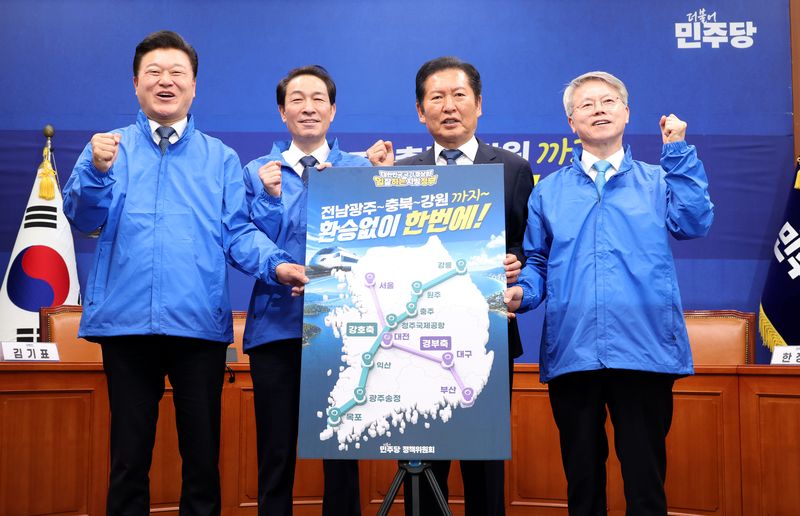
On the 19th, Democratic Party leader Jung Cheong-rae announced the joint pledge for the Gangho Belt rail network at the National Assembly together with Woo Sang-ho, the party's candidate for governor of Gangwon State; Min Hyung-bae, its candidate for Jeonnam-Gwangju Special Mayor; and Shin Yong-han, its candidate for governor of North Chungcheong Province.
The Gangho Belt rail network is a rail project designed to connect Gangneung and Wonju in Gangwon, pass through Jecheon and Osong in North Chungcheong Province, and reach Gwangju Metropolitan City and Mokpo in South Jeolla Province in 4 hours and 30 minutes without transfers. It was conceived in 2014 by former North Chungcheong Governor Lee Si-jong. The idea is to create a new axis for national development by linking Gangwon, Chungcheong and Honam, regions that have been left out of the Seoul-Busan axis-centered development of the country.
The Democratic Party plans to include the project in the 5th National Rail Network Construction Plan for 2026-2035, which is due to be finalized and announced in July. It also aims to complete the Cheonan-Cheongju International Airport double-track rail project by 2030 and the Chungbuk Line high-speed upgrade by 2031. At the event, Jung appealed, "Anyone can make a pledge, but isn't a policy proposed by the government and the ruling party more likely to be implemented? What matters is keeping promises, and wouldn't the ruling party be far more efficient?" He added, "Together with the Lee Jae-myung administration, which gets things done, I will make sure Democratic Party local governments, including Min Hyung-bae, Shin Yong-han and Woo Sang-ho, push ahead with these pledges and carry out the policies."
The reason Jung has put forward transportation pledges while highlighting metropolitan candidates with stronger polling numbers appears to be an effort to steady the party's support, which has recently been wavering even in Honam. According to a poll conducted by Energy Economy Newspaper and Realmeter on the 14th and 15th, the Democratic Party's approval rating fell 2.9 percentage points from the previous week to 45.8 percent. In Honam, its traditional stronghold, the figure dropped 14.3 points from the previous week to 57.2 percent, while in Chungcheong, a swing region, it fell 5 points to 48.2 percent. The cited survey was conducted over two days, from the 14th to the 15th, among 1,003 people aged 18 and older nationwide through an automated wireless phone response system. The response rate was 3.7 percent, and the margin of error was plus or minus 3.1 percentage points at the 95 percent confidence level. For more details, see the website of the Central Election Poll Deliberation Commission.
[email protected] Song Ji-won Reporter