[Editorial] Summit Between South Korea and Japan Should Further Strengthen Supply Chain and Security Cooperation
- Input
- 2026-05-19 18:10:01
- Updated
- 2026-05-19 18:10:01
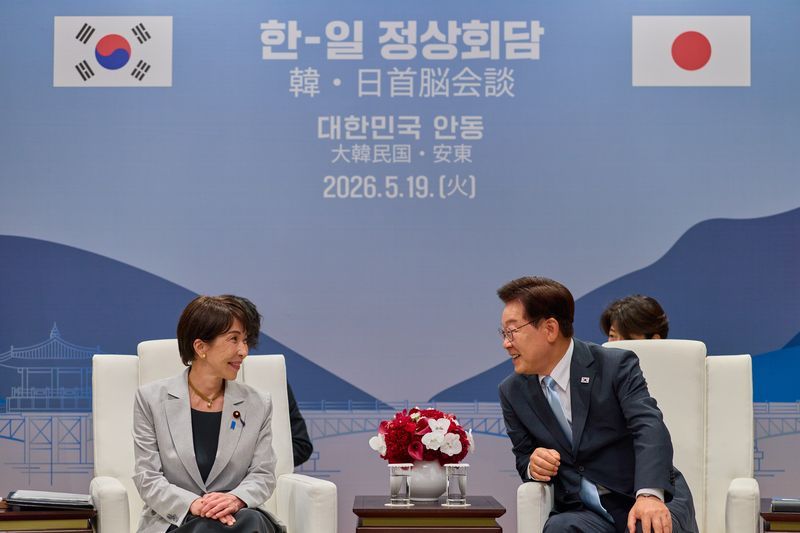
At this meeting, the two leaders discussed shared pending issues amid rapidly changing global conditions, including the Arab-Israeli conflict and U.S. tariff issues. The Blue House said the summit helped deepen trust and friendship between the two countries' leaders, and that alone is enough to give the meeting significance.
South Korea and Japan are now facing very similar circumstances. As both are liberal democracies, they could hardly be more alike. The same is true of the United States. In particular, the two countries share North Korea as a common security threat, and their positions on China are not very different either. Under these circumstances, they must further strengthen cooperation with the United States in response to North Korea's increasingly dangerous nuclear threat. It is never excessive to reaffirm and emphasize security cooperation at every summit.
Economically, too, the two countries must cooperate to secure supply chains, especially as the Middle East crisis drags on. Lee said after the summit that the two sides had already discussed strengthening cooperation among Asian countries in response to supply chain risks, as well as sharing information on crude oil supply and reserves.
Japan is the world's third-largest economy after the United States and China, and it became an advanced country before South Korea did. There is much we can learn from Japan and cooperate on in technological terms. While South Korea is ahead in some cutting-edge fields such as Semiconductors, there are other areas, including biotechnology, where the two countries can build new partnerships.
Japan has also already shown responses to the U.S. administration's tariff policy that South Korea can use as reference. For that reason, Japan is a neighbor with which South Korea needs to maintain good relations. We should once again recognize that it is a nearby country, like the house next door sharing the same yard.
Beyond economic cooperation, the two countries also share social and cultural issues such as low birthrates and aging populations, joint responses to digital crime, and cooperation in culture and tourism. Through policy cooperation, they can help each other solve these problems.
As is well known, historical issues between the two countries have repeatedly resurfaced even after appearing to be resolved, becoming obstacles to the restoration of bilateral ties. Even now, domestic debate continues over whether Japan has apologized for its colonial rule and the comfort women issue, and diplomatic friction frequently arises over Liancourt Rocks and Shinto shrine worship.
It is only natural to respond firmly to Japanese provocations that violate international customs and principles. Japan, too, should refrain from diplomatic and military actions that provoke South Korea. On that premise, bilateral relations can move in a constructive direction for the future. In international relations as well, emotions often stand in the way of improved ties. This does not mean the two countries should simply abandon historical issues. But they must not worsen relations by repeatedly raising matters that cannot be fully resolved.