MOU says it does not recognize North Korea as a state under domestic law, clarifies constitutional controversy over 'two-state theory' again
- Input
- 2026-05-19 12:41:47
- Updated
- 2026-05-19 12:41:47
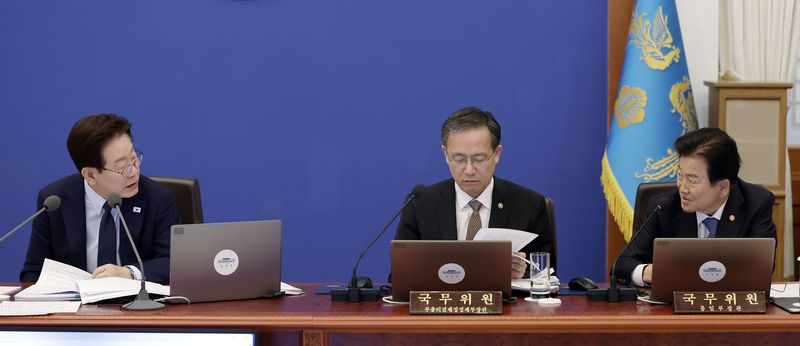
The controversy over constitutionality arose after the Lee Jae-myung administration's first Unification White Paper, released by MOU the previous day, included the peaceful two-state theory. However, the ministry explained that it is a political concept, not a legal one.
A ministry official said on the day that the peaceful two-state theory does not legally recognize North Korea as a state. The official added that it is not the position of the South Korean government reached through interagency agreement, but one of MOU's own proposals. In his opening remarks at the 2025 International Korean Peninsula Forum (GKF: Global Korea Forum) in September last year, Minister Jung had first presented the vision and concept of a 'peaceful two-state relationship oriented toward unification.'
However, the conservative opposition attacked Minister Jung, calling MOU's concept, which resembles North Korea's two-state theory, unconstitutional.
The People Power Party (PPP) said on the day that the inclusion of the 'two-state theory' advocated by Kim Jong Un, President of the State Affairs Commission, in the Lee Jae-myung administration's first Unification White Paper was a "declaration of division that goes against the Constitution." North Korea had already formally codified the 'two-state theory' in March through a revision of its own constitution, defining inter-Korean relations as relations between separate states.
PPP leader Jang Dong-hyuk criticized on Facebook, saying, "A Unification White Paper that denies unification is a clear violation of the Constitution," and added, "Kim Jong Un's orders have been placed above the Constitution of the Republic of Korea."
Jang also pointed out, "North Korean human rights have effectively disappeared from the white paper, and North Korean defectors have been renamed 'Bukhyangmin,' as Kim Jong Un wants," adding, "The status of UN resolutions on North Korean human rights and the UNSC's sanctions against North Korea have also been deleted."
Lee Jong-bae, a four-term lawmaker, said on Facebook that "President Lee must immediately dismiss Minister Jung, who violated the Constitution, and revise the Unification White Paper." Yoon Sang-hyun, a five-term lawmaker, also called for a "complete review of the white paper's overall direction."
[email protected] Kim Kyung-soo Reporter