"Sell When SK hynix's Market Cap Surpasses Samsung Electronics," Securities Firm Warns, Citing the 2000 Dot-Com Bubble
- Input
- 2026-05-19 19:00:00
- Updated
- 2026-05-19 19:00:00
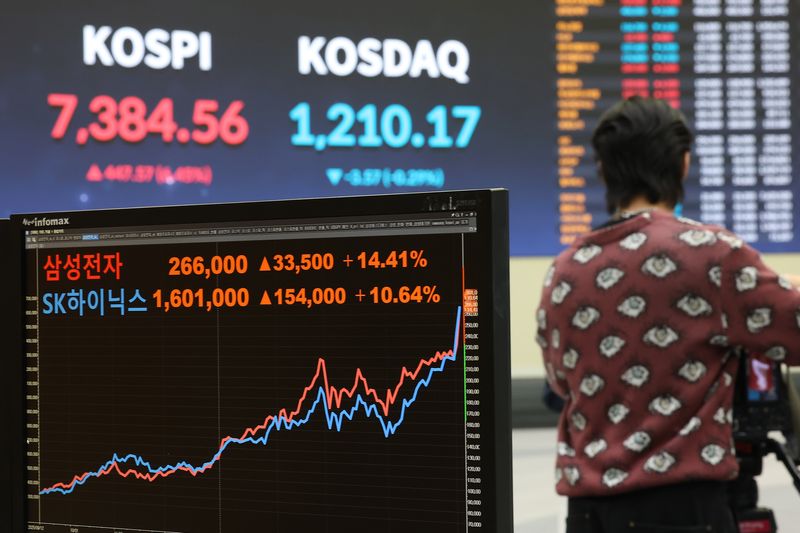
[The Financial News] As the KOSPI's recent rally continues, an analysis has drawn attention by identifying the decisive sign that could bring the current bull market to an end. The key warning signal, it says, could be the point at which SK hynix overtakes Samsung Electronics in market capitalization.
Hana Securities: "A change in the No. 1 market cap ranking is a classic overheating signal"
On the 19th, Hana Securities analyzed potential risk factors tied to the recent strength in the domestic stock market in a report. The report pointed to the moment when SK hynix's market capitalization surpasses Samsung Electronics as a signal that the current earnings-driven bull market is coming to a halt.
The analysis argues that when the No. 1 spot changes hands purely because of stock-price overheating, without any reversal in earnings scale, it marks the peak of a bubble and an early sign of collapse. Lee Jae-man, a researcher at Hana Securities, cited the collapse of the dot-com bubble in 2000 as an example.
At the time, Cisco Systems, a network equipment maker, posted a market capitalization of $551.6 billion, overtaking Microsoft (MS) and General Electric (GE) to become the largest company by market cap in the S&P 500.
However, Cisco's annual net profit was only $2.7 billion, equal to 20% of GE's and 28% of Microsoft's. As expectations pushed the stock higher ahead of earnings, the market cap ranking changed on overheating alone, regardless of profit scale. Soon after, the NASDAQ Composite Index entered a full-fledged downtrend, leading to the bubble's collapse.
The researcher advised that if market cap rankings reverse solely on a sharp stock rally, without any change in the two companies' earnings fundamentals, investors should prepare for the end of the index's upward run. The current domestic market, however, is different from that period. Samsung Electronics' estimated net profit for 2026, at 28 trillion won, still exceeds SK hynix's 20.8 trillion won. The current concentration in market cap is also seen as a justified phase based on fundamentals.
The two companies account for 48% of KOSPI's market cap, while net profit is nearly 72%
At present, the two companies make up about 48% of KOSPI's total market capitalization. Contrary to market concerns, their combined share of expected net profit over the next 12 months reaches nearly 72% of the entire KOSPI. That means their contribution to earnings generation is far greater than their share of market cap, supporting the view that the current dominance reflects a rational liquidity-driven market.
SK hynix currently accounts for 22% of KOSPI's market cap. That has already surpassed the all-time high share once held by SK Telecom (SKT), which reached 13% in May 2000 as the second-largest company by market cap. SK hynix has also narrowed the gap with Samsung Electronics to about 85% of its market cap. For now, Samsung Electronics still has the stronger earnings base, so the bull market remains intact. But the analysis says risk management will become necessary if the growth rate of capital expenditures (CAPEX) by U.S. tech firms falls below the pace of oil price increases, or if the two companies' market caps reverse.
Meanwhile, the upper end of the KOSPI target was raised from 8,470 points to 10,380 points. The researcher explained, "The market's direction is determined by liquidity and earnings," adding, "If the KOSPI's average price-earnings ratio (PER) since 2010 of 9.96 times is applied to the 2027 expected net profit of 853 trillion won, the KOSPI's market capitalization would reach 8,499 trillion won and the index would stand at 10,380 points." He said that even without a valuation re-rating, the index could enter the 10,000-point range if current earnings estimates materialize.
[email protected] Kim Hee-sun Reporter