Japanese media report that South Korea and Japan will create a policy dialogue on energy cooperation at summit talks
- Input
- 2026-05-19 09:34:27
- Updated
- 2026-05-19 09:34:27
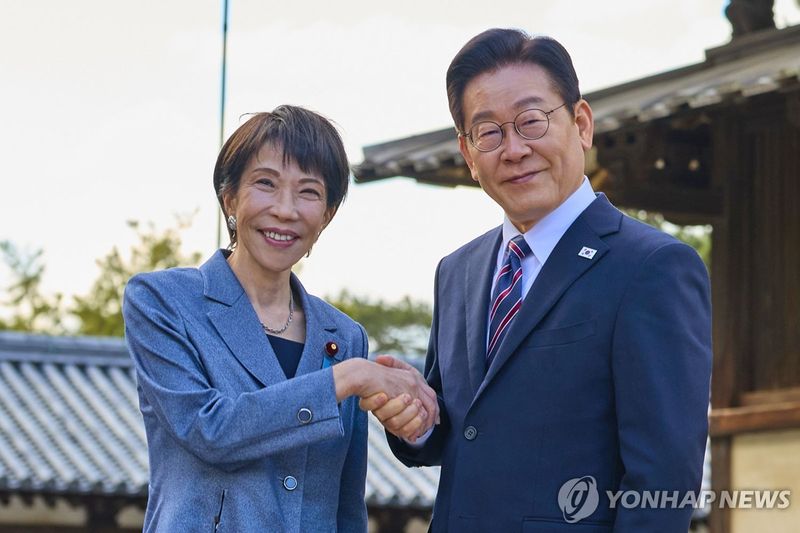
[The Financial News, Tokyo = Correspondent Seo Hyejin] As Japanese Prime Minister Sanae Takaichi prepares to visit South Korea on the 19th for summit talks with President Lee Jae Myung, Japanese media including NHK reported on the same day that the two countries are coordinating a plan to establish a policy dialogue aimed at deepening cooperation in the energy sector, including mutual supply of petroleum products during emergencies.
At the talks, the two sides are expected to confirm a government-level document on strengthening energy security in light of the situation in the Middle East.
The document is expected to include mutual supply of petroleum products such as gasoline and diesel in a crisis, restraint from unnecessary export controls, and cooperation in crude oil procurement.
They are also expected to push ahead with stronger regional oil stockpiling through the "Power Asia" initiative that Prime Minister Takaichi proposed to Southeast Asian countries on the 14th of last month. Nihon Keizai Shimbun reported that the two leaders are likely to agree on building a cooperative framework, including joint stockpiling for crude oil procurement, and that the "Power Asia" framework unveiled at last month’s AZEC Plus Summit, which Japan hosted online on the 14th, will be used.
At that meeting, Takaichi proposed cooperation with Southeast Asian countries in building and using storage tanks, securing critical minerals, and diversifying energy sources, while also expressing Japan’s willingness to provide $1 billion in financial support. Kim Min-seok attended the meeting from South Korea.
The two countries are also considering launching a policy dialogue on industry and trade.
They will also discuss security cooperation at the summit.
According to multiple Japanese government officials, the Republic of Korea Armed Forces and the Japan Self-Defense Forces (JSDF) are expected to resume a joint search and rescue exercise (SAREX) in early June. If that happens, it will be the first such drill since 2017. The move is expected to confirm stronger strategic cooperation among South Korea, Japan and the United States, including defense exchanges.
Japan hopes South Korea will take part in economic security and defense cooperation aimed at countering China. It is also expanding cooperation with Australia, the Philippines and others. South Korea is likewise reviewing participation in similar security cooperation frameworks.
The two leaders are also expected to share information on the recent U.S.-China summit held in Beijing. Each leader received a briefing on the talks from U.S. President Donald Trump.
Asahi Shimbun noted that although South Korea and Japan have been raising the level of cooperation, including holding their first vice-ministerial-level 2+2 talks between foreign affairs and defense authorities on the 7th, there is still a gap in views on defense exchanges and cooperation.
One such issue is the Acquisition and Cross-Servicing Agreement (ACSA). If the ACSA is signed, the JSDF and the Republic of Korea Armed Forces would be able to facilitate the provision of fuel and other supplies. According to multiple South Korean and Japanese officials, Japan proposed concluding the ACSA at the 2+2 meeting on the 7th, but the South Korean side reportedly reacted cautiously.
Asahi Shimbun reported that opposition to signing the ACSA remains strong, especially among progressive circles, which form part of Lee’s support base, because of issues related to Japan’s colonial rule.
Meanwhile, Prime Minister Takaichi’s visit to South Korea is seen as a return visit after Lee visited her hometown of Nara Prefecture in Japan in January.
This will be the third formal bilateral summit between the two leaders, following their meeting at the APEC Summit in Gyeongju in October last year and another in January this year.
[email protected] Seo Hyejin Reporter