"Am I in the top 30% of the wealthy?"... 10 million people knocked out in a chaotic high-oil-price relief payment rollout
- Input
- 2026-05-19 05:25:43
- Updated
- 2026-05-19 05:25:43
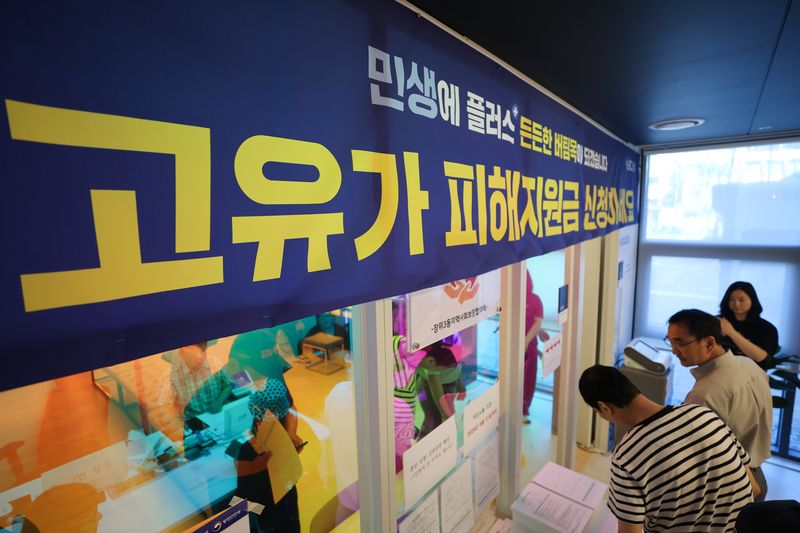
[Financial News] On the first day of in-person applications for the government's second high-oil-price relief payment on the 18th, citizens began arriving early in the morning at Administrative Welfare Centers nationwide. But because the income standard was tightened sharply compared with the previous Livelihood Recovery Consumption Coupon payout, many people left empty-handed.
The second relief payment is limited to the bottom 70% of income earners, or about 36 million people. Compared with the consumption coupon program, which covered 90% of the population, the number of beneficiaries has fallen by more than 10 million.
The confusion at the scene stemmed from the much stricter cutoff for the portion of National Health Insurance premiums paid by the insured. For a single-person household with an employee plan, the threshold used to be 220,000 won or less in monthly premiums, roughly equivalent to an annual salary of 73 million won. This time, however, the cutoff was lowered sharply to 130,000 won or less, or about 43.4 million won a year. For a single-person household under the regional plan, the standard was also tightened from 220,000 won to 80,000 won or less.
Choi, 52, who visited an Administrative Welfare Center in Seo-gu, Daejeon, told Yonhap News Agency, "I received the previous payment, so I expected to get this one too and took time off to apply, but I was told I am not eligible, which is frustrating." Office worker Na, 33, also criticized the decision, saying, "I'm an ordinary working-class person with a lot of debt, but I was excluded. I don't know whether I should laugh because my income is high or cry because I can't get the payment."
Criticism is also growing over fairness, as the exclusion criteria for high-asset households remain unchanged from before. The government excluded households with a property tax assessment value above 1.2 billion won, or roughly 3 billion to 4 billion won in market value, as well as those with financial income exceeding 20 million won. But in practice, that means people with apartments worth several billion won or deposits of around 900 million won can still receive the payment if they have no clear earned income and therefore pay low health insurance premiums. That is why salaried workers, who pay their premiums faithfully, are complaining about reverse discrimination.
The burden on service counters was further increased by older applicants making unnecessary trips after failing to realize that the birth-year-based five-day rotation system applies only during the first week.
The Ministry of the Interior and Safety (MOIS) explained that it used the health insurance premium system, to which the entire population is subscribed, in order to determine eligibility quickly without building an additional system. It said the measure is intended to concentrate limited resources on low- and middle-income households hit economically by the Arab-Israeli conflict and other factors.
The government plans to review applications and provide between 100,000 won and 250,000 won per person on a tiered basis, while also operating an appeals process. However, as many ordinary workers who actually need the aid were excluded and the mismatch between asset and income standards was exposed, public expectations for the policy have fallen sharply.
[email protected] Moon Young-jin Reporter