"I’ve Got 320 Shares of SK hynix" Office Workers Feel Sick at Lunch: "I’d Rather Not Hear About That Than Salary Talk" [The Joys and Sorrows of Salary Workers]
- Input
- 2026-05-19 11:02:29
- Updated
- 2026-05-19 11:02:29
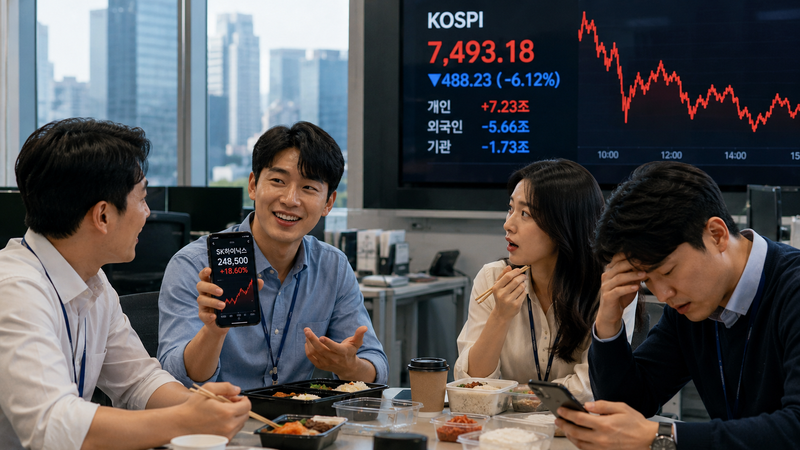
[The Financial News] As the stock market swings sharply, office workers are finding new ways to compare themselves with one another. In the past, salaries and bonuses were the main topics of interest. Recently, however, lunch-hour conversations have shifted to who owns which stocks. Even when people earn the same paycheck, investment results are widening the gap in wealth, and some now say, "I’m more jealous of account balances than salaries."
A stock-account conversation at lunch
A worker in his 30s who works in Yeouido, Seoul, has been hearing stock talk more often at company lunches lately. One colleague talked about returns on SK hynix shares, while another discussed when to buy more Samsung Electronics stock. "Our salaries are similar, but someone made as much as a yearly salary in just a few months," he said. "Talk about account returns sounds louder than talk about bonuses."
Stock talk is nothing new among office workers. But the tone of those conversations has changed in recent market conditions. The KOSPI briefly rose above 8,000 for the first time ever during intraday trading, and the market has been driven by Samsung Electronics and SK hynix. People who held stocks, those who only watched, and those who chased prices at the top all ended up with different expressions.
A worker in his 40s said, "In the past, I envied the department that got the biggest bonus. These days, I envy people who picked the right stocks." He added, "Salaries rise only a little each year, but stocks can create a difference of tens of millions of won in just a few days, so the comparison is unavoidable."
On the day KOSPI hit 8,000, individuals bought more than 700 billion won
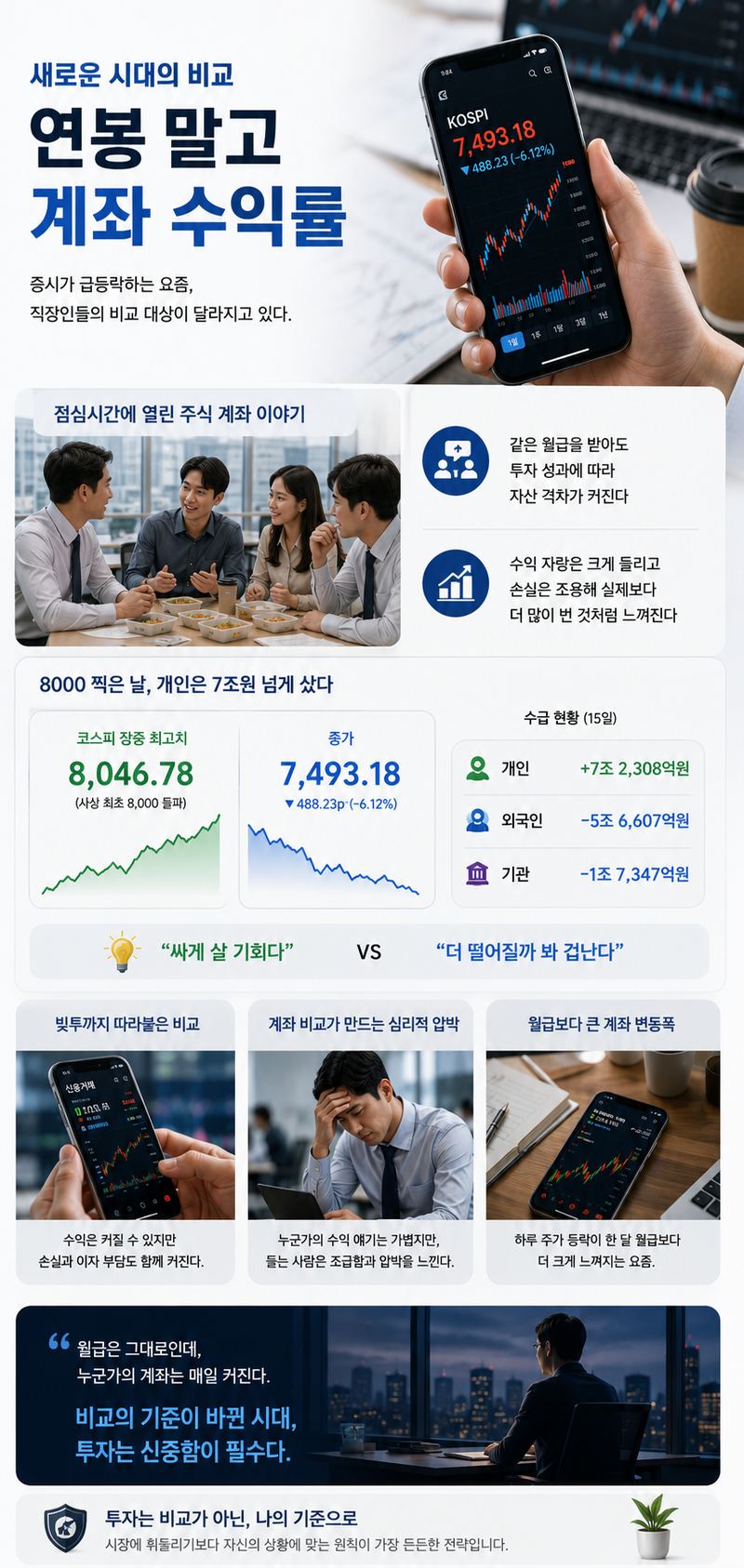
The reason office workers are checking their accounts more often is the recent volatility in the stock market. On the 15th, the KOSPI climbed as high as 8,046.78 during the session, breaking above 8,000 for the first time in history. It came just seven trading days after the index first moved above 7,000 on the 6th.
The rally did not last long. The KOSPI closed at 7,493.18, down 488.23 points, or 6.12%, from the previous session. A sell-side circuit breaker was triggered in the afternoon. Foreign investors sold a net 5.6607 trillion won, institutions sold 1.7347 trillion won, and individuals bought a net 7.2308 trillion won.
As individual investors stepped in to absorb shares during the sharp drop, reactions inside offices were mixed. Some saw it as "a chance to buy cheaply," while others said, "I can’t bring myself to buy because I’m afraid it will fall further."
A worker in his 30s said, "A colleague tells me, 'You have to buy when it falls,' but once my own money is on the line, I get scared." He added, "If I don’t buy, I feel like I’m falling behind. If I do buy, I worry I’ll get stuck holding losses, so I keep checking the app."
Boasting about gains is louder, while losses stay quiet
In a rising market, the voices that stand out most are those of people who made money. Those who lost money usually stay quiet. As a result, offices can feel as if far more people are profiting than really are.
One worker said, "Screenshots of returns get posted in group chats, but people rarely show proof of losses." He added, "Even knowing that, I still feel like I’m the only one not making money." He said, "When stock talk comes up, it makes my salary feel smaller."
That is also why investment performance intensifies feelings of comparison inside the workplace. Salaries are relatively predictable based on rank and experience. Stock returns, by contrast, can differ sharply in a short time depending on when and what someone bought. Even people on the same team doing the same work can end up with completely different account balances.
Recently, the concentration in large semiconductor stocks has also fueled comparisons. Samsung Electronics and SK hynix are among the leading names behind this year’s market gains. In particular, SK hynix has been frequently mentioned among office workers investing in stocks, as expectations for high-bandwidth memory, or HBM, have been reflected in its share price.
Comparison that extends to margin trading
Comparing account balances does not end with investment pressure alone. Some office workers, worried that they missed the rally, even consider borrowing money to invest. Margin lending is a transaction in which investors borrow money from a brokerage to buy stocks. If share prices rise, profits can grow larger. But if prices fall, losses and interest costs can increase at the same time.
The financial investment industry is now watching market liquidity and margin trading together. Rising customer deposits and stronger net buying by individuals show that interest in the market has increased. But in a sharp downturn, the risks of forced selling and larger losses also grow.
A worker in his 30s said, "I even thought about using margin because saving only from my salary feels too slow." He added, "But after last week’s plunge, I started to question whether it was money I could really handle."
As stock talk enters the office, even people who do not invest are affected. Conversations about stocks before meetings, during lunch, and on the way home may sound like information sharing, but for some people they become pressure. What sounds like a casual remark about returns can make listeners recalculate their own salary and savings pace.
The new benchmark for salary workers
For office workers, a salary is still the most stable source of income. But in a bull market, account swings can feel bigger than pay raises. At times, a single day’s stock move can look larger than a month’s paycheck.
Ahn said he recently reduced stock app notifications. "Even while I’m working at the office, a price alert can break my concentration," he said. "After hearing colleagues talk about their accounts, my salary somehow looks smaller."
Even in a rising market, office workers do not all react the same way. Those already holding stocks that have gone up hope for further gains, while latecomers keep checking their apps after every daily move. Ahn said, "At work, it feels like everyone is talking about making money, but my own account is not like that." He added, "My salary stays the same, but watching other people’s accounts grow quickly is the hardest part."
[email protected] Han Seung-gon Reporter