"Maintain Normal Staffing," Court Rules, but Union Vows to Push Ahead with Strike [Samsung Electronics at a Crossroads]
- Input
- 2026-05-18 18:22:01
- Updated
- 2026-05-18 18:22:01
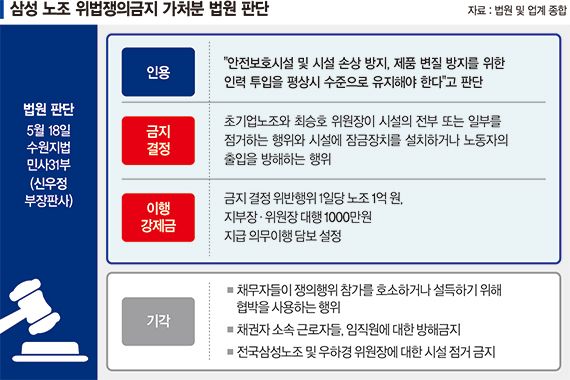
According to legal sources on the 18th, Civil Division 31 of the Suwon District Court, presided over by Chief Judge Shin Woo-jung, ruled in the case filed by Samsung Electronics against the Samsung Group Enterprise-Level Labor Union, Samsung Electronics Branch, and the National Samsung Electronics Union, saying that "the same level of staffing as usual must be maintained."
The court found that the fire protection facilities, ventilation systems, and drainage systems cited by Samsung Electronics all qualify as safety-protection facilities. It also said wafer-related work and other tasks fall under security operations and must continue as usual even during industrial action. In short, while the right to strike itself was recognized, most processes that could harm the company if stopped must continue operating normally.
Yang Tae-jeong, CEO of Kwangya Law Firm, interpreted the ruling as effectively banning the union's industrial action, given the nature of the semiconductor industry.
A former judge-turned-lawyer also said the court had effectively sided with Samsung Electronics. However, he added that because the court did not mention a specific number of essential workers and instead used the term "usual," the company and the union could clash later over staffing levels.
The part that left room for dispute was the section of the ruling stating that "during the period of industrial action, the debtors must maintain safety-protection facilities with staffing at the same level as usual (weekdays or weekends and holidays)."
The union focused on the phrase "weekends and holidays" in the parenthetical explanation of "usual." In other words, it argues that because the court recognized weekend or holiday staffing as part of normal staffing, it should be able to operate with a smaller minimum workforce than the 7,000 workers Samsung Electronics had requested for weekdays.
The figure of 7,000 was the minimum number of workers Samsung Electronics said was needed to protect life and safety when it applied for the injunction.
Majung Law Firm, which represents the union, said, "The union argued for weekend and holiday staffing, and that point was accepted, so the specific number should be lower than 7,000." It added, "Samsung Electronics wants the union to be notified of the exact staffing needs by department so that it can direct its members, and the union will carry out its planned industrial action on the 21st."
Legal opinion, however, appears divided. A lawyer in Seocho District said, "With negotiations between the union and the company still under way, this looks like a strategy to maintain bargaining leverage by taking a hard line on the strike." Another lawyer said the union had likely "misread the court's ruling."
When issuing the injunction, the court also ordered the union to pay 100 million won per day for any violation, and 10 million won per day for the branch chairperson. A lawyer who previously served as a judge said, "If the company demanded 7,000 workers and the union deployed 6,900, the union would be responsible if an accident occurred."
A former deputy chief prosecutor said that if a Samsung Electronics strike were to materialize, it would likely hurt not only Samsung Electronics' stock price but also public sentiment. He added, "If the stock market falls, it could affect the next election as well, so from the government's perspective, there is a high chance it would invoke emergency arbitration powers if the situation turns critical."
[email protected] Lee Hwan-ju, Kim Dong-gyu, Jung Kyung-soo Reporter