Park: "Bio Hub & Downtown Regeneration"... Yoo: "Transition to International Free City" [June 3 Local Elections D-15]
- Input
- 2026-05-18 18:20:02
- Updated
- 2026-05-18 18:20:02
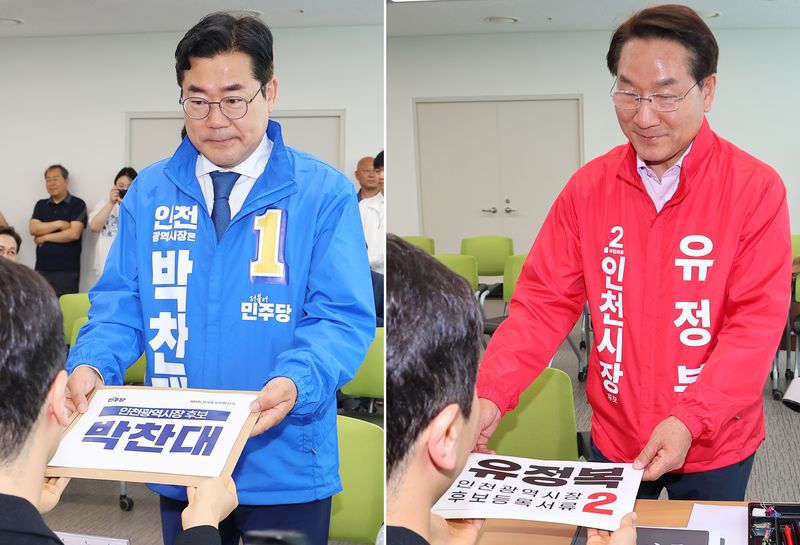
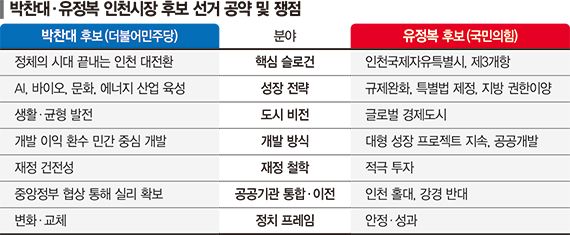
■ Park Chan-dae's Lifestyle-Tangible Innovation Candidate Park presented "Incheon's Great Transformation," which combines the improvement of citizens' quality of life with industrial innovation, as his core vision. Candidate Park announced that he would transform Incheon into a key hub city for the G3 era (Korea's top three major cities) through the 'ABC+E Strategy,' centered on the artificial intelligence (AI), bio, culture, and energy industries. In particular, he emphasized his commitment to connecting the fruits of industrial growth to the daily lives of citizens by presenting a concrete goal of "an average annual salary of 55 million won by 2030, making it one of the top five cities in the nation.
" In the AI sector, he unveiled a plan to establish Incheon as a national logistics AI hub city by automating the logistics systems of Incheon Airport and Incheon Port based on AI. In the bio industry, his strategy is to foster Incheon into a global bio hub through the establishment of the Incheon Institute of Bioscience and Technology, the attraction of a public medical school, and the creation of a Bioscience Park. Furthermore, he stated that he would create an ecosystem where startups and investments form a virtuous cycle by establishing a 150 billion won bio fund.
Candidate Park is particularly demonstrating a strong commitment to the regeneration of the old city center. Through the 'Jemunbu Project,' he envisions developing Jemulpo, Munhak, and Bupyeong as the three major axes of innovation for the old city center. Jemulpo is planned to become a center for history and tourism, while Munhak is to become a hub for the K-culture industry.
As a strategic hub, the plan is to develop Bupyeong Camp Market into a complex space combining a historical and cultural park with lifestyle and cultural facilities. This is interpreted as a strategy targeting the dissatisfaction of residents in the original downtown area who feel marginalized by development centered on Songdo, Cheongna, and Yeongjong. There are also distinct differences in transportation policies.
While Candidate Yoo focuses on macroscopic infrastructure plans centered on the airport economic zone and international logistics, Candidate Park is putting forward a large number of pledges focused on citizens' mobility convenience, such as the timely opening of GTX-B, the inclusion of GTX-D and E, the early implementation of Incheon Line 3, and the construction of trams in Songdo and Yeongjong. He also stated that he would establish a circular road network of five east-west and six north-south axes to make the entire city of Incheon a one-hour living zone. ■ Yoo Jeong-bok's Global Growth Strategy Candidate Yoo's core vision is the "Incheon International Free City.
" Following the opening of Incheon Port and Incheon International Airport, Candidate Yoo argues that the "Third Port Era" must now begin, presenting a plan to transform Incheon into an international free city that competes directly with the world. He Emphasizing that "Incheon's standard is the world, not Seoul," he announced plans to elevate the city into a global investment and business hub through the deregulation of the metropolitan area and the enactment of special laws. Candidate Yoo's strategy is closer to an institutional reform-oriented growth model.
Identifying metropolitan area regulations and the central government-centric authority structure as the biggest obstacles hindering Incheon's development, he maintains that resolving these issues is essential for the city's competitiveness to revive. Accordingly, he presented the enactment of the Special Act on the Incheon International Free City, the expansion and strengthening of authority for Free Economic Zones, and the fostering of industries centered on the airport economic zone as his major pledges. In particular, he plans to establish a global economic zone by intensively developing aircraft maintenance, repair, overhaul (MRO), air logistics, Urban Air Mobility (UAM), and advanced aviation industries centered around Incheon Airport.
Reorganization of the administrative system is also one of his core pledges. Candidate Yoo defined the Yeongjong-gu, Geomdan-gu, Jemulpo-gu, and Seohae-gu, which will launch on July 1, as the first phase of reorganization, and stated that he would pursue a second phase of administrative system reform that includes the creation of Songdo-gu and Nonhyeon-Seochang-gu. Simple The explanation is that this is not about separating administrative districts, but about establishing a future-oriented administrative system tailored to changes in industry and urban structure.
Another characteristic is a strong stance on decentralization. Candidate Yoo advocates for the transfer of the Incheon Port Authority and agencies related to the Capital Region Landfill to Incheon, and emphasizes that the authority of special regional administrative agencies, such as the Ministry of Oceans and Fisheries and the SMEs and Startups, should also be gradually transferred to local governments. ■ Debate over Development Methods and Relocation of Public Institutions The biggest issues in this election are development methods and fiscal philosophy.
Candidate Yoo argues that large-scale growth projects such as Songdo Bio, Yeongjong Aviation Logistics, and Cheongna Future Car Industry must be continued. He maintains that expanding local bonds to a certain level is inevitable for future investment. On the other hand, Candidate Park argues that an overly development-oriented budget could lead to a burden on citizens, advocating for fiscal soundness and the principle of prioritizing budgets closely related to daily life.
In particular, the debate over "Daejang-dong style development" is emerging as a major variable. Candidate Yoo's camp criticizes Candidate Park's development plan as the "Daejang-dong model," warning that private-sector-led development could lead to controversies over preferential treatment and speculation.
Claiming that [there is] a need for strengthened public management, [he/she] is advocating for it. On the other hand, Candidate Park’s camp criticizes the Yoo Jeong-bok administration for neglecting issues in the original city center while focusing on development centered on Songdo and Cheongna, and emphasizes the return of development profits to the citizens.
The integration of Incheon International Airport Corporation and the relocation of public institutions to the provinces are also sensitive pending issues. Candidate Yoo has expressed a strong stance of opposition, labeling the moves to integrate Incheon International Airport Corporation, Korea Airports Corporation, and the Gadeokdo New Airport, as well as the relocation of public institutions located in Incheon, as "neglect of Incheon.
" He is concerned about the weakening of airport competitiveness and a decrease in local tax revenue. On the other hand, while Candidate Park also opposes integration, he is taking a realistic approach of maintaining airport functions and securing regional benefits through negotiations with the central government.
Regarding the issue of relocating public institutions to the provinces, Candidate Yoo advocates for virtually outright opposition, whereas Candidate Park emphasizes maintaining strategic functions and selective responses. Local civic groups are questioning the sincerity of policy implementation, as local Democratic Party lawmakers are showing a passive attitude despite Candidate Park having expressed a stance of "opposition.
" On the political sphere regarding this Incheon mayoral election. It is being assessed as a "clash between global growth strategies and regional balanced development strategies.
" Analysis suggests that while Candidate Yoo focuses on strengthening urban competitiveness and the international city brand, Candidate Park places the center on the quality of life for citizens and innovation in daily living.
[email protected] Reporter