MOLIT Faces a 2.2 Trillion Won Budget Cut as 80 of 156 Projects Are Slated for Spending Restructuring
- Input
- 2026-05-18 18:17:06
- Updated
- 2026-05-18 18:17:06
Jeong Chang-gil, director general for fiscal performance management at the ministry, said, "This is the result of a strict review of fiscal waste and inefficiency by a panel of 153 outside private-sector experts." He added, "We plan to link this strongly to next year’s budget process."
The performance review showed that 901 of the 2,487 projects evaluated, or 36.2%, were identified for spending restructuring, including budget cuts, abolition, or consolidation. If the 15% restructuring rule is applied to cut projects, fiscal savings could reach about 7.7 trillion won. That is nearly six times the 1.3 trillion won in spending restructuring achieved through last year’s voluntary fiscal project evaluation.
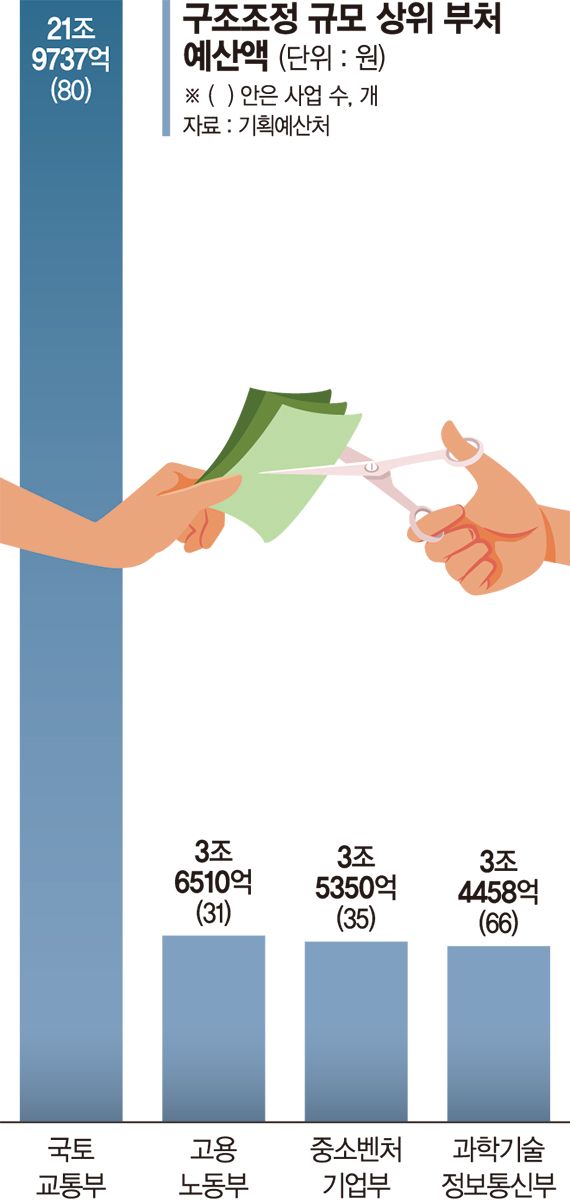
By ministry, the Ministry of Land, Infrastructure and Transport had the largest amount of budget subject to restructuring. Of its 156 projects, 80, worth 21.9737 trillion won, were classified for cuts or consolidation. It was followed by the Ministry of Employment and Labor, with 31 projects worth 3.651 trillion won; the Ministry of SMEs and Startups, with 35 projects worth 3.535 trillion won; the Ministry of Science and ICT, with 66 projects worth 3.4458 trillion won; the Ministry of Climate, Energy and Environment, with 91 projects worth 3.2567 trillion won; the Ministry of Health and Welfare, with 69 projects worth 2.6696 trillion won; and the Ministry of Culture, Sports and Tourism, with 69 projects worth 2.4086 trillion won.
Among ministries, agencies, and commissions, the Ministry of Personnel Management had 5 projects worth 618.3 billion won on the restructuring list, followed by the Korea Forest Service with 25 projects worth 1.227 trillion won and the Financial Services Commission with 10 projects worth 167 billion won.
By project type, the Ministry of the Interior and Safety’s commuter bus service for civil servants was cited for needing route reductions in the Seoul metropolitan area and a reorganization centered on the Government Complex Sejong. The Ministry of Health and Welfare’s National Smoking Cessation Support Service was flagged for overlap with similar programs, while the Financial Services Commission’s contribution program for the Youth Leap Account was criticized for accumulating reserve funds and carryover resources.
Among the consolidation targets, the Ministry of Climate, Energy and Environment’s Carbon Neutrality Commercialization Support Program was said to need integration because it overlaps with similar programs within the ministry. In addition, the safety inspection project for each household in aging apartment complexes and the electrical facility safety inspection project were judged to be more efficient if their management systems were integrated under the same law, the Electrical Safety Management Act.
The Ministry of Science and ICT’s "3D Printing Industry Promotion Infrastructure Establishment Project" was presented as a representative candidate for abolition because there are many similar projects across ministries. The Ministry of Oceans and Fisheries’ Jeju Marine Healing Center construction project and the Ministry of Land, Infrastructure and Transport’s temporary subsidy for additional Seoul urban railway rolling stock were also included on the abolition list for similar reasons.
The ministry overhauled its evaluation method this time. It shifted ministry-led project reviews, which had previously been handled separately by each ministry, to external private-sector experts. The scope of evaluation was also expanded to include fiscal projects such as disaster and safety evaluations by the Ministry of the Interior and Safety, employment programs by the Ministry of Employment and Labor, balanced regional development by the Presidential Committee for the Era of Local Autonomy, and small and medium enterprise support by the Ministry of SMEs and Startups.
The move is seen as meaningful because it improves a backward evaluation system that had lost credibility over the past 20 years under ministry-controlled, opaque, and collusive assessments. However, some say that budget cuts through project evaluation alone will not be enough to achieve bold spending restructuring, given that mandatory spending, which is nearing 400 trillion won, is rising rapidly every year. There is growing support for parallel structural reform of mandatory spending, including the Basic Pension paid to 70% of seniors and the Local Education Subsidy Grants, which automatically allocate about 20% of national internal taxes.
[email protected] Jung Sang-gyun Kim Chan-mi Reporter