Exchange rate fallout from the 1,500 won level raises fears of heavier foreign selling
- Input
- 2026-05-18 18:16:56
- Updated
- 2026-05-18 18:16:56
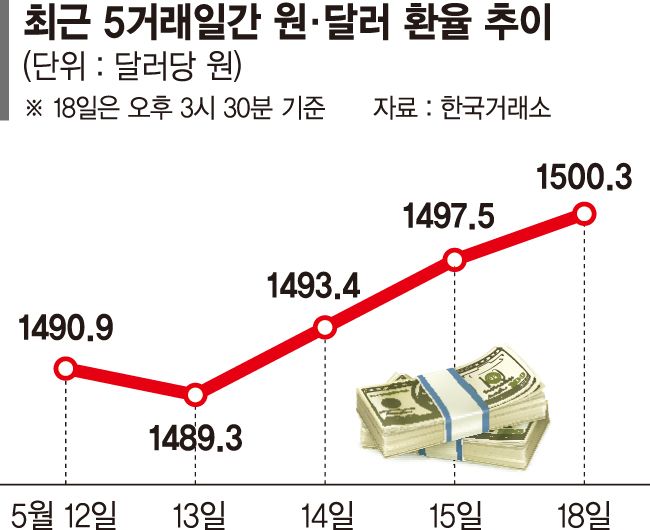
In the Seoul Foreign Exchange Market on the 18th, the won-dollar exchange rate closed at 1,500.3 won, down 0.5 won from the previous trading day. The rate opened at 1,501.2 won, breaking through the psychologically important 1,500-won level, and climbed as high as 1,506.9 won during the session. Rising global interest rates quickly fueled a risk-off mood. On the New York stock market on the 15th local time, the Dow Jones Industrial Average (DJIA) fell more than 1%, while the Nasdaq and the S&P 500 also posted losses.
The KOSPI was hit by continued foreign selling, and a sell-side circuit breaker was triggered around 9:19 a.m. Foreign investors sold a net 365.21 billion won in the KOSPI Market in a single day. Their cumulative net selling over the past eight trading sessions has reached about 3.57 trillion won.
In the foreign exchange market, foreign capital flows have emerged as a key factor driving the direction of the won. As the domestic market, which had risen rapidly on expectations of a semiconductor supercycle and a wave of artificial intelligence (AI) investment, has been shaken by higher U.S. rates and a stronger dollar, foreign investors appear to be taking profits. Market watchers warn that the won's break above 1,500 could further dampen foreign investor sentiment.
Behind the sharp rise in the exchange rate, which has added to stock market risks, is the increase in U.S. Treasury yields. The U.S. 10-year Treasury yield jumped 11.18 basis points in a single day to 4.5934%, while the 2-year Treasury yield also rose by more than 5 basis points. International oil prices also surged more than 4% each for WTI and Brent Crude Oil, driven by Middle East risks and supply concerns, stoking fears of renewed inflation.
Min Kyung-won, a researcher at Woori Bank, said, "The rise in global bond yields, which began with renewed inflation concerns, inevitably brings valuation pressure to the stock market." He added, "In particular, the KOSPI, which rose quickly, could face accelerated foreign capital outflows."
He also explained, "A stronger exchange rate can prompt hedging through forward purchases by foreign investors with open won positions and lead to the unwinding of positions in won-denominated risk assets." He added, "The most important variable in today's foreign exchange market is the scale of net foreign selling in the stock market."
Market analysts expect U.S. interest rate trends and foreign investor flows to remain the key drivers of the domestic stock market and the exchange rate for the time being. If U.S. inflation and oil prices come under renewed upward pressure, a stronger dollar and a weaker won could last longer.
[email protected] Choi Du-seon Reporter