Reducing Dependence on Daigong and Restructuring Operations: Duty-Free Industry Sees Earnings Rebound
- Input
- 2026-05-18 18:15:40
- Updated
- 2026-05-18 18:15:40
■ Breaking away from a money-losing model
According to the industry on the 18th, major duty-free operators all maintained profit-making momentum in the first quarter of this year. The shift away from the old practice of competing through sales commissions to attract customers, and toward cost efficiency and a strategy centered on Free Independent Travelers (FIT), is seen as the reason.
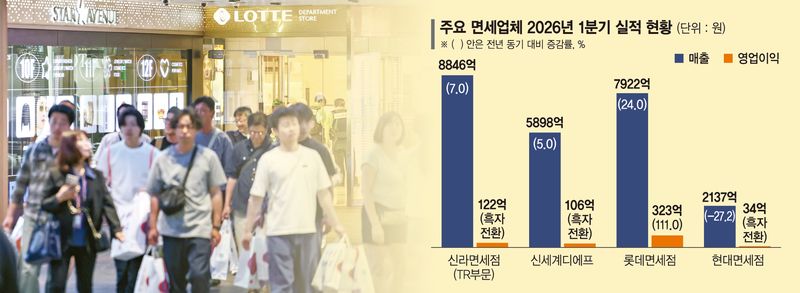
The Shilla Duty Free reported sales of 884.6 billion won and operating profit of 12.2 billion won in the first quarter. Revenue rose 7.0% from a year earlier, and operating profit turned positive. Shinsegae DF also posted sales of 589.8 billion won and operating profit of 10.6 billion won in the same period, moving out of the red. Analysts say its withdrawal from Incheon International Airport DF2 and cost-cutting efforts helped improve profitability. Lotte Duty Free reported sales of 792.2 billion won and operating profit of 32.3 billion won in the first quarter. Sales rose 24% year on year, while operating profit jumped 111%. The company has now stayed in the black for five straight quarters since the first quarter of last year, while also posting double-digit sales growth. Hyundai Duty Free saw sales fall 27.2% from a year earlier to 213.7 billion won due to store closures, but it still returned to profit with operating profit of 3.4 billion won.
Since the pandemic, the duty-free industry has struggled with worsening profitability due to the slow recovery of Chinese group tourism, excessive competition in sales commissions, and the burden of airport rent. In particular, as competition intensified to expand the share of daigong sales, the industry became locked into a structure in which revenue grew but actual profits did not.
■ Downsizing through overseas exits and airport restructuring
Another factor behind the profit recovery is the aggressive restructuring carried out by duty-free operators over the past few years, including voluntary retirement programs, store rationalization, and a reduction in airport operations. Lotte Duty Free is currently reshaping its portfolio around major airport stores overseas. It is also reviewing an early exit from its downtown store in Sydney, Australia, where the contract runs through 2034, and a possible withdrawal from Guam International Airport has also been raised. The industry is increasingly willing to cut low-profit businesses without hesitation.
Industry insiders point to a reduced dependence on daigong as the main reason for the rebound. In the past, it was common to boost sales by raising customer referral commissions. More recently, however, companies have been changing their customer mix itself, focusing on higher-margin individual tourists. An industry official said, "In the past, the size of sales itself was seen as a competitive edge, but now the business model is shifting toward making money. Reducing excessive commission competition and turning to FIT and luxury consumption is improving profitability."
Lotte Duty Free is also seeing results from its strategy centered on individual tourists. In the first quarter, net sales from foreign FIT customers rose 50% from a year earlier. Growth was especially strong across multiple markets, with sales from China up 68%, Taiwan up 38%, and Vietnam up 255%.
The effects of airport restructuring are also beginning to show more clearly. In the past, operators had to shoulder heavy rent burdens during the bidding wars for duty-free concessions at Incheon International Airport. Now, the industry is moving to streamline low-profit businesses and reorganize around core hubs.
An industry official said, "Since COVID-19, the duty-free industry as a whole has significantly reduced fixed-cost burdens through store efficiency measures and voluntary retirement programs. The trend is clearly shifting away from blind expansion and toward rebuilding business structures around profitability."
clean@fnnews.com Lee Jeong-hwa Reporter