Japan's 10-year government bond yield touches 2.8% as government pushes to diversify bond demand
- Input
- 2026-05-18 15:00:54
- Updated
- 2026-05-18 15:00:54
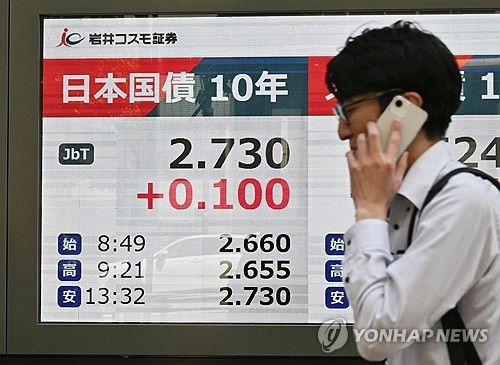
[Financial News, Tokyo = Seo Hyejin, correspondent] Japan's benchmark 10-year government bond yield surged to as high as 2.80% intraday on the 18th, marking its highest level in 29 and a half years. The move reflected growing concerns over fiscal expansion as inflationary pressure from high oil prices intensified and the Japanese government considered compiling an extra budget to respond to developments in the Middle East. With the Bank of Japan (BOJ) also reducing its bond purchases and unsettling the supply-demand balance, the Japanese government is moving to expand bond buying by overseas and retail investors to ease upward pressure on yields.
At 11 a.m. in Japan's bond market, the yield on newly issued 10-year government bonds stood at 2.790%, up 0.09 percentage point from the previous trading day. It briefly rose to 2.80% during the session, setting a new high since October 1996.
The rise was even steeper in the super-long segment. The yield on newly issued 20-year government bonds reached 3.735%, the highest level in about 30 years, while the 30-year bond yield climbed to 4.200%, a record high.
Nihon Keizai Shimbun, or The Nikkei, said bond selling accelerated as inflationary pressure from high oil prices increased and the Japanese government signaled plans to draw up an extra budget to address the Middle East situation, heightening concerns about fiscal expansion.
Rising U.S. Treasury yields also helped push Japanese rates higher. On the 16th, U.S. 10-year Treasury yields briefly climbed into the upper 4.5% range, reaching their highest level in about a year. Continued pressure from U.S. inflation and concerns over higher oil prices appear to have influenced Japan's market as global bond yields rose broadly.
Concerns are also growing that fiscal risk premiums could widen as the Japanese government considers an extra budget and the possibility of issuing deficit-financing bonds. Market participants also see possible instructions from Japanese Prime Minister Sanae Takaichi to address inflation and review an extra budget as another factor behind the rise in long-term yields.
At the same time, the BOJ, once the largest buyer of Japanese government bonds, has been cutting back its purchases, weakening the market's demand base. The BOJ's share of outstanding government bonds fell to 43.1% at the end of last year from 47.9% at the end of 2023, a drop of 4.8 percentage points.
Room for additional buying by existing major investors is also limited. Life insurers have effectively completed their additional purchases as they respond to international capital regulations, while banks are finding it difficult to expand buying because of risk-management rules.
In response, the Ministry of Finance (Japan) is seeking to broaden the investor base by attracting overseas and retail buyers.
According to Yomiuri Shimbun, Hirokazu Ando, head of the Japanese Government Bonds Office, and others recently met with hedge fund officials in the Middle East to explain Japan's fiscal policy and the state of the government bond market. In 2024, the number of meetings with overseas investors reached 204, up 70% from five years earlier.
However, there are also concerns that overseas investors, especially hedge funds, could increase yield volatility because they tend to trade in the short term. Large-scale selling could send yields sharply higher, which would mean bond prices falling.
The Ministry of Finance (Japan) plans to strengthen sales of government bonds to retail investors, who are expected to hold them more stably. Starting in January next year, it will rename the product Individual Savings Bonds Plus and expand the investor base to include unlisted companies and condominium management associations.
In a proposal submitted to Japanese Prime Minister Sanae Takaichi on the 14th, the LDP's Asset Management Nation Diet Members' League also called for improvements to government bond products and the development of new offerings to create a better investment environment.
Junichi Kanda, an LDP member of the House of Representatives of Japan who compiled the proposal, said, "As the share of overseas investors rises, market instability could become a bigger risk, so the share held by individuals should be increased."
[email protected] Seo Hyejin Reporter