"Throw Away Even the Commemorative Badges"...Large Trash Bin Appears in Front of Air Force One
- Input
- 2026-05-18 06:53:13
- Updated
- 2026-05-18 06:53:13
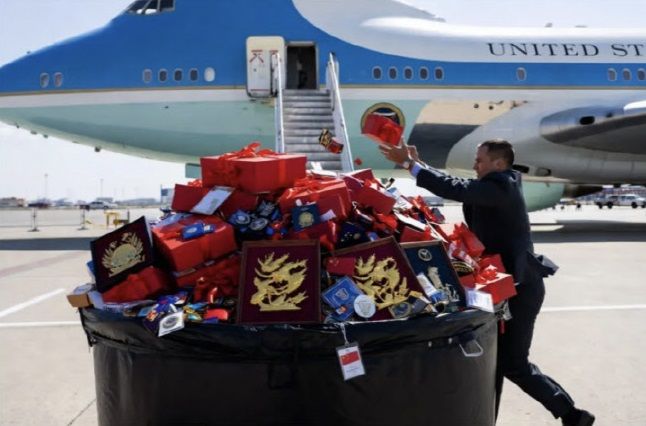
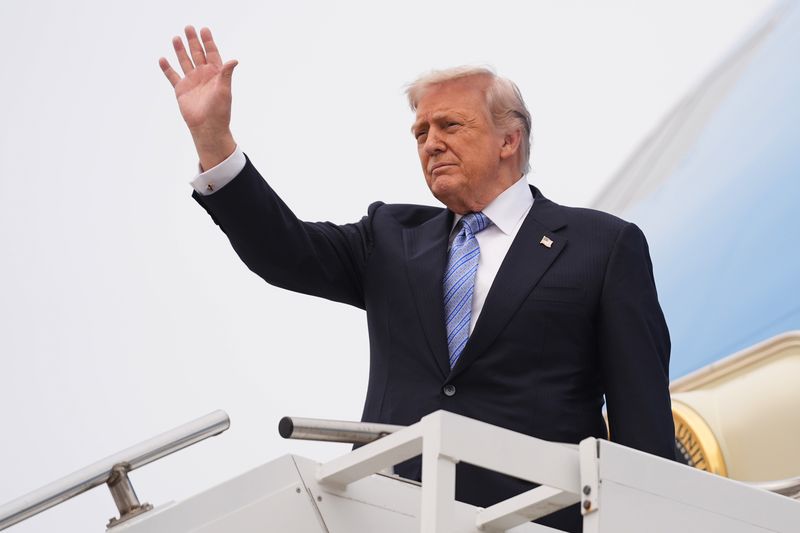
[Financial News] It has been confirmed that President Donald Trump and his entourage, who visited Beijing for the U.S.-China summit, threw away all items received from the Chinese side just before boarding the presidential aircraft on their way home.
According to foreign media outlets including the New York Post and Fox News on the 17th local time, the U.S. delegation tossed the items handed out by Chinese officials into a large trash bin in front of the Air Force One stairs just before departure.
Emily Goodin, a White House reporter for the New York Post, wrote on her X account on the 15th that "the U.S. advance team collected and threw away all items, including passes distributed by Chinese officials, temporary mobile phones issued by White House staff, and delegation badges, before boarding Air Force One."
She added, "Nothing from China is allowed on the plane."
Fox News host Ainsley Earhardt also said that "all Americans used disposable phones and had to leave them in China," adding that "if items owned by the Chinese side were left on the plane, they could contain listening devices or spies."
The disposal was not prompted by the discovery of actual malware or eavesdropping devices in the collected items. U.S. intelligence authorities have long warned that not only electronic devices but also ordinary everyday items and souvenirs can be fitted with tracking or surveillance tools. They apply the strictest standards, especially during visits to China and Russia.
During this trip to China, the U.S. delegation treated the communications environment in China as "high risk" and followed strict digital security guidelines.
To block surveillance, hacking, and data collection at the source, the delegation used only temporary, disposable "burner phones" and "Clean laptops" instead of personal devices. Staff members' personal devices were placed in Faraday bags, which block electromagnetic signals, and stored separately inside Air Force One.
Accessing hotel public Wi-Fi and charging through shared USB ports were strictly prohibited. Internal reporting was also carried out mostly face to face rather than through electronic devices. In particular, sensitive conversations were held only inside a temporary SCIF, where electronic signals are completely blocked, to minimize the risk of eavesdropping.
President Trump, who usually enjoys being active on social media, was also restricted in his phone use during the trip to China, and his social media posts dropped sharply.
Lesson from the 1945 gift of "The Thing"...Trump says, "We spy on China extensively too"
The reason the United States is wary even of simple badges and commemorative trinkets also lies in a painful history of intelligence warfare. A representative example is the 1945 incident involving "The Thing," a wooden eagle ornament given by a former Soviet Union children's group to the U.S. ambassador to the Soviet Union. The United States hung it in the embassy, but seven years later an investigation revealed that it concealed an advanced listening device that worked only when activated by external radio waves and without any power source, causing a major shock.
Meanwhile, during a press briefing held aboard Air Force One on the return flight, President Trump responded to a question about China's cyberattacks by saying, "We do the same intelligence work they do. We spy on them extensively too."
He also said that it was "very likely" China had planted malware in U.S. infrastructure, adding, "We do that to them too," and described it as a "double-edged sword."
[email protected] Moon Young-jin Reporter