"Samsung at 590,000 won, Hynix at 4 million won" Nomura says they are still undervalued despite fears of a 'Black Monday'
- Input
- 2026-05-18 05:19:10
- Updated
- 2026-05-18 05:19:10
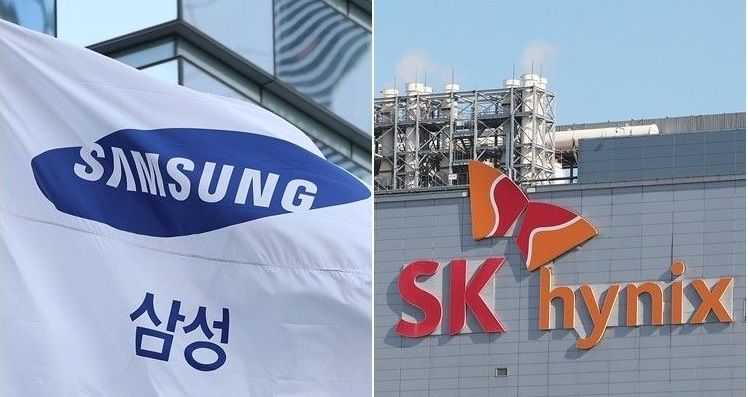
[Financial News] Japan's Nomura Securities sharply raised its target prices for Samsung Electronics and SK hynix. The firm argued that the two companies should be re-evaluated not as traditional cyclical stocks, but as structural growth stocks in the era of Artificial Intelligence (AI). The bold view is drawing attention to how it may affect South Korea's stock market, where concerns have risen after the recent plunge in U.S. semiconductor shares.
According to the financial investment industry on the 18th, Nomura Securities said in a report released on the 15th that it raised its target price for Samsung Electronics to 590,000 won from 340,000 won, and for SK hynix to 4 million won from 2.34 million won.
The key logic behind the sharp upward revision is a shift in valuation methods. Until now, brokerage firms have mainly used the price-to-book ratio because the memory semiconductor industry tends to swing between boom and bust, with periods of heavy profits and losses. That made it difficult to apply the price-to-earnings ratio, which assumes stable earnings.
Nomura Securities, however, said the era when prices swung with demand for PCs and smartphones has passed. The firm noted that Samsung Electronics and SK hynix currently trade at a forward 12-month P/E ratio of about 6 times. It added that the market is underestimating the durability of their earnings, and that they deserve valuations closer to Taiwan Semiconductor Manufacturing Company Limited (TSMC), which trades at around 20 times earnings.
The report pointed to the evolution of the AI paradigm and expanding data center investment as the background for this structural growth.
It said AI is rapidly moving beyond the training stage, where large amounts of knowledge are fed into models, and into the inference stage, where practical services are delivered. In particular, agentic AI, which can make decisions and act on its own, is driving a surge in the use of KV cache memory, which temporarily stores computation results and skips past calculations. Retrieval-Augmented Generation (RAG), in which large language models search external data to improve answers, was also identified as a key factor behind booming demand for High-Bandwidth Memory (HBM).
Rising global data center capital expenditures (CAPEX) are also expected to support demand. Nomura Securities estimated that global data center investment will jump more than fivefold from $1.16 trillion last year to $6.13 trillion in 2030, while the share accounted for by memory will also expand sharply from 9% now to 23% in 2030.
Long-term contracts are seen as reducing risk amid supply-demand imbalances, with operating profit expected to make a 'quantum leap' in 2028.
Unlike surging demand, supply is expected to remain far short. Nomura Securities forecast that memory demand could grow by thousands of times over the next five years, while supply growth will be limited to about five to six times, or roughly 30% a year, leading to a severe supply-demand imbalance.
It also dismissed concerns over the kind of earnings volatility seen in the past. The firm said many current memory supply contracts are now structured as 3- to 5-year Long-Term Agreements (LTA) that include advance payments and commitments to support facility investment, significantly reducing earnings risk.
As a result, profitability at both companies is expected to improve dramatically. Nomura Securities forecast that SK hynix's average selling price (ASP) for HBM per gigabyte will rise from $12.90 in 2026 to $20.90 in 2027. Its operating profit outlook is equally striking. Based on Nomura's estimates, Samsung Electronics' operating profit, which is around 307 trillion won this year, will rise to 511 trillion won in 2028, although the pace of improvement in foundry profitability is expected to remain limited. SK hynix's operating profit is projected to surge from 281 trillion won this year to 480 trillion won in 2028.
[email protected] Moon Young-jin Reporter