"Now It’s Time to Monetize AI" ... Big Tech Flocks to South Korea as a Testbed [Tech Signal by Jo Yoon-joo]
- Input
- 2026-05-17 19:04:00
- Updated
- 2026-05-17 19:04:00
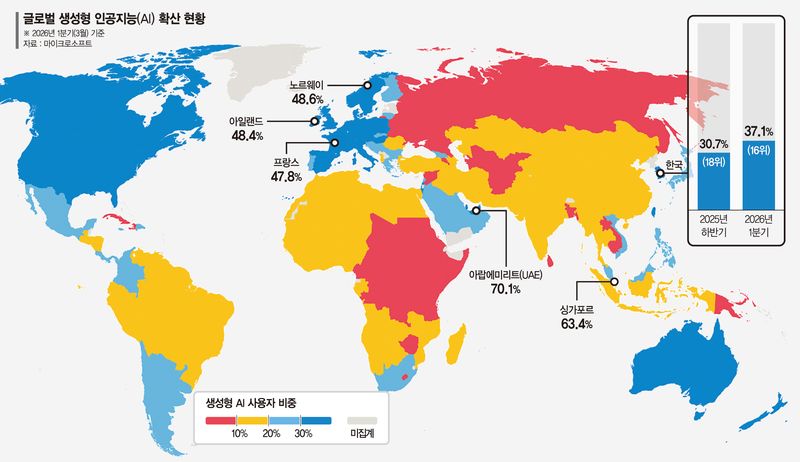
What stands out is that the report identified South Korea as a representative example of AI diffusion in Asia. In fact, 12 of the 15 economies with the fastest growth since June 2025 were in Asia, led by South Korea (+43%), Thailand (+36%), and Japan (+34%). The report cited investment in digital infrastructure, strong consumer receptiveness, and improved model performance in local languages as key factors behind the trend.
Industry observers view South Korea not simply as a consumer market, but as a real-world AI testbed. Mobile-based service consumption is active, content production and distribution cycles are fast, and the country has a high share of developers and early adopters. That is why South Korea, once a fiercely contested market for search portals and messenger platforms, is again emerging as a battleground for global platforms in the generative AI era. The recent wave of partnerships by companies such as NVIDIA Corporation, Google DeepMind, and Anthropic with Korean firms also appears aimed less at fighting for market share and more at verifying actual commercialization potential.
■ Claude rises rapidly amid ChatGPT's dominance
The landscape of South Korea's generative AI market is shifting quickly. While ChatGPT continues to hold a commanding lead, Claude is rising fast, and with Meta AI now entering the market, competition is expanding into a full multi-player race.
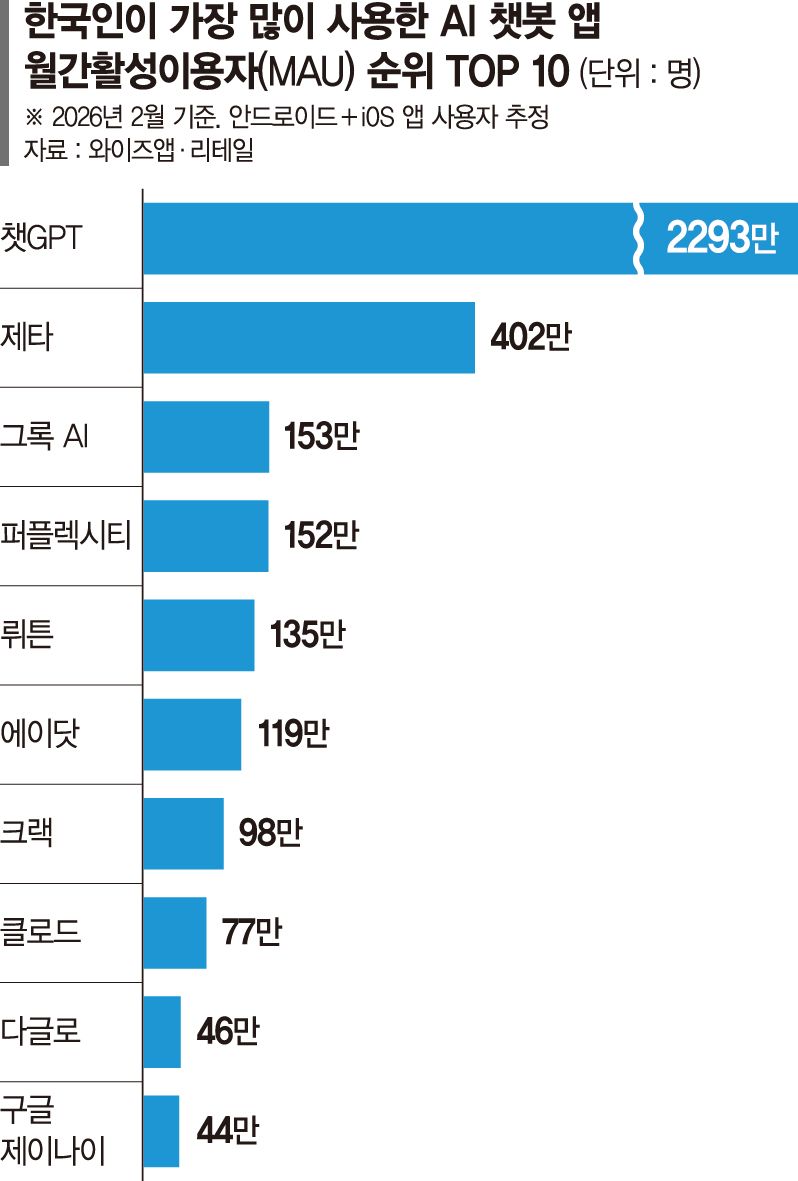
According to WiseApp Retail, ChatGPT had 22.93 million monthly active users in South Korea as of February, ranking far ahead of other AI chatbots. Its usage time also reached 50.47 million hours per month, well above its rivals.
The service showing the sharpest recent growth, however, is Claude. Data from IGAWorks Inc.'s Mobile Index show that Claude recorded 506,684 new installs in April, surpassing 500,000 for the first time. That was nearly 12 times higher than the 42,701 installs in January, just three months earlier. Its share of new installs also rose to 17.7%, placing it second behind ChatGPT's 32.2%.
Its user base is also expanding quickly. Claude's April MAU reached 1,012,307, up by more than 400,000 from 602,276 a month earlier. Its ranking also jumped from fifth to third. That suggests it has entered a phase of rapid real-user adoption. Industry watchers say the main driver behind Claude's growth is rising demand among developers and professionals. As its strengths in long-context processing and coding and document work become more widely recognized, it is quickly capturing demand for work-oriented AI.
By contrast, Elon Musk's AI service Grok is losing momentum. According to app analytics firm AppMagic, Grok's global downloads peaked at more than 20 million in January, then fell to around 8.3 million in April. That represents a drop of about 59% in four months. In South Korea, it still sits in the middle tier by monthly users, but its recent growth has slowed compared with competitors.
Against this backdrop, the arrival of Meta AI in South Korea is seen as a new variable. Meta Platforms recently launched the Meta AI app and web service in the country, about a year after its global debut in April last year. Its strength lies in its existing platform ecosystem. Meta Platforms plans to expand AI features across Instagram, Facebook, Facebook Messenger, and Meta AI glasses. Attention is now focused on how effective its strategy of embedding AI within its social media platforms will be.
■ The real battleground is B2B
Industry players say the real battleground in generative AI is not the consumer market, but the enterprise market. That is also where real revenue is generated. Consumer-facing general-purpose AI services have succeeded in expanding their user base and reaching the mainstream, but they still struggle to secure a clear profit model relative to the high cost of infrastructure. As a result, the key competitive edge is shifting from simple chatbot rivalry to how deeply AI can be embedded into actual workflows.
Observers note that the recent changes in South Korea's generative AI market go beyond a simple race for user numbers. The purpose of use itself is changing. In the early stage, demand centered on translation, search, and curiosity-driven trials. More recently, however, use cases such as coding, document writing, research, and meeting summaries have been growing rapidly. In particular, as developers, startups, and professionals increasingly choose services based on which AI is more stable in real work, the competitive landscape in South Korea is shifting away from broad popularity and toward productivity and work efficiency.
The number of people using generative AI at work is also rising quickly. According to a PMI survey, 44.4% of generative AI users said they "frequently or actively use" AI for work. Among those with AI experience, 71.5% said it helps improve work efficiency, while 45.2% said work would be disrupted if AI services were unavailable. The main purposes of use were information gathering and summarization (47.6%), document and content generation (19.8%), and data processing and analysis (14.4%). That is why analysts say generative AI is becoming not just a search tool, but a real productivity infrastructure.
In particular, global AI companies have recently been focusing on strengthening coding, document, research, and agent functions. The market is moving beyond a stage where users simply ask questions and toward a competition in "action-oriented AI," where AI performs tasks directly. Industry observers say the generative AI market is likely to evolve into a contest over the AI operating system.
■ What is the strategy for local AI firms?
So what is the strategy for Korean AI companies facing Big Tech AI backed by massive capital? On the surface, the competition may look like separate battles in search, messaging, and shopping. In reality, the focus is on how deeply AI can be embedded into existing platforms and consumer ecosystems.
Naver is expanding AI Briefing, AI search, and shopping recommendation features based on its own HyperCLOVA X, increasing the use of generative AI across its search, commerce, and content ecosystem. Analysts say this is less about competing with chatbots and more about transforming the portal platform itself into an AI-centered structure.
Kakao Corp. is also applying ChatGPT-based AI features to KakaoTalk, while strengthening AI Mate, conversational recommendations, and search functions. The goal is to combine OpenAI technology with a massive messenger-based user platform and turn it into an AI hub. The strategy goes beyond simply attracting users and aims to reorganize the entire content, commerce, and advertising ecosystem around AI. Upstage Co., Ltd. recently acquired AXZ, which operates the portal Daum, and is working to enhance services by combining its Solar AI model with search and content data.
Telecom companies are also accelerating their AI platform push. SK Telecom (SKT) is expanding personal AI services around A., while KT and LG Uplus are focusing on strengthening enterprise AI services such as AI consulting and work support. These efforts can be seen as attempts to connect AI to everyday services and work environments based on existing telecom platforms and customer data.
This strategy goes beyond the language advantage of having an AI that is good at Korean. It is converging on a broader approach: penetrating regulations, data, and workflows as deeply as possible. The aim is to build competitiveness in industry-specific areas where global Big Tech cannot respond immediately. But how effective that strategy will be remains uncertain. As Big Tech AI systems rapidly improve their Korean-language performance, the traditional advantage of language barriers is weakening. There are also concerns that if global Big Tech moves aggressively into the B2B market, the space for local AI firms could narrow further.
An industry source said, "Global Big Tech companies have begun to see the South Korean market not just as a consumer market, but as a key market for testing the spread and commercialization of AI services." The source added, "The competition is no longer about a single standalone chatbot. It is expanding into a race to reorganize entire platforms such as search, messaging, content, and commerce around AI." The source also said, "In the end, only AI that penetrates deeply into industrial settings will survive. It is becoming harder to rely on language or cultural specialization alone, and the industry has entered a phase where real-world performance must be proven."
[email protected] Reporter