A 21-Mile Sea Route Reshapes the Global Energy Map [Global Report]
- Input
- 2026-05-17 19:01:18
- Updated
- 2026-05-17 19:01:18
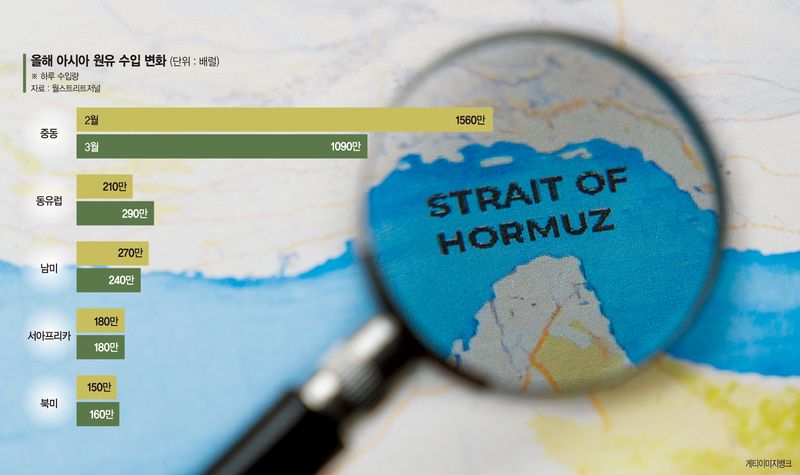
【Financial News New York=Reporter Lee Byung-chul】 On Feb. 28, 2026, a 21-mile (34-km) stretch of sea brought the world to a halt. The shock was not evenly distributed. After U.S. and Israeli airstrikes hit Iran, the Iranian Revolutionary Guard invoked, for the first time in history, the card the world had long feared: a blockade of the Strait of Hormuz, the narrow waterway linking the Persian Gulf and the Gulf of Oman.
Major shipping companies such as Maersk and Hapag-Lloyd immediately suspended transits through the strait or began rerouting vessels. Within three days, more than 150 tankers had anchored outside the strait. Oil flows through the passage plunged from 20 million barrels a day to around 2 million barrels. Traffic is now effectively paralyzed. Fatih Birol, executive director of the International Energy Agency (IEA), stressed that "the world is facing the greatest energy security threat in history."
■The Strait of Hormuz blockade chokes the global economy
The world has once again been thrown into an energy crisis. Europe is facing its second major energy shock since the Russo-Ukrainian war, while major Asian economies such as South Korea, Japan, and China, which depend heavily on Middle Eastern crude, have moved into emergency response mode. The war has reinforced a new global consensus that energy is security. Stabilizing energy supply chains and diversifying import sources are now unavoidable national priorities.
Japan relies on imports for more than 85% of its energy consumption and is especially dependent on oil from the Middle East. Last year, 94% of Japan's crude oil imports came from the Middle East, with most of that supplied by the United Arab Emirates (43%) and Saudi Arabia (39%). JERA, Japan's largest LNG power producer, said it has secured LNG inventories sufficient through July.
India, which depends on imports for about 85% of its crude oil consumption, has been hit directly by the Strait of Hormuz blockade. As disruptions to Middle Eastern crude procurement and surging global oil prices shake the trade balance, inflation, and the rupee at the same time, the Indian government is considering expanding imports of Russian crude and using strategic petroleum reserves.
Southeast Asia is also in crisis. The World Economic Forum (WEF) said 55% of ASEAN's oil imports come from the Middle East and that the crisis could affect as much as 28% of the region's final energy consumption. It also estimated that the shock could raise ASEAN's monthly import costs by $3.36 billion, equivalent to a 3.4% increase compared with the 2026 budget.
■Europe hit by a second energy shock
Europe has also taken a direct hit. Analysts say it is facing another energy security crisis after the Russo-Ukrainian war. By last winter, Europe's gas storage levels had fallen to the low 30% range. The Strait of Hormuz blockade has left Europe facing disruptions to Qatari LNG and Middle Eastern jet fuel supplies. The IEA said Europe's imports of Middle Eastern jet fuel plunged from 330,000 barrels a day to about 60,000 barrels a day in just one month. The International Monetary Fund (IMF) described the situation as "the biggest disruption in the history of the global oil market" and said energy security concerns in Europe's economy are rising again.
■The world turns back to nuclear power
The most fundamental change brought by this crisis is a redefinition of energy security itself. Since the Cold War, discussions of energy security have focused mainly on price stability and supply diversification. This crisis, however, has gone beyond simply diversifying supply routes. It has become a turning point in which renewable energy, electrification, and in some countries nuclear power are being redefined as tools of national security.
Europe, long seen as a symbol of green energy, is adjusting the timing of its nuclear phaseout. The European Commission has recommended that existing nuclear plants should not be shut down early if they can continue supplying stable, affordable, low-carbon electricity. It said nuclear power can help reduce fossil fuel use in heating and industry, while also strengthening grid stability during the expansion of renewable energy. European Commission President Ursula von der Leyen said last month that Europe's anti-nuclear policy was a "strategic mistake."
Germany pursued a nuclear phaseout after the Fukushima Daiichi nuclear disaster and shut down its last reactor in 2023, but Belgium and the Netherlands have recently reversed their anti-nuclear policies. Spain is also moving toward closing nuclear plants from 2027, though energy companies are calling for life extensions.
Taiwan has begun reviewing and approving the restart of two closed nuclear reactors amid energy supply concerns. The Philippines is also pushing ahead with a nuclear power roadmap aimed at bringing its first reactor online in 2032, while expanding cooperation with South Korea on nuclear technology.
■Renewables and electrification emerge as a new security strategy
Renewable energy is also back in the spotlight. After the U.S.-Iran war sent LNG prices soaring, the Philippines is accelerating solar expansion as part of its energy security strategy. To reduce Southeast Asia's highest electricity prices and heavy reliance on coal, it has eased restrictions on foreign investment, while major global companies such as Masdar and TotalEnergies continue to make large-scale solar investments. India is pursuing faster permitting for wind and battery energy storage system (BESS) projects, and Cambodia is expanding tax incentives and tariff cuts for electric vehicles and solar-related industries.
As energy security concerns have intensified again, the EU announced an emergency energy response package called "AccelerateEU." Its core goal is to reduce dependence on fossil fuels from the Middle East and Russia while strengthening Europe's own energy production capacity. The EU plans to expand renewable energy such as solar and wind, electrify industry and transport, and increase investment in power grids. It will also strengthen joint gas purchasing and strategic stockpiling, and consider releasing joint oil reserves if necessary. The European Commission said that "energy security is economic security," adding that the crisis once again exposed the risks of Europe's dependence on fossil fuel imports.
■China had already prepared
China has been preparing for this kind of situation for years. It has subsidized the spread of electric vehicles, increased domestic oil production, and worked with Russia to stabilize energy supply chains. As the world's largest energy consumer and a manufacturing powerhouse, China has also achieved remarkable progress in renewable energy.
In particular, China holds about 900 million barrels of strategic petroleum reserves and sources crude oil from 49 countries. Even among its top five suppliers, no single country accounts for more than 20%, reducing dependence on any one region. Overland pipelines connecting China to Russia and Central Asia have also served as alternative supply routes. More than half of China's gas imports come through overland pipelines rather than by sea.
China has also continued making the world's largest investments in solar and wind power, adding more than 430 GW of new renewable capacity last year alone. Renewables now account for more than 60% of total installed power capacity. Foreign media have described this not simply as a carbon-neutrality policy, but as a "national security strategy to reduce the risks of imported fossil fuels."
[email protected] Reporter Lee Byung-chul Reporter