KOSPI Seen Reaching 10,000, But Foreign Investors Have Sold 100 Trillion Won
- Input
- 2026-05-17 18:19:37
- Updated
- 2026-05-17 18:19:37
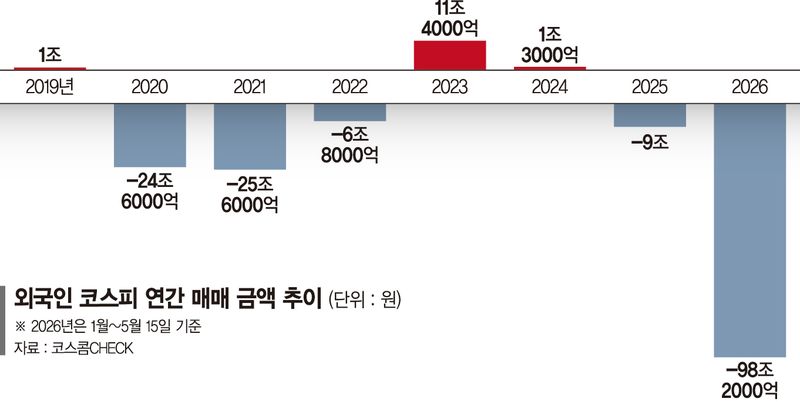
Foreign funds have withdrawn about 100 trillion won from the stock market alone since the start of the year. If the current trend continues, this year's foreign selling spree could become the largest on record. Still, many observers say the more likely explanation is profit-taking by global funds to rebalance their portfolios rather than a broad "Sell Korea" move, suggesting the medium- to long-term uptrend remains intact.
Most experts call it "mechanical profit-taking."
According to KOSCOM CHECK on the 17th, foreigners posted a net sell of 98.2 trillion won in the KOSPI market alone from the start of the year through the 15th. That is 11 times last year's annual net selling of about 9 trillion won, reached in just over four months. The largest-ever net foreign selling in KOSPI terms was recorded in 2008, at the height of the GFC, when it reached 43.4978 trillion won.
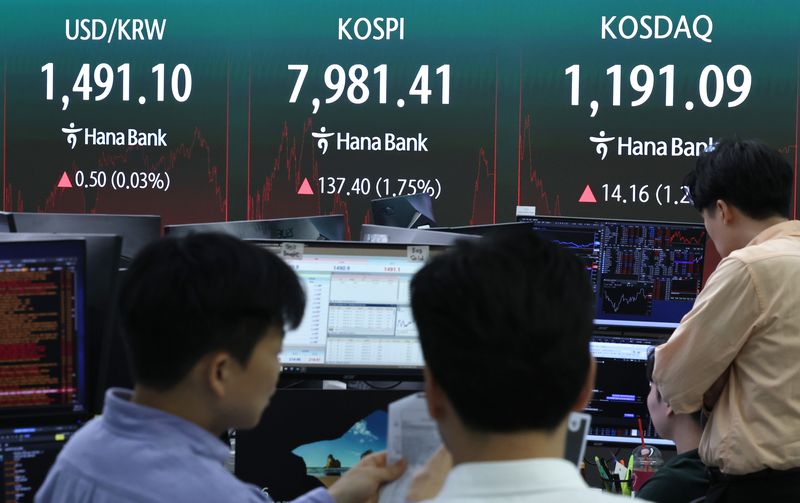
In particular, foreigners sold 6.3173 trillion won worth of shares on the 15th alone, when KOSPI broke above the 8,000 mark intraday for the first time in history. The index surged to an all-time high of 8,046.78 early in the session, but later reversed sharply after a sell-side sidecar was triggered. It ultimately closed at 7,493.18, down 6.12% from the previous trading day.
"The selling is too fast and too intense."
Market participants say KOSPI's climb to the 8,000 level despite foreign selling was supported by buying from domestic institutions and retail investors. In particular, experts say long-term money flowing in from public pension funds and retirement pensions helped cushion the impact of foreign selling. Demand for Exchange-Traded Fund (ETF) investments also expanded, especially through Individual Retirement Pension (IRP) accounts and DC pension plans, supporting domestic market liquidity.
Competition among asset management companies to launch ETFs linked to Samsung Electronics and SK hynix, along with greater ETF inflows into retirement pensions after the default option system took effect, also played a role.
Growing caution in the financial investment industry
However, as foreign selling has lasted longer than expected, caution is also growing across the financial investment industry. Views are split between those who see the selling as short-term profit-taking and those who say structural factors such as monetary policy and exchange rates deserve more attention. The cautious camp is focusing on the size and speed of the selling, as well as the direction of interest rates. Compared with past episodes of foreign profit-taking, the selling pressure is seen as too strong, and the pace has accelerated this month, making it hard to view it as simple rebalancing.
Inflation concerns driven by high oil prices, valuation burdens, and the possibility of rate hikes in major economies were also cited as factors weighing on the broader market. Joain, a researcher at Samsung Securities, said, "Rising U.S. Treasury yields, inflation data that came in higher than expected, and higher oil prices all served as reasons for profit-taking and increased market volatility." Kim Byung-yeon, a researcher at NH Investment & Securities, said, "Falling share prices of U.S. memory semiconductor companies and the Samsung Electronics labor union strike issue emerged at the same time, dampening investor sentiment."
Most experts interpreted the foreign selling streak as rebalancing, noting that KOSPI's sharp rise since the start of the year had increased Korea's weight in Global Asset Allocation Funds. Such funds typically reduce exposure mechanically when a country's share exceeds the target level.
"The uptrend still looks valid" for the medium to long term
In the securities industry, many say the medium- to long-term uptrend in the domestic market remains intact as earnings estimates for companies continue to rise. Lee Jae-man, a researcher at Hana Securities, said, "Even without assuming a PER re-rating, if current earnings estimates are realized, the door remains open to a KOSPI 10,000 era." He added, "That said, we need to keep checking whether corporate earnings growth will continue as expected in a high oil and high interest rate environment."
[email protected] Kim Hyun-jung, Seo Min-ji Reporter