Higher-credit borrowers pay more interest... 'interest rate inversion' in overdraft loans
- Input
- 2026-05-17 18:11:47
- Updated
- 2026-05-17 18:11:47
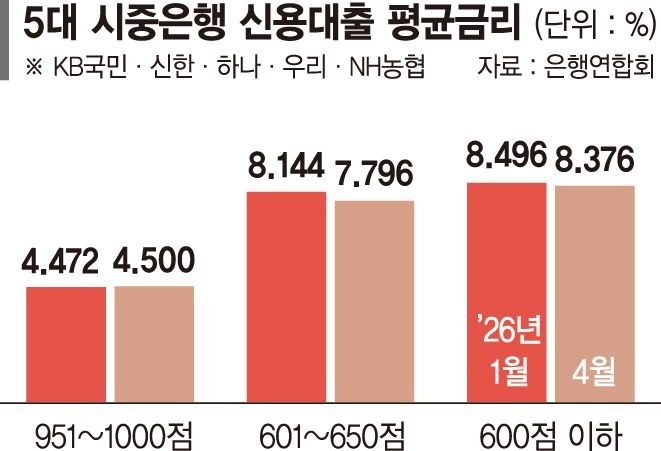
According to the banking sector on the 17th, the average interest rate on general credit loans in April at the five major commercial banks (KB Kookmin Bank, Shinhan Financial Group, Hana Bank, Woori Bank and NH NongHyup) stood at 4.50% for the 951-1000 credit score range. That was a slight increase of 0.028 percentage point from 4.472% in January this year.
By contrast, credit loan rates for the 751-950 range and lower-credit borrowers fell across the board over the past three months. The 901-950 range dropped 0.038 percentage point from 4.942% in January to 4.904% this month. The 900-851 range fell from 5.486% to 5.39%, down 0.096 percentage point. The 850-801 range also declined from 6.018% to 5.928%, while the 800-751 range fell from 6.544% to 6.422%, down 0.122 percentage point.
The decline was especially steep for lower-credit borrowers. The average rate on new credit loans for borrowers with scores of 600 or below fell 0.12 percentage point from 8.496% in January to 8.376% in April. Over the same period, the 601-650 range dropped 0.348 percentage point from 8.144% to 7.796%, the largest decline among all ranges.
Some mid-to-lower credit ranges saw rates rise. The 651-700 range increased 0.13 percentage point from 7.26% to 7.39%, while the 701-750 range also edged up 0.024 percentage point from 6.872% to 6.896%.
Analysts say the sharp drop in rates for lower-credit borrowers reflects the recent push by the financial authorities to expand lending to mid- and lower-credit customers and the broader drive for inclusive finance. Banks have lowered rates for lower-credit borrowers or offered preferential rates, leading to unusual pricing patterns in some segments.
An interest rate inversion was also confirmed in credit line loans. As of this month, the average rate in the 601-605 score range was 5.428%, lower than the 5.492% charged in the higher-credit 651-700 range. A similar pattern appeared in March. The 601-650 range was 5.647%, while the 651-700 range was 5.662%, meaning borrowers with higher credit scores paid more.
Under the usual banking rate structure, lower credit scores generally mean higher add-on rates. In particular, when market rates are rising, funding costs and concerns over asset quality often push rates for lower-credit borrowers up faster. But recently, a combination of expanded policy lending, management of mid-rate loan targets and preferential rates has produced a trend that differs from the traditional rate structure, observers said.
[email protected] Seo Ji-yoon Reporter