"Why Is My Account..." More Stocks Are Falling Than Rising
- Input
- 2026-05-17 14:58:34
- Updated
- 2026-05-17 14:58:34
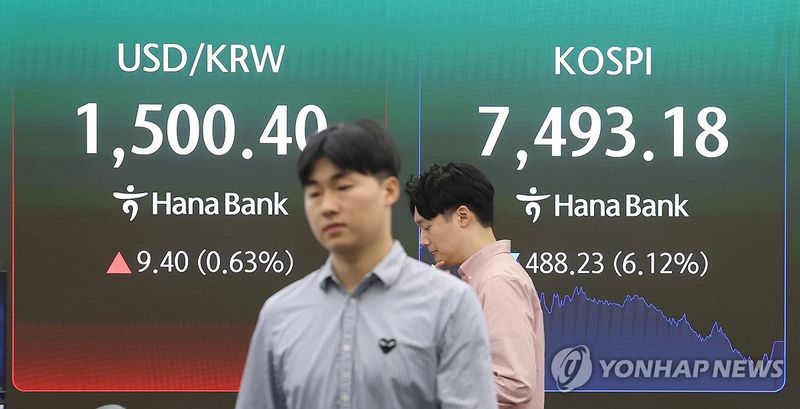
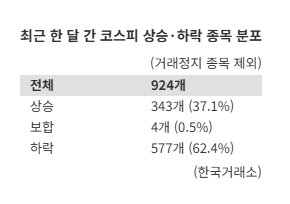
[Financial News] As volatility in the domestic stock market has widened recently, many retail investors have had little reason to smile. In the KOSPI market, the number of declining stocks is about 1.5 times higher than the number of rising ones. On the 17th, Korea Exchange (KRX) said that among 924 KOSPI-listed stocks, excluding trading suspensions, over the past month (April 15 to May 15), 343 stocks rose, accounting for just 37.1% of the total. By contrast, 577 stocks fell, or 62.4%.
During the same period, the KOSPI rose 25.56%, from 5,967 to 7,493. Despite the index's explosive performance, the larger number of declining stocks suggests that gains in a small group of names drove the broader market.
The KOSPI advance-decline ratio, a gauge of market concentration, closed at 77.99% on the 15th, down 7.99 percentage points from the previous trading day. The ADR measures whether buying or selling pressure is concentrated by calculating the ratio of advancing stocks to declining stocks. It is expressed as the percentage of cumulative gainers over 20 trading days divided by cumulative losers. A KOSPI ADR in the 77% range means there are 1.3 times more declining stocks than rising ones.
The KOSPI ADR was above 130% as recently as April 28, when it broke through the 6,640 level. In general, an ADR above 120% is considered an overheated market with too many gainers, while a reading below the 70% range is seen as an oversold zone with too many losers. In less than a month, the index has climbed above 7,400, yet the ADR has fallen to a level close to oversold territory.
This suggests that the concentration in a few leading stocks has intensified in the domestic market this month. Through the 14th, the KOSPI had risen 20.95% this month, but among the 26 KOSPI sectors, only Semiconductors (27.97%) and Automobiles (23.56%) outperformed the index. Han Ji-young, a researcher at KIWOOM Securities Co., Ltd., said, "This is the first time since January 2005 that only two sectors have outperformed the KOSPI on a monthly basis."
The problem is that the sectors that surged in a short period also saw sharp declines. On the 15th, when the KOSPI plunged 6.12% in a single day, the Semiconductor sector index fell 8.41%, dropping more sharply than the benchmark. In fact, through the 14th this month, Samsung Electronics had surged 34.24% and SK hynix 53.19%, but both fell sharply on the 15th, dropping 8.61% and 7.66%, respectively.
Brokerages expect that, as the KOSPI has climbed above 8,000 on the back of concentration in a few sectors such as semiconductors, any short-term correction could also be centered on those same industries. They say investors should be cautious about rising volatility.
Lee Sang-heon, a researcher at iM Securities, said, "In May, expectations for semiconductors were priced in too aggressively within just a few trading days, pushing the index up by more than 1,000 points." He added, "After the domestic stock market options expiration day on the 14th, foreign investors began changing positions from the 15th, which widened the swings further." He also noted, "If the United States CPI comes in far above expectations, it could add pressure for rate hikes by global central banks."
[email protected] Park Ji-yeon Reporter