Vertigo-inducing 'rollercoaster KOSPI'... Volatility surges above COVID-19 levels
- Input
- 2026-05-17 14:53:45
- Updated
- 2026-05-17 14:53:45
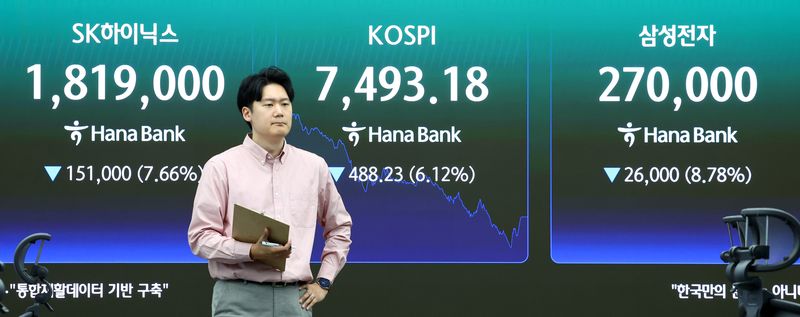
[Financial News] The Korea Composite Stock Price Index (KOSPI) has become more volatile this month. As investors brace for interest rate hikes, profit-taking after the index's sharp short-term gains and bargain hunting have both intensified, widening intraday swings.
According to the Korea Exchange (KRX) on the 17th, the average intraday volatility of the KOSPI from the start of this month through the 15th stood at 4.47%, sharply up from 2.26% in the previous month.
That is well above the 3.77% recorded in March, when the index was shaken by the fallout from the Middle East war. It is also higher than March 2020, when volatility was elevated due to COVID-19, at 4.27%.
Intraday volatility is calculated by dividing the difference between the day's high and low by the average of the high and low. It shows how much the index moves relative to its daily average. The higher the figure, the larger the market's swing within a single day.
The measure has been rising rapidly this year. The average intraday volatility so far this year is 2.87%, more than double last year's average of 1.35%.
The KOSPI 200 Volatility Index, known as Korea's fear gauge, has also remained at a high level. On the 15th, the KOSPI 200 Volatility Index closed at 74.71, staying in the 70s for four consecutive trading days. On the 13th, it surged to 76.16, the highest level since March 4, when it hit an all-time high of 80.37 after the outbreak of the Middle East war.
The KOSPI 200 Volatility Index measures the market's expected future volatility reflected in option prices and usually rises when the KOSPI falls sharply. In a rising market, an increase in the index is interpreted as a sign that investors are becoming more anxious amid short-term overheating.
For now, the tug-of-war between profit-taking and bargain hunting is expected to intensify, keeping the market volatile. Monetary policy direction is emerging as the biggest variable.
Kim Seong-no, a researcher at BNK Securities, said, "As consumer prices remain at a high level, the likelihood is rising that major countries will begin raising rates from next month. In the stock market, a surge in foreign selling is also having a negative impact on the foreign exchange market," adding, "Given the growing uncertainty in financial markets, further volatility appears unavoidable for now."
Still, while a correction driven by short-term overheating is inevitable, the broader view is that the KOSPI will continue its upward trend. Han Ji-young, a researcher at KIWOOM Securities, noted, "Events that could weaken the market's rally momentum may emerge, such as upward pressure on rates from lingering effects of the U.S. inflation shock and the possibility of a sell-off in semiconductor stocks after NVIDIA's earnings." She added, "However, the rally's underlying drivers remain intact, including customer deposits that are increasing by 9.3 trillion won a month on average, a forward price-earnings ratio (PER) in the low 8x range, and the KOSPI operating profit consensus, which has risen to around 890 trillion won."
[email protected] Seo Min-ji Reporter