University departments increased by 12,000 in five years, with 'AI and convergence' as the key trend
- Input
- 2026-05-17 09:00:00
- Updated
- 2026-05-17 09:00:00
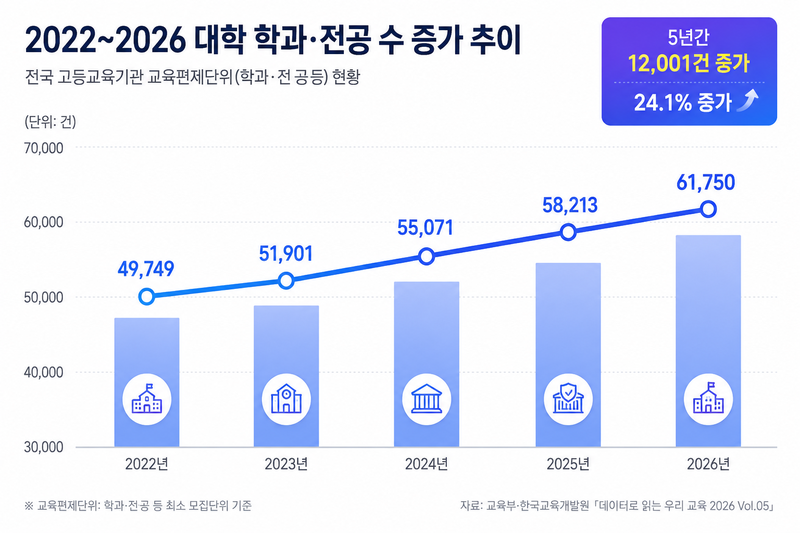
[Financial News] The number of departments at universities in South Korea has surged by more than 12,000 over the past five years. This is not just a quantitative expansion. As convergence programs combining fields such as AI and medicine, or energy and data, have proliferated, the fundamental character of university education is changing.
According to data released on the 17th by the Ministry of Education of the Republic of Korea and KEDI, the number of minimum enrollment units, including departments and majors, at higher education institutions nationwide rose from 49,749 in 2022 to 61,750 in 2026, an increase of 12,001 over five years. That represents a 24.1% jump. In particular, the 2026 academic restructuring alone created 3,471 new departments across universities, graduate schools, and junior colleges. The increase reflects universities subdividing existing majors and launching a large number of new convergence programs in response to social demand.
Engineering fields see AI as the leading keyword, while wellness rises in the humanities and social sciences.
An analysis of the names of newly established departments by keyword found that convergence, AI, global, management, and sports stood out most prominently. In engineering, convergence and AI ranked first and second across all levels of higher education, including universities, graduate schools, and junior colleges. Newly emerging keywords included systems, mobility, energy, and drones at junior colleges. The rapid pace of industrial transformation is being directly reflected in department names.
In the humanities and social sciences, global and management remained central, while wellness, care, and counseling rose sharply from the previous year. Analysts say this suggests that structural changes such as low birth rates and an aging population are increasingly being reflected in curricula. In the arts and physical education fields, design and sports led across all levels of higher education.
AI majors are becoming more advanced.
The qualitative shift in AI-related departments is also notable. The newly established Department of AI Futurology at universities and graduate schools goes beyond simple technology development. It covers data and algorithm ethics, AI policy and legal systems, and governance. The goal is to train policy and social experts for the AI era. The AI Department, which refers to AI transformation, focuses on producing practical talent who can apply AI to major industries such as semiconductors, automobiles, shipbuilding, biotech, and materials. To that end, it operates four specialized tracks: data and content AI, physics and manufacturing AI, and biotech and materials AI.
From infertility medicine to K-Silk Road studies, the range is broad.
Some unusual departments capture the spirit of the times in raw form. The Department of Infertility Medical Industry, newly opened at a university, combines biotechnology with AI-based digital healthcare to train specialists in infertility treatment in an era of low birth rates. It pairs education in life sciences such as Stem Cell Engineering and Embryo engineering with practical training in AI-based infertility medical data analysis.
The Department of Renewable Energy and Auction Convergence at a junior college is a practice-oriented program that combines solar power facility technology with real estate auctions and land management. It aims to train professionals who can handle both power plant operations and land use in the era of energy transition. The K-Silk Road Turkology Department at a graduate school seeks to cultivate Silk Road-style knowledge diplomats who can lead cooperation between Korea and Turkic regions, in line with growing demand for diversified global supply chains and resource diplomacy.
monarch@fnnews.com Kim Man-ki Reporter