Jeju April 3 Incident Becomes UNESCO Memory of the World; Next Task Is Passing Down the Memory, as Digital Archive Solutions Are Explored
- Input
- 2026-05-17 08:55:03
- Updated
- 2026-05-17 08:55:03
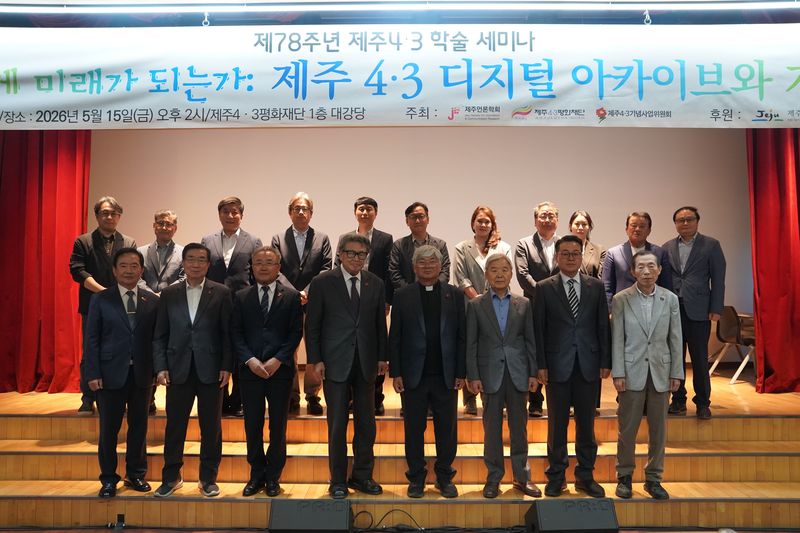
[Financial News Jeju = Reporter Jung Yong-bok] In Jeju, experts discussed ways to pass down the memory of the Jeju April 3 Incident to future generations through a digital archive and artificial intelligence (AI) and extended reality (XR) technologies. A key issue was how to preserve the records of April 3 and turn testimonies, documents, videos and spatial information into public knowledge that future generations can understand and experience.
The Jeju Journalism Society, a nonprofit organization chaired by Jung Yong-bok, held the 78th Jeju April 3 Academic Seminar on the 15th at the main auditorium on the first floor of the Jeju 4.3 Peace Foundation, together with the Jeju 4.3 Peace Foundation, chaired by Lim Moon-cheol, and the Jeju 4·3 Memorial Project Committee, led by Kang Ho-jin.
The seminar was held under the theme, "How Does Memory Become the Future?: Jeju April 3 Digital Archive and the Reproduction of Memory." It came as questions about preserving and using the records of April 3, passing them on to future generations, and ethically applying digital technology have gained attention since the records were listed as UNESCO Memory of the World.
In his opening remarks, Jeju Journalism Society Chairman Jung Yong-bok said, "Memory does not become the future on its own," adding, "Only when we call names, search for materials, listen to testimonies and leave records does it truly become the future." He went on to say, "AI cannot replace memory, and XR cannot testify to pain in its place," stressing that "a digital archive must become a public forum for memory where generations meet and local communities and the world can talk to each other."
In his welcoming remarks, Jeju 4.3 Peace Foundation Chairman Lim Moon-cheol said, "It has been one year since the April 3 records were listed as UNESCO Memory of the World," and added, "Memory does not remain in preservation alone. When it is recorded, conveyed and shared in step with the changing times, it becomes the memory of the next generation."
In his congratulatory remarks, Jeju Governor Oh Young-hun said, "The Jeju April 3 Incident is no longer confined to pain. It is taking shape as a universal history that humanity must remember," adding, "We will also speed up construction of the Jeju 4·3 Archive and Records Center so that the records can be systematically preserved and used."
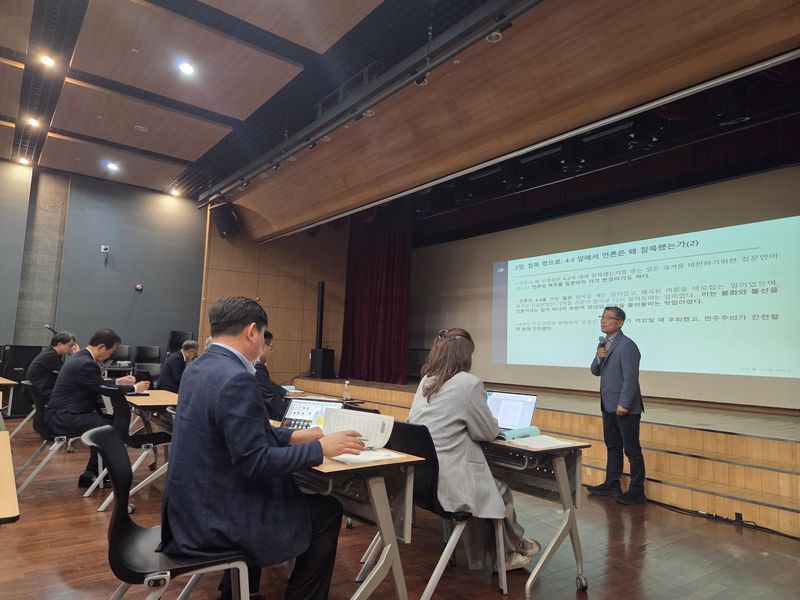
The seminar was organized to ask what the next task is for passing down the memory of April 3 after the records were listed as UNESCO Memory of the World. April 3 is expanding beyond the truth-finding process over state violence and the restoration of victims' honor into a history of peace and human rights that the world must remember together. The question is how to preserve and connect the records, and how to turn them into a language that future generations can access.
The first presentation was delivered by Hur Ho-jun, a visiting researcher at Ritsumeikan University and former senior reporter at The Hankyoreh. Under the theme, "Why Do I Write About Jeju April 3: History Seen Through the April 3 Archive," he reflected on the issues that have driven him to cover and document April 3 for more than 30 years.
He described April 3 not as "an incident that can be summarized in one or two articles and moved on from," but as a history that raises questions about state violence, silence, stigma and the structure of the Cold War. He especially defined the role of a journalist as finding fragments of truth through materials, testimonies, documents and records rather than abstract interpretation. His presentation was a reminder of what responsibility local media should bear in the face of a tragic past.
The second presenter, Lee Wan-su, emeritus professor at Dongseo University, gave a talk titled, "What and How Should Past Events Be Recorded?: A New Approach Through Memory Theory." He explained commemorative memory by dividing it into personal memory and collective memory, and presented a framework for analyzing how the deaths of Jeju April 3 victims are remembered and reproduced through individuals, communities and the media.
Lee said that "memory is not created in a vacuum." He explained that memory is formed through a complex interaction of personal experiences and emotions, institutions and practices, education and the media, and social values. In cases such as April 3, where state violence and ideological conflict are intertwined, the name used for the incident and how each death is recorded determine the direction of public memory.
The third presentation was delivered by Kim Dae-kyung, professor in the Department of Media and Communication at Dong-A University. Under the theme, "Reviving Memory: A Digital Memorial Hall for Jeju April 3 Implemented with AI and XR Technologies," he proposed a model for a Jeju April 3 digital archiving platform that combines AI and XR.
Kim pointed out the limitations of existing archives, which have remained centered on text-based preservation and access. He proposed connecting fragmented April 3 materials into a knowledge graph, restoring damaged or lost historical materials with AI, and developing immersive historical experience content based on XR in connection with historic sites. A knowledge graph is a technology that links people, places, events and documents and displays them as a network of relationships. XR is a technology that encompasses virtual reality and augmented reality, combining real spaces with digital information.
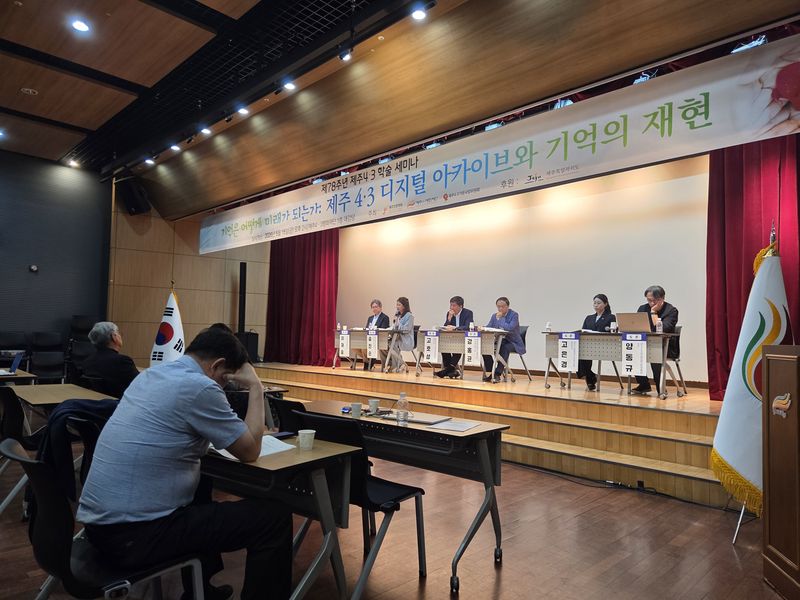
After the presentations, Professor Emeritus Koh Ho-sung of Jeju National University Law School moderated the discussion. Panelists included Kang Hong-gyun, adjunct professor at Cheju Halla University; Lee Jae-seung, regional cooperation leader at Kakao Corp.; Ko Eun-kyung, head of the research team at the Jeju 4·3 Peace Foundation; Song Jin-soon, professor at Dong-A University; and writer Yang Dong-gyu.
The discussion focused not only on the possibilities of building a digital archive but also on ethical standards. Participants noted that while AI can help classify and restore records, caution is needed against over-representing historical pain or turning it into commercial content. The consensus was that the Jeju April 3 digital archive should not be a showcase for technology, but a public platform that supports truth-finding, peace education and respect for the memories of bereaved families and local communities.
Before the seminar, the third Jeju 4.3 Journalism Award ceremony was also held. The award, jointly hosted by the Jeju 4.3 Peace Foundation, the Journalists Association of Korea and the Jeju Journalism Society, is presented every two years to recognize reporting and productions that contribute to uncovering the truth about April 3, restoring victims' honor and spreading the values of peace, human rights, democracy and justice.
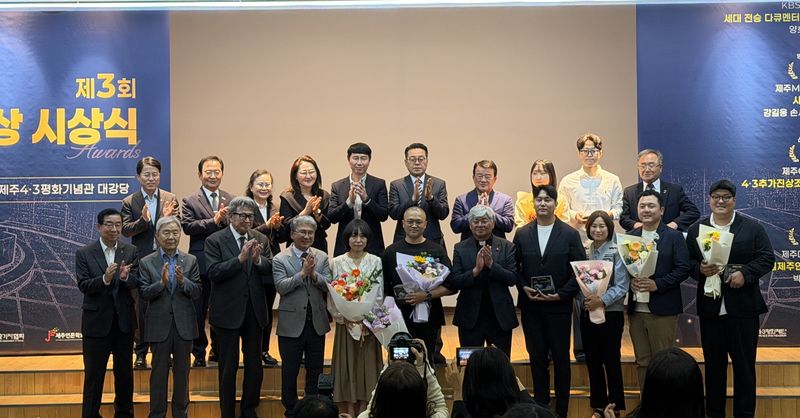
This year's grand prize went to KBS Jeju Broadcasting Station's two-part generational transmission documentary, "Coming Home," and its third part, "Borderline Mitsuki." The main prize in the broadcast and video category went to MBC Jeju's documentary "The Completion of Apology," while the main prize in the newspaper and publishing category went to Jeju CBS's exclusive series, "Controversy Over Additional April 3 Fact-Finding Investigation." The rookie award went to the Jeju National University Newspaper special feature, "Meeting the Zainichi Jeju People of the MZ Generation." The grand prize came with 10 million won, each main prize with 5 million won, and the rookie award with 3 million won.
KBS Jeju Broadcasting Station's "Coming Home" and "Borderline Mitsuki" trace how the memory of April 3 is passed down to the next generation across families, communities and borders. "Coming Home" follows a Jeju April 3 bereaved family member living in New York as they confront a victim's remains through an excavation 76 years later. "Borderline Mitsuki" shows, through the eyes of a fourth-generation Korean resident in Japan, how memories of April 3 that were never directly experienced are passed down through family language and silence.
MBC Jeju's "The Completion of Apology" documented the process by which prisoners detained in prison during April 3 proved their innocence through retrials more than 70 years later. Jeju CBS's series examined procedural and operational problems in the additional fact-finding investigation into April 3, which was launched after a 22-year delay. The Jeju National University Newspaper special feature highlighted the lives of third-, fourth- and fifth-generation Zainichi Jeju people from the perspective of young people.
This seminar and award ceremony together showed the two pillars of passing down the memory of April 3. One is the role of the media in recording the truth of April 3 and expanding it into a social memory. The other is using digital technology to connect scattered records and reconstruct them in a way that future generations can access.
The Jeju Journalism Society plans to expand the academic public forum linking April 3 research, journalism and digital technology through this seminar. The next task is to move beyond simply storing April 3 records as historical materials and connect them to education, research, exhibitions, experiential programs and international exchange.
The memory of the Jeju April 3 Incident has now gone beyond a local wound and become a global record. The remaining task is to document it more accurately, reproduce it more carefully and share it more widely. This seminar left its mark as a starting point for translating the truth and memory of April 3 into the language of future generations.
[email protected] Jung Yong-bok Reporter